Is N.T. Wright Secretly an Open Theist?
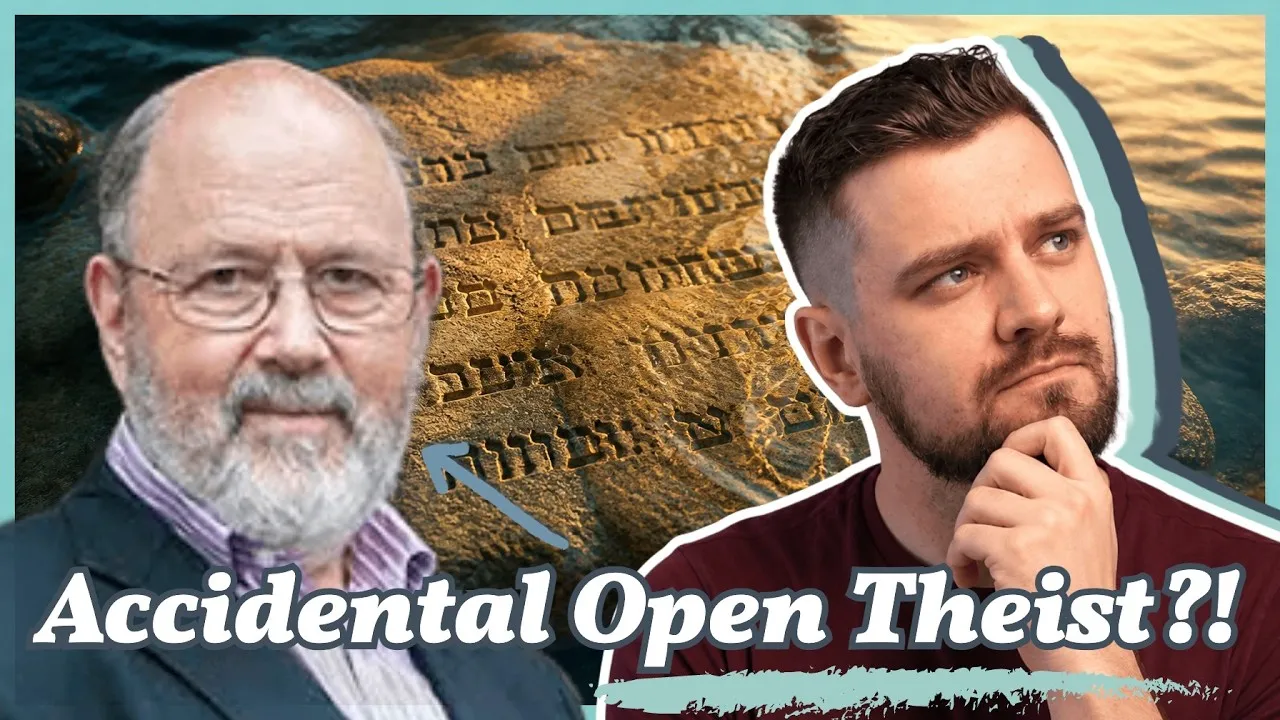
N.T. Wright would refuse the label, but his answer on whether God changes his mind stands right where open theism stands.
By Tim Barber··Video·Updated
No, N.T. Wright is not secretly an open theist, and I'm fairly sure he would turn the label down if you offered it. But I watched him answer the question open theists care about most, whether God really changes his mind, and his answer holds exactly the ground the open view holds. If you grew up with a God who can't be moved by anything you do, I think Wright hands you something better. He gives you a God who responds.
A listener sent Wright's podcast a hard question, and a few people sent his answer to me. English Bibles translate one Hebrew word, naham, as repent, relent, or regret. In Genesis 6:6 the Lord is sorry he made humanity, and in Exodus 32:14 he relents from the disaster he planned for his people. Yet 1 Samuel 15 says God does not regret, because he is not a man. How do you hold those together?
One thing up front. Open theism sits outside the majority view, and you can love Jesus with everything you have and land somewhere else on this. I mostly want you reading these passages for yourself.
What does the Hebrew word for "repent" mean?
The first thing I noticed is that Scripture uses naham the same way for people and for God. When a person regrets something and turns from one course of action to another, including turning from sin, the Bible uses this word, and when God turns, it uses the very same word. The writers saw no need for a softer one.
The golden calf story carries a second detail. Older translations say God "repented of the evil" he planned, but the Hebrew word there is ra, and it means badness, harm, or disaster. A rotten piece of fruit is ra. So when Moses pleads and God relents, God is turning back from bringing disaster, and nothing wicked was ever on the table. I was a little sad Wright skipped this, since he's usually great on it. Maybe we need O.T. Wright for the Hebrew questions.
How can God relent if 1 Samuel 15 says he doesn't?
This is my favorite part, because the chapter answers its own question.
And also the Glory of Israel will not lie or have regret, for he is not a man, that he should have regret.
1 Samuel 15:29
Now look at the frame around that verse. Early in the chapter God tells Samuel, "I regret that I have made Saul king, for he has turned back from following me," and the chapter's final verse says, "the LORD regretted that he had made Saul king over Israel." Both use the same word. The chapter even names the cause: God turned from Saul because Saul turned from God.
Then look at who hears the middle verse. Saul has been rejected, and he's begging Samuel to get the verdict reversed, so Samuel tells him God will not be talked out of this one. The verse that says God won't change his mind is guarding a decision God made in response to Saul. Wright says the chapter states its paradox on purpose. I think he's right.
He goes further, and this is where I wanted to applaud. God made creatures who are truly other than himself, which means they can do things he never intended, and Wright calls that part of the tragedy of creation. It's why the flood story opens with God grieving.
Why does Jesus matter for whether God can change?
Wright's next move is straight to Jesus, and I love that. When your picture of God stops looking like Jesus, he says, you're on dodgy ground, because no one has ever seen God, and the Son is the one who made him known.
So watch the Son. He weeps at the tomb of his friend Lazarus. In the garden he begs, "Remove this cup from me." Wright insists the tears were real, and Jesus did not stop being God to cry them.
Set that beside the old teaching that God cannot change in any way at all. Some classical thinkers pushed it so far that God could not literally speak, because a moving mouth would count as change. Wright quotes an old archbishop: God is Christlike, and in him is no un-Christlikeness at all. I wonder how many of us could say that honestly about the God we picture.
Do open theists think God doesn't know the future?
Wright's co-host offered the usual caricature, that open theists think God doesn't know the future, "but don't worry, he's omnicompetent." Almost no open theist I know would sign that sentence. The open view makes a claim about the future itself: it holds real possibilities that are still unsettled, and God knows all of it perfectly, exactly as it is.
The co-host also borrowed a lovely phrase from a colleague. God is proactive, interactive, and reactive. I'm stealing it, because I think it only works if the future is open.
Walk through the other options. If God decreed everything, then a bomb falling on a schoolroom full of children was his will. If he picked this exact world out of every world he could have made, he chose that schoolroom too, knowing what it would cost. And if he simply sees one fixed future ahead of him, he watches and never changes his mind. That leaves him nothing to react to. Only an open future lets the relenting passages mean what they say.
Wright defines God's sovereignty as being Lord of heaven and earth. A king can rule a whole realm without scripting every word his subjects say.
What does this change about how I pray?
Quite a lot. Wright points to Abraham bargaining with God over Sodom, talking him down from fifty righteous people to ten, and to Moses pleading until God relented, and I read both of those as real conversations where the person praying made a real difference.
So the next time something weighs on you, ask God plainly. Make your case the way Abraham did. Tell him what you want and why. The God of the Bible grieves what goes wrong in his world, and he listens to his people.
Wright avoids the label, and I understand why. What fascinates me is that the more carefully he reads the Bible in its own world, the more he sounds like an open theist. Bible wins again. I don't know what to tell you.
If you grew up with the God who can't be moved and something in you just loosened, you don't have to guess at what's gotten tangled. The quiz names the specific lie in about two minutes: theoverlap.life/quiz
Transcript
[0:00] Does God change his mind? Does he, you know, if we were to look at the way that the scriptures use the words, does he actually repent or relent or have regrets? And for some people, the question is even does God have emotions? Of course, maybe he's not um swayed by or changed by things, but does he feel things? Cuz that's not a foregone conclusion in many corners of Christendom. And what has unfortunately happened in this discussion is that often people have their own ideas or they have philosophical ideas. Every one of us has philosophical ideas, but people have philosophical ideas that they don't recognize as being rooted in something that isn't the same thing as what the scriptures are saying. And if we're Christians and we think that the Bible means anything of any significance at all, then really that
[0:47] should probably be the place that we start. And if you've been around my channel for longer than about 30 seconds, you know that I am a huge fan of the group of scholars that are called biblical scholars or biblical theologians, which are um we are all biblical theologians, but it's the idea of being a biblical theologian is that it's contrasted with systematic theologians. Biblical theology and systematic theology are not the same discipline. In fact, they're often talking past each other. Biblical theology is done by folks like Tim Mackie or N.T. Wright or Michael Heiser, where the idea is let's start with the Bible in its own world and in its own context [music] and see if we can derive the meaning from that first rather than building a systematic way of approaching these things based on what we already understand the situation
[1:34] of reality to be. Making it complicated, it can get really heady, but it's it's my belief that when we take a biblical theology framework into studying the scriptures that we come away with a picture of God that is very different from the one that most of us grew up with. And one of the ways in which I'm sort of best known for advocating for this view is the open theist view. Now, the premier unbelievable channel on YouTube had a has a wonderful little program that's called Ask NT Wright anything. And he was co-hosting this particular episode with a fellow named Michael Bird. I have a high opinion of them both. But what we're going to do is we're going to just let Tom, or NT Wright, explain himself in response to this question. And then we'll pause at different points and sort of offer our own our [music] own commentary. But I want you to hear how NT Wright thinks
[2:23] about this question because I think he gives an unusually good answer, especially for someone who I think >> [music] >> would probably be predisposed to wanting to avoid the open theist label. I really like how he handles this. So let's see what he has to say. >> Hello and welcome to another episode of Ask NT Wright Anything, the program where we try to answer your questions about Jesus, the Bible, and the life of faith. I'm Mike Bird from Ridley College, joined by >> Tom Wright from Wycliffe Hall, Oxford. Our final question >> Can I just pause and say that I love hearing Tom Wright's voice? This deep illuminating blunderbuss just it's excellent. I love I love hearing the guy's the guy speak. Anyway, I like Mike Bird, too. It's just not the same. >> question for this episode comes from Jeremy Gray of Missouri. This is about repentance, including God's repentance. So Jeremy asks, "Dear Tom, the Hebrew
[3:11] word naham for repent, relent, change mind is used when the Lord was sorry that he had made man." That's from Genesis 6:6. "When the Lord repented of the evil which he thought to do unto his people." In Exodus 32:14, "And yet in 1 Samuel 15:29, it says the glory of Israel will not lie or have regret, for he is not a man that he should have regret." And this is the the other the issue. How do you hold these passages together? Does this >> Sorry, I did not know that the the question continued. Um and the fact of the matter is that the interesting data point here isn't just that those words are used of God, it's that those words are also used of humans. So it's this this process is something that humans undergo when they have regrets and then when they are turning from one course of action in favor of another one, including repenting of sin. And it's also the same thing that God does, where he turns and changes his mind and goes from one course of action to another one. But anyway, let's let's let's see where this goes.
[3:58] >> point to genuine genuine relational responsiveness in God, or is it primarily anthropomorphic language that preserves his unchanging character and the classical attribute of immutability? >> Okay, I I have I have to pause again here. Um what you mean is anthropopathic. It's it's not um man-shaped, it's it's the like man's thinking that you're ascribing to God. If you're saying it's anthropopathic, um you're saying that it's like we're trying to describe God's way of thinking, which is beyond our ability to understand in man-shaped ways. And I reject that because I think that man is instead God-shaped. It's not as though some of our language can't be anthropomorphic or anthropopathic, I just don't I I it's mostly it's almost always special pleading. It's it's something that you are trying to shoehorn in because you don't like the implications of the plain meaning of
[4:45] what's being written. Yeah, but unchanging character, I'm right there with you, but the classical attribute of immutability, people just don't understand classical theism and where it comes from. But yeah, immutability basically means that he cannot change. He is unchanging. None of his actions can change. Other, you know, classical theologians would even say that God can't literally speak because his mouth he doesn't have a mouth and his mouth can't move because that would constitute change. There are writings that that indicate stuff like that when you get really into immutability. So, um I am no fan of classical theism. I think N.T. Wright is, so I'm interested in seeing what his response is. >> Uh Tom, does does God change does God change his mind? Cuz metanoia means to have a change of mind. Does God say, "Well, I was going to destroy the Israelites, but you know, Moses put forward a very a very good case and he's told me to chill out a bit, not to be
[5:33] consumed in my wrath, and I've changed my mind on the matter." Is Is that what's happening in these passages in the Bible, Tom? Yeah. >> Now, again, the framing here, and again, I like Mike Bird. I believe he's a Calvinist. The framing from Mike Bird here is very skeptical. He's He's introducing this question in a way that is almost mocking of the question itself or mocking He's He's poisoning the well against one way of interpreting these passages. So, let's just see what Tom does with it. >> I I I actually enjoy the the sort of anthropomorphism almost of It's like God's dialogue with Abraham about what Sodom and so on. And Abraham is kind of beating God down. If we find 50 people there, if we find I find I find 10. And we wanted to go a little bit further and and no, the Lord went his way after that. That was That was quite enough negotiation. Thank you very much. But
[6:19] there was a sort of sense of Abraham learning something about God. Whether God was learning something about God, the text doesn't quite say that. But it implies certainly something which cuts against the classical immutability. And there's so many Christians kind of inherit this idea of God who is totally other, totally different. And as well as being invisible and immortal, he is he's immutable, unchangeable. And And he's he's actually not really like Jesus. And that's that's a problem. It's when >> Ooh, what a good start to this I So, I haven't actually watched this whole thing. I I've only seen parts of this video. I saw it in little clips, but that's such a good answer. Yeah, isn't it radical how many of us have a conception of God that does not look like Jesus? And yet we have the audacity to call ourselves Christians. Do we think that the things that make Jesus Jesus are his
[7:07] human things and then the things that make God God are are are deified, right? And But if God is if Jesus is fully God and fully man, he's 100% of both. That's not my math. That's the Bible's math. Then what Why would we have a conception of God that looks so unlike Jesus? That's a problem. And Tom's right. Let's see where he develops this. >> your God stops being like Jesus, you know you're actually bordering on some very dodgy stuff because in the New Testament, no one has ever seen God but Jesus the the the only begotten son has revealed him and has made him known. And so, as we've been talking in other episodes, we see Jesus struggling with questions. What shall I say, Father, save me from this hour? No, for this reason I came to this hour." Um what what's going on here? Jesus as a human being is wrestling with these issues and this is God incarnate who is wrestling with these issues. It's like when Jesus weeps at the tomb of Lazarus. This is God incarnate weeping at the tomb of his friend. Jesus doesn't It's not
[7:54] play-acting. It's real. Exactly. And Jesus doesn't stop being God incarnate in order to weep at the tomb of his friend or to ask the question "Am I going in the right direction?" And there's there's something very mysterious about who God actually is. And so when we come to the question of God repenting, I mean, our correspondent there refers us to Genesis I'm sorry, to Exodus 32. What was the What was the verse? Uh oh yeah, that's right. Um And and it says and God repented in connection with the evil which he had purposed to do. And as he says the the Hebrew word there is vayan. Vayanasham um God And now but I noticed >> Also importantly, the word is not necessarily evil loaded up with all of the same like metaphysical uh associations we would lay on the word evil. It just means bad, badness. The word is ra in Hebrew. Can [clears throat] be used to describe
[8:42] something that is evil, for sure, cuz evil things are bad. Uh but it can also describe a fruit that has gone rotten or a wild animal, neither of the which is metaphysically speaking evil. It doesn't have moral evil laid upon it. It's just bad. It's something that was maybe good at first but has gone bad. So when God is uh described as working ra, he's not working evil. He's working badness, destruction, calamity. Bad things will happen. Things that are not good for things are going to happen. And I just I'm a little sad that Tom didn't mention that here cuz he's normally very good with that. Uh but he is after all N.T. Wright. Maybe we need to get O.T. Wright on here to answer some of the Hebrew questions. >> The same verb um comes in the same in the passage in 1 Samuel which was also quoted to us. 1 Samuel 15:29 does indeed
[9:31] say that God is not a man that he should repent. But just a few verses later in verse 35, um it says that Saul and Samuel never met anymore after um, Samuel had denounced Saul and then it says that the the chapter ends. Chapter um, 15 verse 35, um, that that that um, Yahweh repented that he had made Saul king over Israel and it's the same word for Yahweh. >> It's actually it's bookended at the end of the passage is also said again at the beginning of the passage. Right? So it's this this whole um, chapter is bookended by two statements out of the mouth of God that he regrets having made Saul king. And then the words of the the prophet um, who comes to to confront Saul are that God has turned away from giving him right to rule over the kingdom because Saul has turned from serving him. So
[10:19] it's a little bit of Hebrew word play. They God has repented from making Saul king because meaning that's a causal statement. God was God did this in response to Saul's turning away. So it's not just at the end of the passage, it's actually also at the beginning. >> Nisham uh, ki himat et Shaul al Israel. And so um, the the the passage in 1 Samuel I think is itself stating the paradox that says God is not a man that he should repent. He doesn't change his mind. But then almost immediately afterwards says God looked back at his choice of Saul and thought, uh, I wish I'd never done that. Um, and then we're back with the Genesis 6 thing about God repenting that he'd made human. Um, and I think that's part of the tragedy of of creation is that God's create God's creatures, his human creatures are able to do things which God did not intend them to do. It's like when in the prophets it says um, that you sacrificed
[11:07] your sons and your daughters to Moloch which was something that never even entered my head. It never occurred to me that you would do that kind of thing. And I think that's part of the um, the the the shame and the glory of creation that it is other than God and has the possibility to rebel against God. Um, so >> I just I just want to give Tom a round of applause. He's answering this so unbelievably well so far. Um, I like this is just this it just is open theism. Now, a little bit later I think Mike makes a dig at those open theists and he kind of waves us off because again I think he's in the sort of the reformed camp. And I think Tom Wright has history back into the reformed camp, but I don't think he's too much too big a fan of Calvin these days because he thinks Calvin's a Platonist, which he was. And he's not answering questions that the scriptures themselves are raising, which he isn't.
[11:55] But I think if I do find it really really interesting that the more Tom has focused on studying the Bible in its context in its ancient world, uh the more he starts sounding like an open theist. Isn't that wild? Anyway, let's see where he goes. >> That we've got somehow to hold together um God's overarching sovereign love with the fact that he's made a world that is other than himself, which he then intends to redeem and rescue, but which at the moment does have the capacity to do things which he finds abhorrent. And I mean, it's in that space that of course we have to understand all the wicked things that are going on in the world. When God looks at the world, he doesn't just sit back and say, "Well, my providence is working itself out. That's all right." No, God is aware of the fall of a sparrow, how much more of the death of a whole schoolroom full of children when somebody's bomb drops on their school and so on and so forth. So that I think um I want to move closer towards the idea of God grieving and being sorry for what his human creatures have done,
[12:43] because he never intended that they would go there. Um and God had a perfect will for them, but part of them being his creatures was that they would have the chance to do it differently, to do it the other way around. So I I think the paradox is bound to remain, but ultimately it ends up with the paradox of Jesus, the son of God, as we said in a previous episode, learning obedience through the things that he suffered. Jesus did not stop being sovereign. He did not stop being the Lord of heaven and earth, but as a human >> Thank you. Okay, I was going to say he used the word sovereignty earlier, but I wanted he didn't really define it just yet and I wanted to hear it. He just sort of uh his little addendum there was very instructive. He said, he did not stop [clears throat] being sovereign by you know, almost with a by which he means he did not stop being Lord of heaven and earth. Being Lord of heaven and earth does not mean being the meticulous micromanage of every molecule such that there's nothing that happens in the world that wasn't
[13:31] ultimately God's plan and God's will for it to happen exactly the way that it transpired. It's a different claim. Again, I would argue that this same claim in a lesser form cuts right through both simple for knowledge and Molinism as well, but that's a that's a video for a different day. I like what he's saying, he's making a ton of sense. This is a great answer. >> human being and as God incarnate, he had to live through this and die through this. >> So, like most theological mysteries, it comes back to the cross at the end. >> Yeah. I like what you're saying, Tom. It It reminds me that God has to be at least as nice as Jesus. You know, God is as nice as Jesus because it's God the Father who sent God the Son. So, God is as nice as Jesus. Yeah, I'm I'm teaching theology. >> What man? That's an interesting thought from Mike Bird there. God has to be at least as nice as Jesus. Well, God has to be
[14:20] cuz if Jesus is God, then God is as nice as Jesus. >> [laughter] >> Uh that's worth a that's worth a cup of tea and a long walk, I think. Fascinating thought. >> Yeah, at the moment we're getting into the doctrine of God proper and we're wrestling with, you know, we don't want to have a view of God that is stale, inert, just sort of he's he's made all these eternal decrees and now the algorithm is just running through eternity. Then there's the opposite extreme. There's those those open theist people say, "Well, God doesn't really know the future, but don't worry, he's omnicompetent. He can probably handle anything." >> Again, there's a mocking tone here that I don't especially appreciate, but that's all right, Mike Bird. You're I I understand you're ideologically driven to defend the ground. This is also not a very flattering place for me to have paused you. So, one good turn deserves another, I suppose. But I we don't want to be like those open theists who say that God doesn't know
[15:07] the future. Again, almost any open theist that you speak to will recognize and and recognize this as something of a straw man. God only doesn't know the future because the future does not exist and isn't real. It's not a statement about God's knowledge so much as it is about the the future that God perfectly and exhaustively knows without category error. It's a statement of the fact that the future does not exist as a settled reality, that future possibilities are real, and that they aren't settled in it in advance either by God himself determining them or by something else determining them and then God simply knowing about it. The future is open and has real possibilities. But let's let's let's see what what Tom does with that. I'm curious. >> I I don't like I don't like that, but I had a colleague um Graham Graham Cole-Finch, a principal of Ridley College, wrote a great article once saying God is proactive,
[15:55] interactive, and reactive. And I found that article he wrote was a great way of getting through them the mass of all these >> But none of those things make sense if the future is exhaustively settled ahead of time and God knows it. Like if if there is one line of what will transpire called the future, if there's one unique actual future, there is no sense in which God is reactive. And if he's classically immutable and impassible, then he's not interactive. Everything was proactive, and God has proactively either decreed everything to come to pass exactly the way that it did, or decided not to intervene and not to do anything while everything else transpires the way that he would like for it to. That's transparently the claim if you're saying
[16:42] that there's a unique actual future that God knows. I love the framework of proactive, interactive, and reactive, and I'm going to be stealing it mercilessly because I think it only makes sense coherently on an open theist worldview. But again, this is I don't know if I would say that that's splitting hairs, but I'm I'm I'm taking that one. That's good. >> Yeah, but I think that's a that's a that's a great way to put it, Tom. Yeah. >> Yeah. Yeah, yeah, yeah. And and the the idea of of Jesus perfectly reflecting God, it it's a famous saying of the late Archbishop Michael Ramsey, um which then I think um it may go back to William Temple. I'm not sure. There's a sort of succession of episcopal um obiter dicta, that God is Christ-like and in him is no un-Christ-likeness at all. >> Yes. >> But if you start having a picture of God, which makes us say, "Well, of course Jesus was a bit different." Um then we're we're we're in danger at that point. >> [music] >> Oh, wow. That's a really powerful thought. God is Christ-like, and in him there is no
[17:31] un-Christ-likeness at all. I wonder if your average, you know, rank and file Christian could actually affirm that based on what they think God is like. I'm not sure that we could. So, anyway, this this this is likely to be uh a shorter video today, to be honest. There I don't have My My instinct is to just as it relates to Tom Wright say basically 10 out of 10, no notes. I He He He answered the question darn near perfectly, and he rightly, I think, avoids labels. He doesn't want to give labels to things. He um There's something I really admire about Tim Mackie and Michael Heiser as well, is that they don't label a systematic and then teach you the systematic. They teach you the underlying Hebrew, you know, ancient Jewish worldview, and even the Hebrew and Greek words, and then illustrate to you the point that would
[18:19] lead you to the systematic if you were to give it a label, but they don't want to give it the label. They simply say this They show you They show their homework. They show you the work. This is what the Bible is saying. And are we going to take that seriously or aren't we? is the question ultimately, right? And in this case, Tom seems to really gather that yeah, God does change his mind. His human creatures, it's a tragedy. I agree that it's a tragedy that his human creatures often do what he did not intend for them to do. But, if he decreed all that comes to pass, then he surely did intend everything that happens with specificity, and you can absolutely know it looking backwards. As soon as the past has taken place, you can look back at the past and say God God's will was done perfectly. The The The schoolchildren being bombed and dying was apparently God's will in
[19:07] determinism. I would say also that Molinism makes this unavoidable by the same turn that God chose to actualize this world in which this would happen because this world otherwise optimizes for his greatest and most most important goals. But that the same criticism holds that he chose this world which means he intended for that to happen. We may say that it's a that God is in some ways on Molinism a victim of the best possible world contain you know being required to contain this feature of children being bombed in a school building. It's not that he would have chosen this to transpire but that his middle knowledge showed him that this was the right world to instantiate to optimize his other goals and you're just sort of so much hamburger ground up in the meat
[19:54] grinder of of the violence of human history because he chose to give us freedom but there's nothing that he could do about it. And then the simple foreknowledge view makes God essentially completely passive such that he knows what will transpire in the future and he knows when he will intervene intervene and when he won't. But he certainly you know never changes his mind. He's he all of that's just anthropomorphism anthropomorphism anthropopathism and we have to hand wave that off. The only person who can take those words seriously is the person who's an open theist. That's it. Again, whether you're you know more traditional open theism style or a dynamic omniscient proponent like my buddy Warren regardless that's the only camp that says that God can change his mind. [music] There's no other world in which that makes sense. So bravo to Tom Wright. I am not surprised. [music]
[20:40] That was a really good answer. I'm glad I have people who sent this to me for response. And um there's there's a reason that I'm a I'm I prefer biblical theology because starting with the Bible gets you better answers 99 times out of 100 999 times out of 1,000. And good philosophy exists if only >> [music] >> that bad philosophy can have a response. But this is this was great. So yeah, thanks for thanks for sending this to me. Bravo to Tom Wright. And uh Bible wins again. I don't know what to tell you guys. It just keeps happening that way. >> [music]
Tagsopen theismn.t. wrightdoes god change his mind1 samuel 15nature of god