
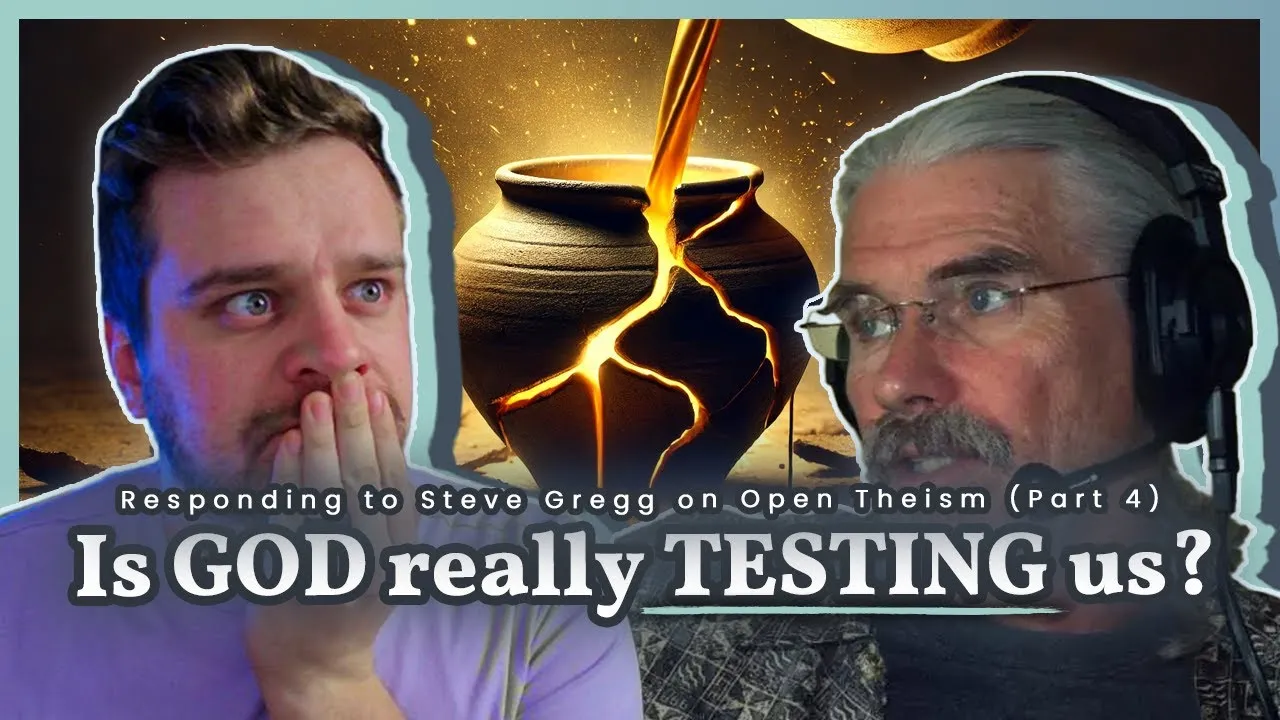
On TESTS, Trials, and Trolley Problems • Steve Gregg (Part 4/4)
Part 4 with Steve Gregg: God's foreknowledge, open theism, and what our trials might be testing.
By Tim Barber··Video·Updated
Chapters
- 0:00Does God Know Every Future Choice?
- 0:47Exploring Open Theism and Divine Foreknowledge
- 1:12Biblical Examples of God's Knowledge
- 2:04The Role of Prophetic Visions
- 3:24God's Interaction with Human Decisions
- 7:18Jeremiah's Prophecies and Divine Knowledge
- 10:28The Sacrifice of Isaac: A Test of Faith
- 13:04Theological Implications of Divine Testing
- 23:41Life as a Test: Biblical Perspectives
- 27:15The Biblical Theme of Testing
- 27:44Critique of Molinism
- 28:55Deuteronomy and the Heart's Test
- 30:55Judges and Chronicles: Testing Loyalty
- 32:57Exodus: Indeterminate Future
- 38:49Jeremiah and Ezekiel: Conditional Statements
- 48:37Steve Gregg's Approach to Theology
- 53:28Final Thoughts and Reflections
Title: Exploring God’s Knowledge, Open Theism, and Divine Tests with Steve Gregg
In my recent video, I delved into an intriguing theological discourse centered around the challenging notions of God’s foreknowledge, open theism, and divine tests. In this particular episode, I took the time to engage with Steve Gregg’s insightful perspectives, as well as some interesting points from Braxton Hunter on the Trinity Radio show. Our discussion unraveled over various biblical texts and complex theological questions.
Understanding the Nature of Divine Knowledge
We began this exploration by asking pivotal questions: Does God know every future free choice, or are there instances where even God is surprised by human actions? This inquiry paved the way for an exploration of the concepts of open and closed futures. Steve Gregg’s approach to this dialogue is both respectful and intellectually stimulating, offering a fresh outlook on age-old theological debates.
Steve’s views, particularly on prophetic visions within the Bible, provide a backdrop against which one can contemplate the possibility of open theism. His reflections on God’s interactions with human decisions brought forward some marvelously thought-provoking ideas concerning divine tests and human hearts.
Exploring the Depth of Open Theism
Steve and I tackled pertinent biblical examples, discussing passages that raise questions about God’s foreknowledge. His insights into the book of Jeremiah and the testing of Abraham offered a nuanced look at how divine knowledge and human free will might interplay. I admire how Steve handled these complex topics without definitive biases but rather through an evidentialist perspective, which allows for individual navigation through these intricate discussions.
Divine Tests: More Than Mere Trials
A significant portion of our discourse revolved around the idea of life as a divine test. Steve offered a unique perspective, suggesting that God’s tests are meant to reveal what’s in our hearts. Despite the trials we might face, the goal remains consistent: discovering and nurturing our loyalty to God. This idea aligns beautifully with the theme that reality is a test to trust not in our understanding, but in the wisdom and goodness of God.
Molinism and the Future Unknown
The conversation also steered towards Molinism and its implications. Tim’s critique of this theological perspective unraveled the complexity of divine providence and the concept of “future history.” It was enlightening to hear Steve Gregg’s reflections on this subject, and his approach served to create a space for sincere and open theological reflection.
A Call to Curiosity and Reflection
Throughout the video, I appreciated Steve Gregg’s stance on theological uncertainty. His willingness to entertain questioning and his respect for differing viewpoints encourage us not to shy away from theological exploration. We can approach our faith journey with humility and curiosity, recognizing the vastness and complexity of divine knowledge and human understanding.
In wrapping up this engaging discussion, I extend a heartfelt invitation to watch the video on YouTube. Steve Gregg’s perspectives, along with my responses and reflections, create a rich conversation that speaks to those keen on exploring theology beyond binary thinking. It’s a discussion that reminds us of the beauty found in seeking understanding and the depth found in the wisdom and power of God.
Thank you all for your continued support and engagement. I hope this conversation enriches your faith journey as much as it has mine.
Transcript
[0:00] does God know the future free choices of literally every human being that has ever existed down to the specificity of the second and the molecule or is there even one instance one time anywhere in the scriptures that God describes himself as being surprised by an outcome of someone's choices or a person having done something that he did not foresee if God does know absolutely every choice that anyone will ever make what we are dealing with is a 100% closed future whether God determined it or whether God simply forn knows everything that will happen nothing will change everything is going to transpire exactly as God always knew that it would but if there is one possibility even if it's only that one possibility we are dealing with a partially open Future we're dealing with a future in which there was something that could have gone either way I hope
[0:48] you've been enjoying this series where I have been responding to Steve Greg and braxon Hunter on the Trinity radio show I anticipate and I hope that this will be the last of my response videos to Steve Greg and Braxton Hunter for this discussion around open theist proof texts I do have a fair bit of video left to go but I'm going to do my best to make it through all of the rest of this and give my responses in a timely way so let's just get them get them moving all right uh we're going to go into a section now where God doesn't seem to know what people would choose to do and so that begins with first Kings chapter 22 and verse 20 which says the Lord said who will entice Ahab to go up and fall at ramth Gilead and one said this while another said that then a Spirit came forward and stood before the Lord and said I will entice him the Lord said to him how and he said I will go out and be a deceiving spirit in the mouth of All
[1:35] His prophets I mentioned lastek you are to entice him and also Prevail go and do so so God is asking how this is going to come about as if he didn't know well obviously is asking for suggestions now this is mAh has seen a vision of God surrounded by the Heavenly court and asking advice from hisence of what the best way would be to get Ahab to go out to R ofia to die and uh you know this conversation may have literally taken place and Mah may have actually seen something that did happen in heaven as many Visions many prophetic Visions they are dramatizations of an idea you know Zechariah has a number of these he he sees things there's conversations going on there's different colored Horsemen and the angel they're having conversations and the bottom line is there's a certain one point being made by the whole Vision which may or may not
[2:24] correspond to literal conversations that have taken place are there to illustrate and make their point I mean even in Zechariah 11 about the 30 pieces of silver the trail that's a whole story about Zechariah taking a you know couple of staffs and and saying you know pay me what you think I'm worth and breaking staff those things didn't literally happen but they were making points uh I believe it was a vision in that case uh crowning um well in in Zechariah 3 we have a you know prophecy in which Joshua the high priest is standing in filthy garments and Satan is there uh you know accusing him and God says give him clean garments that didn't literally happen that's that's simply a visual dramatization of of something that God is trying to get across and here this may be true here too but it is something he's trying to get across accurately it is something that he's trying to communicate in an accurate way not in an inaccurate way and if I don't know I
[3:13] don't even particularly know why this verse is used as an open theist proof text if it is it's not I don't think a very good one it's a super interesting passage and there's a lot of really interesting stuff going on in it um I don't know if I'm making the connection there but at the same time when God's prophets Express something it's an accurate representation of the way things are not an inaccurate one in any case it doesn't actually say that God's ignorant just like God will listen to our prayers and and our suggestions and he'll evaluate them and answer them or not according to his wisdom whoever he's asking okay but then that application of this concept is really weird because if God a knew all along that I would pray and B knew all along that he would answer or not answer and that c what the answer would be and all of the downstream second third fourth order consequences of what my prayer being answered would be then he had an answer
[4:01] prepared ahead of time no matter what and he is actually not in any way responding to me not really there's my prayer didn't actually unlock anything it was simply a fact of the matter baked into the script ahead of time again I'm not saying that God is the one who wrote the script but that's also a problematic aspect of like a simple forn knowledge view is that God is essentially just dealt a hand and he knows already what he will do and how he will respond but the shape of the future is already settled ahead of time and he knows where he will and will not intervene and the state of things the state of reality if we're not actually in a war but God has predicted absolutely everything that will happen and knows exactly what he will do and when and the state of the world is pretty weird if God knew everything ahead of time and is responding exactly in the ways that he
[4:49] would wish to respond but if he responds in the moment according to his own great wisdom and power and we are at War where not every outcome is known ahead of time but there are emergent circumstances that require differences and shifts in strategy and policies as from our video a couple weeks ago then I think all of those things need to be taken into account in hear this court these spirits that are around him maybe Michael Heiser type of you know Council of the gods or something or maybe oh God I miss Mike but God says well you know how should we do this this is what I'm going to do I'm gonna get him dead I'm gonna get him dead at R what's the best way to do this I'm getting suggestions and say okay let's do that one I don't think God needed the suggestions uh I think this is again anthropomorph God doesn't need advice people need advice so sure anthropomorphism is the phrase is doing a lot of heavy lifting here I don't
[5:37] think it's anthropomorphic for God to ask for advice when he already has a plan in place and he already is you know basically going to make a make a thing happen that's not anthropomorphic necessarily that that even is a bridge too far if he says that this conversation could literally have happened it's not anthropomorphic to ask for advice even if you already know what you're going to do and you have a really solid plan this is God in his character acting the way that he always has as a being who delegates decision-making authority to other people and he delegates the concept of Adam naming the animals is something he delegated to Adam's control and perview even though he didn't need to God was perfectly capable of naming animals nevertheless he wanted to share power he wanted to share Authority with beings in love
[6:25] relationships with him who wanted to work with him to take the world someplace beautiful that's what Genesis and two is so in this same case when God is in a Heavenly throne room having a sort of a a war room meeting with with his Divine Council he doesn't need the advice but he's delegated some governing authority over the creation and the way that things ought to be done to a boardroom to a board of beings which have a say in the governing structures of the universe at least that's the way that Michael Heiser would put it so whether God needs the advice or not that doesn't make this an anthropomorphism it's simply God acting the way he always has which is as one who shares power with those who are in his Circle God doesn't need advice uh you know it's it's God's being depicted as a king with his counselors take there's nothing actually indicates he doesn't know the
[7:11] future right I I don't get this passage being used that way what's the best way to do this yeah yeah yeah that's right okay uh Jeremiah 7:31 we've got a few here that are that are similar Jeremiah 7:31 says they have built the high places of Toth which is in the Valley of the son of hinam to burn their sons and their daughters in the fire which I did not command and it did did not come into my mind now that sounds pretty pretty tough Steve what's your response to that these vers there's three just like it and yeah I'll go ahead and read those in fact yeah they're all the same they're all the same go ahead Jeremiah 195 says and have built the high places of Baal to burn their sons in the fire as burnt offerings to baale a thing which I had never cained or spoke of nor did it enter my mind and then Jeremiah 3235 they have built the high places of baale they're in the valley of Benham to cause their sons and their daughters to pass through the fire of Molech which I had not commanded them nor had it entered my mind that they should do this
[7:58] Abomination to cause Judah to sin so there are the three there that that are very similar and so the question is what does it mean it didn't enter my mind does it mean well I never thought that happen or does it mean it never crossed my mind to give commands that like that he says I didn't command you to do that it never crossed my mind to command such a thing and you can sort of see it in the latter one especially it did not enter my mind that you should do this he's he's basically saying this is the furthest thing to who I am and kind of ERS I would give this is like the opposite direction of anything I would Comm in the question is is openness true or is false if it's true then God didn't know if it's false that he didn't but it doesn't I actually don't agree with that I actually don't even agree with that phrasing I don't agree with that framing of the problem um because it's very possible that God knew in some sense that this thing was possible he knew that they would do it and I agree with the phrasing of what I think he's saying
[8:46] there is it never entered my mind to command you to do something like that that's what I think the passages are saying but even if I think he's saying it didn't enter into my mind to command you to do such a thing that doesn't therefore mean that this was an exhaustively forn own eventuality from before the creation of the world that never emerged as a possibility where before it was not a possibility or before it was a remote possibility that was actualized by decisions made by people who are profoundly foolish and rebellious that God hoped they would choose a different route and when they did not choose a different route he was dismayed the only way that makes sense is if there is an open Future it's not 100% open it's not 100% settled it's somewhere in between and the settled things are settled by a mixture of God decreeing things and bringing them about
[9:34] by his own power and by God being able to extrapolate and knowing that some things are going to happen with certainty and there really is no way to avoid it but then there are some things that in the shape of reality that at least the way the Bible depicts it is that God didn't anticipate it coming or he's very dismayed at the outcome it did not go the way he wanted it to which speaks to the openness of the future because you can't respond to those ways in an honest way if you knew all along that it would come or especially if you determined it to be that way it just makes hash of these passages it's an incoherent way of interpreting God's own actions in this page it's saying what didn't enter his mind never crossed his mind to give orders like that I didn't command you to do things like that I think that's what it's saying so he's not really talking about what he knew but but would be consistent with his mind to give command so I don't see that as relative to the for knowledge
[10:21] question all right so that brings us to yet a new section where God tests people to seemingly to find out information about them so we begin here with Genesis 22 and it says he saido not stretch out your hand against the lad and do nothing to him for now I know that you feared God since you have not withheld your son your only son from me so we have the sacrifice of Isaac here and um it looks like God is saying now that now that I see how you've acted now I know seemingly implying to the open theist I would imagine I didn't know before but now I know why the language of it seems like seemingly implying no buddy that's how it's written uh Braxton I I don't know can I call you Braxton are we on a first name basis how well do we know each other it's written that way it gives on the pages of inspired scripture
[11:09] both the timing and the reason for his gain in knowledge now I know now there are going to be some people in the chat I bet if I opened up the chat over there I'd see Phil bear um talking about uh well the angel of the Lord isn't the Lord I disagree vehemently I think on biblical grounds where the angel of the Lord initiates a conversation and then there's no change in context there's no shifting of where you know the person's attention goes for example Gideon on the threshing floor the angel of the Lord comes and talks to him and then Gideon's carrying on this conversation with him and then it says Yahweh looked at him and said blank uh I think the angel of the Lord is the Lord the angel of the Lord is just God in a form coming to speak to someone some people would say it's Jesus I don't even think I need to make that case I I'm simply saying it is Yahweh coming as a messenger to speak to
[11:57] someone it's the angel of the Lord I believe that's also in the burning bush talking to Moses and then he's carrying on a conversation with Moses from the burning bush and it is the Angel of the Lord let me just go see if Phil bear is over there if I'm right that'd be crazy well Phil bear is definitely in the chat I don't know if he has said anything about the angel of the Lord but I'll keep my eye didn't know before but now I know yeah this one and and the other ones in this section all mentioned that God tests so that he will know or or to see if they will do this or that thing how it's written what's interesting though is the others in this section actually do suggest I I want to see what you will do in this case he doesn't say I did this to see what you do I did this to see if you fear me or not the thing that he said I now know is not not I know you'll obey me now I know that you know you won't sin and rebel he say now I know that you fear me Abram did this
[12:44] because he feared God this revealed that he feared God to be sure but didn't God know his heart before that doesn't God know the hearts of all men didn't I mean this is again not not saying I didn't know the future if we take it literally and not anthropomorphically then we have to say God didn't even know the present God didn't even know whether fear him or not well doesn't God know no no no no no no no no no no because um I know I can trust my wife like I know I can trust her but then if we're in a situation where like a baby is choking and she is the only person around who knows the heick maneuver and then she demonstrates that she is a trustworthy person and a capable and competent person and then she flips the baby around and does a very specific kind of the specific kind of maneuver you need in order to clear an obstruction from the throat of a baby
[13:32] and she pulls it off I'm like man now I know I can trust you there was a possibility that she'd crumble under the pressure before but I can say now I know I can trust you there's a sense in which sure Abraham feared God but this is written in an indeterminate way and the entire purpose of a test is to see what's really going on and then to prove it so that I know God is testing him to know that he fears him and you know it says what what's in his heart in these other passages is fear of God not something that transpires in the heart is not God in some way testing to know what's in Abraham's heart is that not the point so sure he knows Abraham's present heart but there's this tiny tiny percentage chance that Abraham will completely cave at the moment of highest pressure when the knife is actually in the air and he is being tasked with killing Isaac which is this again the
[14:21] crazy story a lot of people really recoil at this story and I want to be sensitive to that and I want to make a video about it at some point sort of looking the context but up until the moment he is literally going to do it there is a percentage chance that exists that he'll go the other way he succeeds to the end uh CS Lewis talks about this in the in the context of Temptation he says that someone who gives in at the first sign of Temptation does not know the real weight of Temptation it's only someone who endures to the end of Temptation and makes it through the other side that understands its real weight if you give in all the time then you don't understand Temptation you don't know how powerful temptation is because it's never actually tried you it's never actually worked against you to try to cause you to do something and he goes on to talk about how Jesus is the only one who knows the real weight
[15:09] of Temptation really because he faces Temptation and then never ever ever gives in but the more you face a Temptation the more you are going to exhaust your own human weakness and willpower in trying to resist it that's the point Lewis is making so I think that there is a sense in which when we read this passage that's what's happening with Abraham Abraham has at any point the possibility of failing this test he could always give in he could always turn away he could at any moment God may may know that this thing is in doubt until it's over it's not over until it's over right but the minute that Abraham I think that the the way that this ticks over to 100% it's going to happen it's like win probability in sports I don't know if you guys have ever seen these probability charts but while the clock is still ticking the game could go either way the win probability swings wildly if one team takes a pretty big
[15:58] lead lead over the other but if the other team starts to chip away at that lead the win probability starts to swing the other way it used to be hey it's a 95% chance that if things continue as they are going that this team will win the game and this team will lose there's a 95% chance because it's a basketball game and my Denver Nuggets led by the best basketball player maybe ever niik yic um is up by 30 points like it's a secure lead but then because niik yic sits on the bench for a while and the other team scores 28 points now the lead is dwindling the win prob probability swings back this way but there's a moment where the win probability taks over to 100% maybe it's actually impossible for the other team to score enough points in 5 seconds to actually win the game and it takes over right at the end because now the outcome is certain there is no getting away from it
[16:46] it is certain but up until then there was always the chance that something crazy could happen I think of this as kind of like a win probability chart where it's probable it's probable that Abraham could win but we don't know until he has faced the test to the end and come through the other side having succeeded and the longer you face a test the more you face a Temptation the longer you face a difficulty and God isn't the one who tempts people okay hear me clearly James is super clear about that but if you're facing a test you have the possibility of failing that test up until the last second of the test and it's only if you pass the test through to the end that your character is proven and that God can now say now I know and he's doing this specifically to figure out Abraham's fear and respect and reverence and awe level towards God is he really willing in every circumstance to through the end follow through and do all do all this stuff so
[17:34] that he can work with Abram as a covenant partner that's God's goal here anyway there's there's a lot to this but oh Phil it says now I know means you have provided visible evidence it's a colloquialism or it means now I know anyway know who fears him who doesn't the eyes of the Lord in every place beholding the good and the evil you know they run to and for throughout the Earth seeking one whose heart is perfect toward his God you know does God recognize these people and he fear Him who doesn't I would think so uh so so in in saying now I know that you fear me I don't think it could Poss saying I wasn't sure if you did or not I wasn't sure what was in your heart but now I know I think the word that I may know what you know from testing is what you've demonstrated is what what you brought to the surface what is now knowable to all I have made this a a a knowable thing a visible revealed thing and years ago when I was dealing with
[18:21] this verse I mean I'm talking decades ago I was I'm not sure if you guys can see I really and we'll get to this in a minute I really like some of these people in the chat are awesome people the Twitchy Theologian like one of my favorite Calvinists ever he is super irenic he's super caring he is you know he resists a lot of the pressure that's on him in his Camp to be really rude and unkind to people in my camp for example like he's had Warren McGrew on uh Warren's had Twitchy Theologian on he's a really good dude um I love Jamie Russell probably one of my one of my favorite Adventists ever he's awesome Chris date even again we talked about him Chris and I disagree on a few things we agree on the nature of hell and he is actually was an instrumental piece in my journey away from Eternal conscious torment for that I'm eternally grateful to God for Chris date um and I even
[19:11] agree with what he wrote here what enter what didn't enter God's mind is the thought to command them to do so that they should do it um but this this comment down here some things aren't true until they happen exactly uh it's not it's not as if God was testing to see 100% whether there was reverence to God in the contents of his heart that's not the point the point is that God was testing him putting him to a test to see if that was what would win out it's the whole meme of like there's two wolves inside of you right maybe there's the fearing God and reverencing him as Lord wolf and there is the seizing autonomy and trusting in my own understanding of right and wrong and F kind of following
[19:58] the serpent wolf in me and the one that wins is the one you feed right the test is which of these two wolves is going to win when it's under pressure and Abraham fails in lots of other contexts too so it's not this binary thing it's like the binary thing is the outcome did you pass or did you fail the test but we're all a spectrum the soier it'ss in line of the line of Good and Evil runs through the center of every human of every human heart is true during a test as well the purpose of the test is to see which part of you is going to win and then he says now I know that the you fear me part of the of your heart that wolf won that's the part that we proved that out in the test good I needed to test you first to kind of see where you were at really and now I know that you fear me anyway boy that that picture makes Steve Greg look really angry he's not no in the lexicons and there was like a all the I want to
[20:48] back him up here let me back him up here talk decades ago I was interested in this verse uh I looked up the word no in the lexicons and there was like a all the different ways that the Hebrew word can be used made up there must have been dozens and dozens of place it was like a big paragraph and I would use other Le now but I was us like a really long list of ways that this and among them was uh to reveal or to disclose uh so I mean it's not just having cognizance of something it can mean I've now but but who is he disclosing it to it's just him Abraham Isaac and the ram up on the is he is he disclosing that Abraham fears God to the ram Ram's not going to do anything with it he's about to die like is it for just for Abraham's sake is it for Isaac's sake why doesn't it say that what it
[21:36] says is now I know that you fear God because you were not willing to spare your only son so but that's just it's just not what it says sure that that can mean that but you can tell from the context clues what's happening in the passage the way that it's actually written and then what transpires afterwards that God puts Abraham to the test to know what's in his heart for the purpose of more closely partnering with him as a covenant partner to further his his purpose in the world a choice which does not always have the outcomes God wants by the way in the ensuing chapters I've now revealed I've now made know I've now revealed what's in your heart um which is true that he didn't know what was in abr's heart before that would raise other theological problems worse anything that opens theology you know he doesn't know what we think he doesn't know inside or not well then we've got real problems I don't have any real problems if he doesn't know the
[22:24] future I you know if God doesn't know for sure what I'm going to do tomorrow I don't care I mean I don't either God God and I can work it out when that happens so know if God doesn't know the future it's not a problem to me like a Chessmaster is the example always given you the Chessmaster doesn't know what his opponent's gonna make and he can he can play a whole room full of opponents at the same time he doesn't know any of them so you can still beat him because he's the best and you know it won't prevent him from winning it won't prevent him you know getting his will done so whether God knows or not the future is of no concern to me I'm only interested in ex Jesus I'm only interested in you know KN what the Bible teaches because they can go either way as far as concerned but if God doesn't know what's in my heart if God doesn't know me at all now that is greater concern that'd be a much greater theolog conc and that's and that's not what we're saying that would be what you could prove from this verse not not uh if you could prove anything but of
[23:12] course the fact that it cannot be that God was ignorant of what was in Abram's heart before this moment means this is anthrop Marin no as I cases that close that very interesting that may be my favorite answer so far all right Exodus chapter 16 in verse four says then the Lord said to Moses behold I will reain bread from heaven for you and the people shall go out and gather a day's portion every day that I may test them whether or not they will walk in my instruction yeah same thing I'm going to test them and and bring out whether they're gonna be obedient or not um now I will say this in my opinion one of the major themes of the whole Bible is this life is a test that's why there was a tree in the garden of that's why there's a tester T that's why God even allows there to be a devil is because we are being tested we're being vetted for
[23:59] the destiny of reigning with Christ and reigning with Christ the one qualification we're vett for is total loyalty being faithful un death if we're faithful and loyal we pass that test if we endure we'll reign with him the Bible says so that's what this life is for uh it's it's vetting it's testing now the question arises well why does go need to test if he already knows what we would do if we're not gonna actually do it in real time he doesn't know we're GNA do it because it's not gonna happen if we say God knows what future things are going to happen it doesn't mean that he knows what might have happened maybe he does maybe he doesn't but that's a different subject if God knows I'm going to sin tomorrow it's because I actually am going to sin tomorrow if God's just going to cancel that part out and just know that I wouldn't well then there's no test at all I have no culpability I have no involvement I'm not an agent you know God has to test us so that we will actually do what we are going to do even if he knows we're going to we still have to do it but that's just not what these passages say though like it doesn't say I'm testing you to refine you and cause
[24:48] you to become the kind of person who follows through on what I desire for you to do this just not what he says that's not what any of the passages say the passages say that he tests to know he tests to know he seeks to find he guides and leads and protects and provides with the hope that others will respond when he does so and they frequently don't God didn't get the outcomes he wanted in lots of these different situations or he undertook a plan and a course of action that backfired that went wrong not because of anything that he did but because of fault in the person that was chosen to partner with God that's not God's fault it's only God's fault if he knew ahead of time exactly how it would go again let's we've got my owner of a company and CEO analogy if I go and I hire a CEO and all the signs to everyone
[25:38] are that this guy is Rock Solid he's going to do a great job maybe he's even succeeded before and we're all expecting rightly that it's just going to rock It's going to go really really really well and I hire him to run my company and then he does the whole sacrificing a pig to Zeus in the corner office of the CEO thing and then burns the building down and I don't know does awful things to his own employees and kills some of them he's at fault unless I knew he was going to do that and then I'm the one responsible oh man I got a video to do here and so you know he he tested them if to see if they'd walk in his way well yeah we're all being tested that way I believe all of life is a test the fact that we're tested doesn't speak to me one way or the other about God for what we'll do yeah the only objection I could see there from someone who's not an open Theologian would be from the molist perspective saying that God does have
[26:25] knowledge of what might be in other scenarios but on this understanding you make a really good point that he knows what we will freely do because we're gonna freely do those things and he knows that will happen but that still means we have to play out what's going to happen yeah I mean if we say God knows all future history is because there's going to be a future history if there's not gonna be a future history then he doesn't know the future whoa future history that sounds like an album name the problem is that on both of these schemes that either a the information comes to God too late for it to be providentially useful to him so for example the middle knowledge is not something that God has possessed from time Eternal it's something that God has possessed from the moment he decided to create now he knows the sub the outcomes of every subjunctive counterfactual truth set which in the way that Steve phrased it I like the idea I I I think I agree with the idea of all of reality for every one of us being phrased as a
[27:13] test or Being Framed as a test I I agree with that I think that that's true because that's a theme that shows up everywhere in the Bible people are under a test constantly if they are going to give into the temptation of the serpent in the same way that Adam and Eve did in the garden or if they're going to trust not in their own definitions of right and wrong but follow after God's definitions of right and wrong and choose to follow his wisdom and submit to him in which case they're going to become the same people that return to the Garden in the end reality is a test in that way molinism reduces the entire universe to a trolley problem like a trolley problem that sets off a series of other trolley problems and it reduces God to after the moment he creates he's simply doing the best he can with all the possible outcom that are going to happen it is an eternally cascading
[28:00] train wreck of outcomes that are this is the best God can do because he's optimizing for some goal that means he has to allow for all kinds of other horrible awful things to happen and if you happen to be the person that's caught in the crossfire too bad God's got this utilitarian balance where he's trying to get like the most of the thing he does want even if you are caught in the crossfire and all God can do in that scheme is just shrug his shoulders and say sorry your casualty in the war here you you needed to be sacrificed so that I could go and get this other thing there's no other way for me to get the thing that I wanted than to run you over by a trolley future history though I'm just coming back to that phrase man that's really ft now you know molinism would say well he can think of all kinds of possible future histories well true but those are all imaginary they don't exist um so I'm not a Mist again that's
[28:49] another serious problems with I just don't see a real good reason to accept it I think there's easier explanations of these things yeah all right so we've now arrived at Deuteronomy chapter 8 verse two it says you shall remember all the way which the Lord your God has led you in the wilderness these 40 years that he might humble you testing you to know what was in your heart whether you would keep his Commandments or not same answer yeah it's interesting too he says to know what is in your heart and of course what's in your heart will determine whether you're gonna obey or not but it's interesting that KN what's in the heart is something that we assume God knows quite apart from any question of knowing the future um he's testing to show what is in the heart he's testing to see what kind of person we are now is seen visually in the decisions we make in the future you know but but they arise from what's already in our heart and is not unfamiliar with that but although he says he's testing us to find that out yeah and I want to say that I realiz to that typically I would be interacting a little more in the chat
[29:35] and those sorts of things but there's a lot going on on my screen here to keep this moving so forgive me for that okay uh Deuteronomy chapter 13 veres 1 through3 says if a prophet or a dream or of Dreams arises among you and gives you a sign or a wonder and the sign or wonder comes true concerning which he spoke to you saying let us go after other gods whom you have not known and let us serve them you shall not listen to the words of that Prophet or the dreamer of dreams for the Lord your God is testing you to find out if you love the Lord your God with all your heart and with all your soul anything extra to on this passage no once again he's testing to see what's in their heart you know in other words to reveal what's in their heart the test actually brings to the surface not as if God couldn't read it but no one else could and God speaking anthropomorphically you know we all need to know what's in there so we're gonna bring it down through this test yeah lay what it says yeah yeah it's but he's not just leading it out all all out on the table he's testing to know it says to know what's in your heart and it's not just to declare and
[30:23] it's not just to lay bear for everyone God makes decisions B based on the information he gathers from the test it's framed as a test to gain information God then gains that information and then he makes decisions based on the choice of the person who either passed or failed the test the reality is that the state of the test is indeterminate until the test is over you could pass the test or you could fail the test at any time until the test is over my goodness okay judges 2: 21 and 22 says I also will no longer drive out before them any of the Nations which Joshua left when he died in order to test Israel by them whether they will keep the way of the Lord to walk in it as their fathers did or not um anything additional to add here same phenomenon
[31:10] uh you know all of life is a test uh uh and the reason for the test is to expose our loyalty or disloyalty really to God yeah yeah all right 2 Chronicles chap 32:31 says even in the matter of the envoys of the rulers of Babylon who sent to him to inquire of the of the Wonder that had happened in the land god left him alone only to test him that he might know all that was in his heart so similar thing again if I'm understanding what you've said so far we this is a question about the present what's in the man's heart and this is just going to be a displaying out of of the actions that bear all of that out right and I don't think I don't think any Christian Theologian believes that God doesn't know what's in our hearts but the fact that he tests in order to know it means obviously in order to expose it in order to bring it to the surface yeah the problem again what's in a man's heart is a very complicated matter none of us is 100% one way or the other way the
[32:00] purpose of the test is to show when you are under pressure when you are being tried when you have to you know when the the rubber meets the road when you are up against the wall what are you going to prove what are you going to prioritize um there's a concept in uh I think I learned this first from Joo willing you don't rise to the occasion you sink to the level of your training and so there's a sense in which it's like what is this person going to default to when they are under duress and that's an indeterminate question until you're put to the test and it gets proven now the problem is that there was good and evil in your heart prior to the test God is looking to see which one you're going to choose which one you're going to prioritize what's really at work in your heart which one is going to win out that's what needs proving and he
[32:49] puts the test forward so that he can know which one of those things is the priority for you because of the test and it's indeterminate until he does so all right so uh the next passage is the first in our final section here uh where it looks like God is not certain about the future and in Exodus 4:9 it says but if they will not believe even these two signs or heed what you say then you shall take some water from the Nile and pour it on the dry ground and the water which you take from the Nile will become Blood on the dry ground yeah um again when God says if if they don't or if they do this if you know if they don't believe then do this he's just giving instructions he's not saying God's not saying whether he knows they will or not he's saying when you You're Gonna Learn you're gonna find out whether they will or not you know when you do this if this is what you find to be their reaction then do this uh God doesn't say he doesn't know uh it's it's evident that he's speaking of Moses as a person who doesn't know as Moses doesn't know so
[33:37] it's sort like in that whole same conversation uh Moses said uh well what if they ask me who it is that sent me you know uh what do I say then see Moses is not sure how the people yeah but Moses definitely assumed that the future was settled and that God was going to you know he just said sure thing God anything you say it's going to go exactly the way that you said it's going to go and it's going to work out exactly the way that you wanted it to work out I don't even need to think about it I'll just kind of go with the flow and whatever you want to have happen will happen no he says I'm not really a big talker God like it's I don't think that's going to work God and he pushes back and God meets him there and then they come up with a plan that's different because again you go back to my video I think it's two videos ago where it's talking about this exact passage I didn't even know this showed up later in the video I'm reacting to all this live I'm not preparing my responses and my stuff ahead of ahead of time um James White would be proud but
[34:26] I'm I'm literally looking at this and say saying if you go back to the context of that passage God says the sign that will be unto you is that you will go serve God on this mountain and that's the thing he proposes to Moses as the proof that he's going to as like the sign that he should give to the people that he's going to win out and that this thing is going to go the right way Moses doesn't buy it he doesn't think the people will buy it and then God gives him like a cascading list of signs to try and he States it in indeterminate terms it's like if it goes this way then do this and perhaps they'll believe this but if if they don't then do this he doesn't say in any way it doesn't read at all like give them this sign some people will believe some people won't for the people who don't believe you're going to do this sign and then these people will believe and others won't and then you'll get all of the rest of the ones who don't believe by using this sign that's not the way that it's
[35:13] phrased the way that it is stated is indeterminately as if some people might believe if they don't believe that then try this one if they don't believe that then try this one and we know that because the end result of all this discussion is that the shape of the plan changes pretty dramatically from when God starts this to where it ends what actually transpires but we already handled this passage people skip ahead and God just placed well if they ask you that tell them I am that I am you know God is talking about things that are unrevealed about the future unrevealed to to Moes Moses says well what if it goes this way what if it goes that way God says well if it goes that way do this if it goes that we do that uh it's it's not really addressing whether God knows the way it's gonna or doesn't know he's just answering a man according to a man's own ignorance all right Exodus 13:17 says now when Pharaoh had let the people go God did not lead them by the way of the land of the Philistines even though it was near for God said the people might change their minds when they see war and
[36:00] return to Egypt yeah yeah they might but it didn't happen because he didn't take them there it says the Reason God didn't do that is that it could cause that to happen it was indeterminate right it could you know God was prognosticating looking ahead and considering that the that set of circumstances might lead in a direction that he didn't want and so he chose a different direction he chose a different set of circumstances because he did not want that outcome this is God's thought process happening in real time if he's having realtime thoughts and it's being described as real time thoughts where he is strategizing which path to go down because he thinks that this path with his present knowledge he looks at this path and he says that set of outcomes if we go down that route is bad I don't like the the odds there I don't like what we're dealing with there we're going to go a different route kind of like Gandalf wanting to go through the paast of caradus rather than through
[36:48] Moria because he knows there's a balrog down in Moria he knows that Moria has been taken out by Orcs And that it's infested with all kinds of horrible beings including a cave TR he doesn't want to go down that route he prefers to go the caradus route even though Saruman is going to be attacking them from the hillside because although it's bad it's better it's the better of the two options the same thing could be happening here nevertheless when God goes down this route and they get to Mount Si a whole bunch of stuff happens that he doesn't want to have happen down there either and he gets mad because the people are disobedient and he gets a lot of outcomes he doesn't want as a result of this story but I have no problem with saying that God knew the present circumstances and he didn't like the possibilities and the outcomes on the other side of it but neither did he know exactly what would happen because it's just not phrased that way it's not stated that way that's why he didn't do it so it's not that God didn't know what would happen it's not like God didn't
[37:35] know the future in this way possible future dictated the future by not putting that Temptation in front of you know if they were tempted to this way they might very well do something I don't want them to do in this case so I'm gonna deliver them from that particular if I leave my three-year-old daughter in the front yard she might wander into traffic so I'm gonna not leave her in the front yard but keep her in the house right so what is it about the future you didn't know there right there's nothing all right okay uh Numbers Chapter 14:1 the Lord said to Moses how long will this people spurn me I think we did this one already didn't that's when they came up earlier and I said I think it was misplaced yeah we had it for a second yeah okay so we'll just skip that one for now okay Hosea chapter 8 verse5 says he has rejected your calf oh Samaria saying my anger Burns against them how long will they be incapable of Innocence now I'm imagining that you're gonna say this is another rhetorical statement of exasperation exactly it's not like God is asking somebody to tell him when they're going to change you know when are they going
[38:22] to do this like God doesn't know but maybe the person he's asking does you know I mean why would God ask information about the sure it's a rhetorical question but it's betraying exasperation which is only true if it's not something you anticipated happening exactly the way that it did and in fact knew 100% exactly what would happen exactly the way that it did that's just a goofy way of looking at this just goofy the future suggesting that a man might even know but God does I mean this is rhetorical question it's more of a rebuke seeking information yeah okay Jeremiah 38:1 17-18 and verse 20 so get the point here then Jeremiah said to zedekiah thus says the Lord God of hosts the god of Israel if you will Michael Faber again just goat comment why would God be frustrated with what he caused you might not be able to see that down there but in the bottom right Michael Faber's comment is why would God be frustrated with what he caused exactly
[39:09] why be exasperated with something that you either caused or knew from all eternity would happen indeed go out to the officers of the king of Babylon then you will live the city will not be burned with fire and you and your household Will Survive but if you will not go out to the officers of the king of Babylon then the city will be given over to the hand of the calans and they will burn it with fire and you yourself will not escape from their hand Jeremiah said they will not give you over please obey the Lord in what I am saying to you that it may go well with you and you may live yeah the first part of that is just again a condition if you surrender the babyl won't wipe you out if you don't surrender they will okay uh I I suppose the openness people would take this kind of statement which is like any other kind of conditional statement in Bible of which there are many many conditional statements uh it's just saying well the outcome isn't determined the outcome is and if it's undetermined then God can't know what it is because if he did his knowing it determin it but that's that's a question how no no I would not phrase it that way the knowledge of God does
[39:59] not determine anything if anything it's weirder because it means that something else determined the truth value of the thing that's going to happen other than God and other than the person doing it the truth value is determined ahead of time by something other than the event itself transpiring and that's part of what's so weird about this and part of why it makes us so uneasy it's indeterminate because it's neither true nor false until something takes place it's an open question what will happen how for knowledge really affects necessity I think the the NE the fact that something will happen affects for not the other way around by God knowing something that makes it necessary the question is why does that thing happen that's that's the unanswered part of that and the other another part is how does God know that it's gonna happen or does he you know but if he does give evidence that he knows how does he know well that's those are interesting questions I'm not even sure but the question is not does this tell me that God doesn't know something no he says if
[40:46] you do this if you do that that happen do does God know which they'll do well I think he does but it's still true but if they didn't do it something else would happen yeah okay last passage here Ezekiel 12: 1-3 says then the word of the Lord came to me saying son of man you live in the midst of the rebellious house who have eyes to see but do not see ears to hear but do not hear for they are a rebellious house therefore son of man prepare for yourself baggage for Exile and go into Exile by day in their sight even go into Exile from your place to another place in their sight perhaps they will understand though they are a rebellious house perhaps they will understand is the question here does God know whether they maybe they will maybe they won't I I don't again we had a verse like that back in I think it was in Jeremiah 26 it says you know perhaps they will heed and change you know uh I think I mentioned at the time the wording definitely sounds as if God's not sure which way it'll go maybe they will maybe they won't word perhaps means maybe but again I think that again resorting to the the old uh common place answer this is I think God speaking as if he was ignorant about things he's not
[41:33] really ignorant about here we go this our last scripture to talk about this gets me back to one thing I try to make clear at the beginning or earlier and that is that we can decide that God is speaking you know ex exactly according to his own limitations or we can assume that God is speaking according to to human limitations and revealing himself or there's a third option in that reality that God created is shaped in a certain way he's not limited within the bounds of the real reality that he created in any way but the bounds of the reality that he created are real and maybe he can't transcend time he's not able to Traverse moments backwards in backwards causation so for example if uh if God if something turns out in a way that God didn't want he can't go back and change it something happened that is not something he can go back and change and that's not a limitation on God and
[42:21] that's not a limitation on us that's a limitation of reality as God created it that's how it operates so um I think it's a false dichotomy whether Steve was intending to do it that way or not I tend to believe he wasn't trying to make a false dichotomy relating to men as if he were on our left sense not knowing the future either a person can take either Choice uh my personal study of the scripture has concluded that there's a great deal almost a consistent anthropomorphising about God's dealings with man throughout the Old Testament and therefore want to find something like that it's not to my mind out of character it's not surprising if somebody is thinking well that's just an excuse for ignoring what's really being said here well I don't think just an excuse it's an explanation but it may it may not be a correct one I think it is I think the evidence is for it um if someone says well I'm not going to accept that explanation be my guess no just go ahead and believe that God does know the future I don't care I mean uh
[43:09] again I could if I if I conclude it from SCP I could believe God doesn't know the future so what it wouldn't change a thing in my life I don't live my life depending on God knowing the future I do depend on God's faithfulness to keep his promises in the future that's all matters to me and being Sovereign and and uh you know omnipotent and able to do whatever he feels need to do amen you know the old I think it's an old illustration but the illustration of the cruise ship going from New York to London you know it the captain knows where it's going to go because he's steering the ship he doesn't know everything that the people on the ship are going to do they might play shuffle board they might lay by the pool they might gamble they might drink they might just lay in the Sun the captain doesn't know what they're all going to do it's Not Gon to change anything about where the ship goes uh you know these kinds of things if God doesn't know what I'm G to do it's not gonna prevent his will from being done in my life exact so it doesn't really matter to me my only reason for not being an open theist is that I'm not persuaded that the evidence I'm not I really I really love this
[43:57] answer from Steve and again I just really love Steve in general but this is a very very good answer because from my point of view there's nothing that is ascribed to God's exhaustive knowledge of what will transpire in the future that isn't better and more biblically explained by his great wisdom and power and ability to get the outcomes he desires even in the face of an indeterminate future equally co-authored by humans and evil entities that hate God and His purposes it is more praiseworthy it is a greater Testament to his greatness that we are not able to thwart his ultimate plans than it would be if he were able to move our hands in the chess match or have a exhaustive list of all of the things that we would do in the chess match um it's his wisdom and his power by which he brings things
[44:46] about and that's that's a very praiseworthy thing and whether you believe open theism or not as long as we can all agree that God's wisdom and power is the way by which he causes things to come to pass and gets what he wants ultimately maybe he loses skirmishes along the way and things don't go the way that he want that would be my contention but as long as we can agree that God will have his purposes fulfilled uh I think that we are really I don't want to say that this is not important I think it's massively important but we have room for disagreement in the specifics I'm not rejecting it out some kind of loyalty to a certain theory about the forign knowledge of God I I just reject it because I don't see that the biblical evidence is making that point very well and because I actually predicting future moral choices people make I gave the example of Moses saying I that after I'm gone you're going to turn from yourself and Jesus saying to Peter I know you're going to deny me three times before the clock R and then you'll repent so to my
[45:33] mind let them take either view but the view you take has to be able to explain all the data it's not enough that you have you know 40 verses that sound like that can be taken to support your view if there's even a handful of verses that just don't work with your system um it sounds like exactly what I said in my debate but just kind of like turned on its head right my debate with James White 100% of the evidence has to point your way and if you're making an exhaustive forn knowledge View 100% of all things that have ever transpired must be explicable on the pages of scripture every verse needs to say that God knows 100% of all things that will happen if there's any one verse that says that perhaps there's something that was indeterminate then open theism becomes true so it's kind of just an interesting interesting difference here but I I love Steve Greg so much man you've got to choose your theology based on proposition will quite naturally and comfortably explain all
[46:23] the data available and uh so that's why I'm not yet and I may never be an openness theologi but in saying it that way it's very clear I'm not hostile to the you it's just so interesting again like I wanted to let him cook for a minute and talk about that but the fact of the matter is that the openness view is the only one that is flexible enough to accommodate all of those different things that truth values all those different ways that truth values of future events come to be known ahead of time God determines some things God forn knows others through whether it's prediction prognostication whatever it's not a bit of knowledge that is an inherent part of his being co-equal to his nature that he has possessed from before the creation of the world as an eternal property of his being like it is in some classical theist formulations it's something that maybe arises from his exhaustive knowledge of the present
[47:11] including the hearts of men and what they'll choose to do and what kinds of things they think and believe and feel in the moment and how they respond Under Pressure but it's the only one that's flexible enough to allow for some things to be determined some things to be forn and some things to be open questions but in this view everything is forn there there are no open questions this is the only view that's flexible enough to accommodate all of the data and it's just funny that he agrees that what we need to do is pick the model that best fits all of the data but he he still thinks that the one that best explains the data and best explains the nature of reality and the shape of reality is the one where everything is forn and there are no open possibilities I just find that very interesting because I use the same line of reasoning in my debate against James White and I thought it was an effective case that I made and apparently a lot of you agreed but Steve is unconvinced I I don't think it hurts
[48:00] someone to hold that view but to me I feel like if you're going to have any opinions about theology might as well have the right ones and hurt it don't right wrong on and that's why I'm not yet well you know Steve whether you're right or wrong one thing that I can attest to is you don't represent any particular organization that pays all your bills or has any command over what you're allowed to say or what you can believe and in fact that's very obvious uh to people who know anything about your history you moved on the nature of Hell certainly it's still something that people lose positions over but certainly at the time you did you moved on your position on end times things and that has not been popular during your lifetime and in the country you live in so you're willing to move on it so I take you out your word when you say I I'm just not convinced that that's what the Bible's giving us on this and I think most of these well down to a few different things I'm gon I'm gonna pause Braxton there because I I W to I want to speak on that that is one of my favorite things about Steve Greg I mentioned it earlier he is broadly an evidentialist
[48:49] wherever he thinks the scriptures are headed and whatever he thinks the scriptures attest to that's what he's going to believe if he he has put himself into a position and I would say that God has been amazingly good and faithful to Steve Greg in that he's been an itinerant teacher Unbound to having a paycheck attached to his name for many many years he is a product whether you believe the same things that he believes or not he's not the product of outside ideological pressures trying to cause him to come to a certain stance he is a single data point uh and he's not infallible but he is a person who has done the work without having been paid by an institution to do so to find certain conclusions uh he is a person who has
[49:38] opened his scriptures submitted himself to his Lord continually over a long period of time and landed on St the stances that he's landed upon firmly because he is convinced that it is the testimony of the scripture is what he's teaching even if he felt crazy for doing it this is one of the things that I am most most grateful for about Steve that I want to model in my own Ministry and that's why he's on my theological Mount Rushmore because that attitude alone to to say nothing about the radical trust in God for his provision being an itinerant teacher and not getting a a stable steady paycheck that willingness to just I have a father don't I I'm going to trust that he's going to provide for me as a son if I'm about my father's business then why wouldn't he if he's a good father and it's proven out he's he looks great I love it I love him for this um and so that even if we
[50:25] don't agree my goodness have I ever got respect for that approach I love that approach I want to embody that approach and that's why I've landed on open theism but uh yeah it's like yeah Steve it's true man I I want people to to have the right beliefs um why would I ever want people to hold the wrong beliefs um and I think I think that I've done that I think he's convinced that he's done that and uh I have confidence that if he and I were ever to talk and get into a room together um that we would have a lot of really good and positive things to talk about that may have nothing to do with these response videos that I'm making to his uh his talking about the open theist proof text but I just I love me some Steve Greg let's see what Braxton has to say to close us out the Jesus issue that serves as a microcosm of God's knowledge of the future that you mentioned uh the issue that even in passages where it seems like uh God is um does not know what's going to happen
[51:12] uh he's he's talking about trying to get out what's in the heart of man which we take him to already in the present know and a few other things like that I I think that's would be really helpful to people so thank you so much for doing this is there anything else on this New Year's day that you would like to say to wrap this up New Year's Day wow uh no but other than it's a pleasure of fron to be able to spend some time interacting with you both the things we've said will be helpful to people whether they believe in openness or not I will say this I I never intended for my Ministry to have this effect but I have found in retrospect looking at it a major aspect of my Ministry is creating uncertainty you know people who want to be theologians often are somewhat addicted to certainty they want to find out what camp they're in and then dig in and have the approbation of everyone else in that camp it's sort of like joining a club uh yep and you know my book on the four views of hell my book on three views of I mean three views of Hell four views of Revelation those books do not Advocate they just raise question I mean I write them with a mind not to persuade someone that I'm correct
[52:00] because I'm not sure I am but to let them know that they don't have as much Reon to believe they're correct as they think they do and to not be afraid of uncertainty not be afraid of saying hey I'm not really sure which way to go on this but frankly not knowing because I know God and that's what life is full knowing god yes and I can learn more about time goes I I have definitely moved closer to a sympathy for openness theology over the past four and a half decades because I was debating against it in 1980 and I'm still you know arguing against it but I certainly have a lot ofense Sympathy for the mentality of those who adopted and I certainly see how some of these scriptures at first glance anyway to be strong supports for it so I've got no disrespect for the view I just you're gonna persuade me with the text those and I should say uh that you did not ask to come on and talk about this topic I reached out to you with this topic um and I would love it if you'd be willing to give this treatment to another Topic at some point but thank you so much Steve for the time that that you've spent with us here
[52:46] today and for everyone out there I will try have him do it to dispensationalism have him do it to uh the doctrine of the church ecclesiology have him do it to uh premillennialism that would be solid gold I'd love to hear him do those cuz frankly I think his answers are a heck of a lot more compelling for those subjects because frankly he's a lot more knowledgeable and doesn't just have to punt to anthropomorphism and this passage doesn't mean what it says when he does those things he's one of my very favorite resources on any of those things I came to hold the views that I hold as it relates to those things well in advance of my ever having come across Steve Greg but then when Steve Greg started saying the same things that I was saying in that way I felt a lot less crazy so um yeah he's top four top five all time favorite Theologian for me I love his work let's see what if there's any get the chapters divided for this video uh maybe on Monday if not before Steve I hope you have a Happy New Year I
[53:34] hope everyone else does thank you again so much for your time and uh you stay with me on while I shut everybody else off so uh to the rest of you we'll I love that when I was on Trinity radio I also had a nice long extra conversation with uh Braxton Hunter and Jonathan pritchet uh afterwards after the stream ended and it was a great time they wonderful people uh and so is Steve Greg I'm really grateful that I know about his ministry and that God has used him so mightily for so many different years uh in the lives of so many different people uh even if I think he misses the Mark here God bless Steve Greg for his ministry thank you guys so much for staying on I know we're getting pretty long in the last couple of videos here I really wanted to make sure that I got through them so that it's not two or three months after this video is released uh that I'm making responses I think that they could have gotten someone a lot nastier to come in and uh
[54:22] and talk down about open theism and uh that they chose Steve Greg is just very uh he's a very kind person I think that uh there would have been a little bit more I would have been more tempted maybe tested uh by going through and pushing back a little bit more on someone who wasn't quite as genial as Steve Greg is um but yeah I'd much rather give Steve Greg a hug than push him so um thanks guys appreciate you all and may God continue to bless you
Tagsopen theismsteve greggforeknowledgemolinismdivine tests