You’ll Never See Ministry the Same Way Again | A Conversation with Steve Gregg
A conversation with Steve Gregg on church as people, ministry without pay, and hope for a renewed creation.
By Tim Barber··Video·Updated
Chapters
- 0:00Introduction and Welcome
- 1:38Steve Gregg's Early Life and Christian Upbringing
- 4:08The Jesus Movement and Calvary Chapel
- 7:25Journey into Ministry and Teaching
- 10:40Questioning Dispensationalism and Developing New Views
- 24:27Approach to Teaching and Ministry Philosophy
- 33:29Questioning Respect and Ecclesiology
- 34:02Teaching Eschatology in a Spanish-Speaking Baptist Church
- 37:23Debating Alcohol in Church Culture
- 41:55Personal Ministry Philosophy and Financial Independence
- 47:55Defining the Church: Institutional vs. Organic
- 1:07:34Understanding Authority in the Word of God
- 1:08:41The Role of Obedience and Persuasion
- 1:09:24Parenting and Authority: A Balanced Approach
- 1:11:13Unity in the Body of Christ
- 1:12:33Eschatology: Beyond the Next Things
- 1:14:11God's Redemptive Plan and Human Partnership
- 1:14:44The New Heavens and New Earth
- 1:24:17Teaching and Discipleship
- 1:28:53Resources and Future Plans
- 1:36:26Final Thoughts and Blessings
**“**The Church Is the People”: My Life-Changing Conversation with Steve Gregg
When I first discovered Steve Gregg’s biblical teaching years ago, it was like finding water in a desert. Here was someone who approached Scripture with both intellectual rigor and humble openness – something sadly rare in Christian teaching. Last week, I was blessed to finally speak with Steve directly in what became one of the most affirming, encouraging conversations of my ministry journey. For those unfamiliar with his work, Steve Gregg has been faithfully teaching Scripture for over 50 years. He hosts The Narrow Path radio program, has taught verse-by-verse through the entire Bible multiple times, and has written several books examining different theological viewpoints.
A Different Approach to Ministry
What makes Steve’s ministry distinctive isn’t just his content but his approach.
For his entire career, he has never:
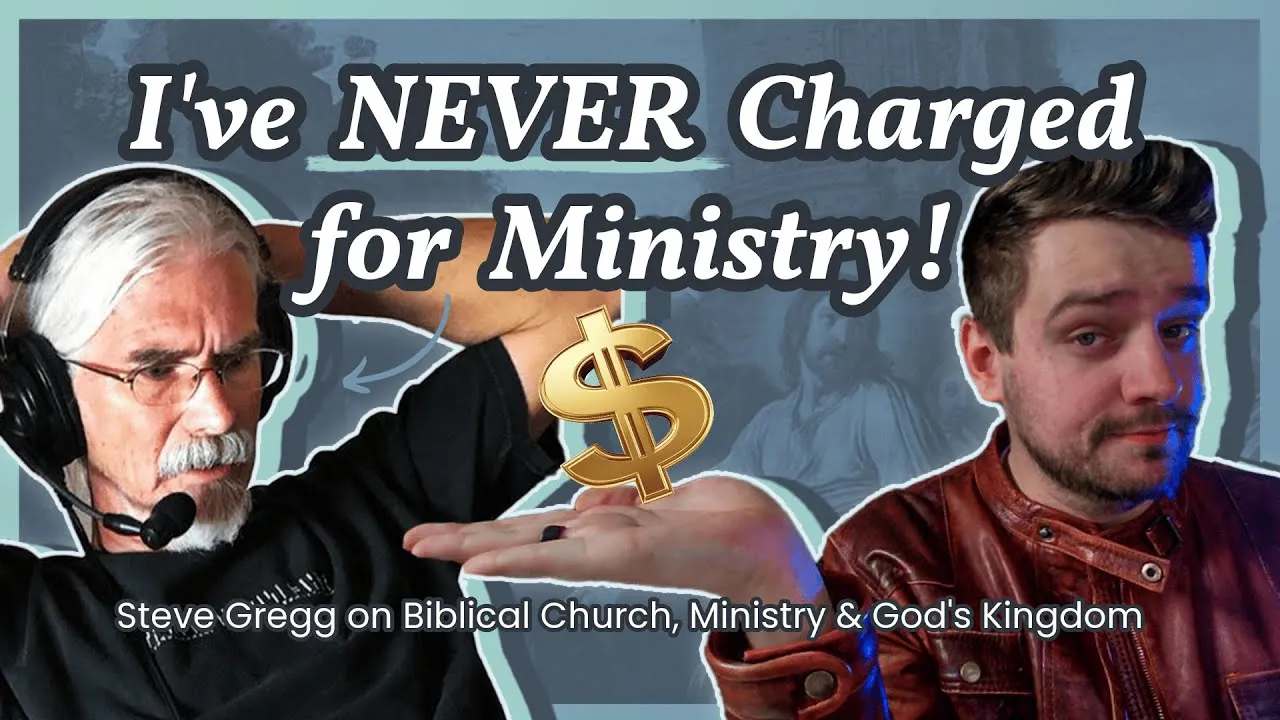
- Charged for his teaching or ministry
- Accepted a regular salary from any organization
- Compromised his biblical understanding to fit denominational requirements
- Claimed authority based on position rather than faithful biblical teaching
This approach has freed him to follow Scripture wherever it leads, even when it meant changing long-held views or challenging popular interpretations. Steve shared how he gradually moved from dispensationalism to amillennialism simply by studying Scripture more deeply – not because any institution required it.
The People Are the Church
Perhaps the most powerful part of our conversation centered on ecclesiology – what the Bible teaches about church. Steve articulated what I’ve felt for years but struggled to express: **The church is not an institution but the people themselves.**
The New Testament never portrays church as:
- A building – A 501(c)3 organization
- A hierarchical structure with offices
- A Sunday event you attend Instead, it’s a family of believers walking together, with leadership emerging organically through service and example – not through titles or positions.
As Steve explained, “Jesus didn’t have an institutional idea of the body of Christ. He had an organic family idea.” This perspective transforms how we understand leadership. Biblical leaders don’t exercise authority over others but serve from among them. They’re recognized by their character and service, not by filling an “office” that must be staffed.
A Different Eschatology
Steve and I also discussed how our eternal future isn’t about “going to heaven” but about resurrection and New Creation. God’s plan isn’t to destroy earth and take us to heaven, but to renew the entire cosmos and unite heaven and earth once again. This understanding transforms everything about the Christian life. We’re not waiting to escape earth but preparing for its renewal. Our work, relationships, and creative endeavors have eternal significance because they’re part of cultivating the creation God will ultimately restore.
Why This Matters
Why do these perspectives matter? Because they change how we understand:
1. Our identity – We’re citizens of God’s Kingdom now, not just waiting to “go to heaven”
-
Our purpose – We’re called to represent God’s rule and cultivate His creation
-
Our relationships – We’re family members serving one another, not institutional members
-
Our ministry – We serve freely because we’ve freely received
I’m deeply grateful for Steve’s faithful example and teaching. If you want to explore his work, visit [TheNarrowPath.com](https://www.thenarrowpath.com) or check out Matthew713.com and OpenTheo.org where volunteers have organized his teachings by topic.
Have you experienced institutional Christianity that seems disconnected from the New Testament’s picture of church? How has your understanding of church and God’s future plans shaped your faith journey? I’d love to hear your thoughts.
Transcript
[0:00] It brings me no small amount of joy to be able to say, Steve Greg, welcome to the Overlap Life. What an absolute joy it is for me personally to have you on here. Uh the way that I typically describe you when other people ask me about your ministry is that uh you are on my personal theological Mount Rushmore. That's just the way I've grown accustomed to saying it. I'm not sure that uh you know, maybe it's not even healthy to say such a thing, but that's how I feel and there's nothing for it. I'm grateful for you taking the time out to join me on here. How are you doing today? I'm having a great time. Great day. Good to be with you. Thanks for having me. My genuine pleasure. As some people know, and they may even think that this is a continuation of the series, to be honest, I had a series of uh videos, four four videos long uh in which I was responding to your uh
[0:48] Trinity Radio video about uh 40 plus open theist proof texts. And uh there's a fair few people who are probably hoping that we're going to talk about that. Personally, my laundry list of things that I want to talk to you about and pick your brain about is far more interesting to me than the open theism discussion. And there's a million things that I think would probably be a better use of our mutual time. So, sorry to disappoint people right at the outset, but I'm going to want to set that aside. For those who don't know your ministry, who don't know where you have come from, what your focus is, and where you're headed, I would really love to give you an opportunity to introduce yourself to my audience, and tell us a little bit about your ministry, the narrow path, what you're working on, what you're praying for, what you're excited for,
[1:35] and all of those various things. Uh, well, yeah, I'll give you some background of my life, which led me into the ministry and what I've done since then. I'll try not to be too lengthy, but I was raised in a Christian. Take your time. Yeah. I was raised in a Christian home. We were a Baptist family. My brother and sister and I are my only siblings. I all uh came to Christ when we were young in Baptist context. My parents were good Christians, solid Christians. They were a model couple to me and model marriage. They were happily married for 71 years till my dad died at 95. and and you know I just think one of the greatest blessings and certainly one of the most life-shaping things in the providence of God in my life has given me those parents and that family situation. Like I said all my siblings also I mean my two siblings became Christians but I
[2:23] would think they would agree with me and say like unlike them I had really maybe more of a passion for the for the for the scriptures really. I mean, I I really took God seriously and I really believed that God, you know, inspired the scriptures and therefore I thought, well, there's I can't imagine anything more important than to know what God said. You know, either there's a God or there's not. If there's not, then it's not important at all. If they if there is a God, there's nothing that remotely comes near to him in importance and knowing what he wants me to know. So, I don't know if I would have expressed it that way, but that was my attitude. I thought, well, this is God's word. I mean, that's different than everything else I'll ever encounter anywhere. So, I wanted to know God's word. I I was not a good reader as a young person. I didn't
[3:12] read disciplined way, but I tried to read through the Bible a number of times before I was even a teenager. I never got all the way through just because I'm a slow reader and I got bogged down in the probably Leviticus or maybe in the tabernacle descriptions in Exodus or something, you know. But somehow even though I never read through the whole Bible as a child, my mind took serious whenever someone quoted the Bible, I took it very seriously. That's the word of God, you know. I mean, and I I didn't make any effort to memorize scripture at all. Found that as I was in my early teens. I could quote all kinds of scripture. Not that I'd memorized, but that I just heard. Maybe I'd heard it, you know, a dozen times brought up in sermons or whatever, or maybe just a few times it stuck. And so I had a a pretty good store of uh scripture in my head. Regarded myself to be that
[3:59] knowledgeable, but it turns out I later found out that the kids in the junior high and high school group, the Baptist church always looked at me as a Bible nerd. Anyway, I my family moved to Orange County. I was in LA County growing up and and Orange County, California is where the Jesus movement began around 69 or 70. And I it was in January of 1970. family moved to Orange County just like ended up being about 12 miles away from Calvary Cost of Mesa Calvary Chapel which was the only Calvary Chapel at that time. Chuck Smith, Lonnie, and those people were there. That's right. Many of your listeners probably saw the movie The Jesus Revolution, which is about that time. I was I was at Calvary Chapel the day Greg Lori got saved, for example, and Lonnie Frisbee was Lonnie Frisbee was preaching uh the first time I came and and he preached every Wednesday night. Eventually, when I was older, I
[4:47] actually did some ministry in in a smaller church alongside Lonnie, but he was older than me. Uh, but I was 16 when I started going there. And it was a revival taking place. I'd heard of revivals. I had never seen one, but it was fascinating. And and it was the best kind of revival in that it was a Bible-based revival. It wasn't just a bunch of emotion. Uh it was Chuck Smith was just the right guy for God to use to get to me because Chuck uh he was a spiritual man came from a Pentecostal background. I did not I had never heard of the gifts of the spirit or the baptism of spirit those were total unfamiliar things but he didn't talk about them a lot either. But he came from a four square Pentecostal background but he didn't like the excesses of Pentecostalism. He didn't like a lot of the uh phony stuff that the denomination and all denominations
[5:37] did to kind of increase attendance and and finances, giving and so forth. He just he just was a real honest, humble guy and he did not like manipulation and he thought the church needed to know the Bible better. So he took uh the opportunity when he got it to leave the Pentecostal four square church and to become the pastor of this little independent church called Calvary Chapel at the time. small church at the time. Um, and and he retained his like charismatic Pentecostal beliefs of sort, but he did not want any of that manifested in his services. He wanted to have a Bible teaching ministry. His philosophy, we need to teach right through the Bible verse by verse. And I was so fortunate to come to that because that was just the kind of thing that my temperament and my particular in intellectual proclivities and stuff were
[6:26] drawn to. So I was I loved it. Uh Lonnie Frisbee eventually laid hands on me to be baptized in the spirit and I I count that to be uh a major turning point in my life. Um yeah, but um people have to understand there were so many thousands of young people my age, late teens in my case, getting saved. Now I didn't get saved in the movement. I was saved before, but I got radicalized in the movement. You know, I my whole ex church was in a Baptist church which is of course not too formal and certainly not too uh you know Pentecostalish lurggical. Certainly certainly not that. It was a pretty balanced church and I was I'm kind of a eventempered kind of guy. I don't have really a lot of highs and lows. So Chuck's temperament seemed to be that way. So I was very drawn to him and I started going there every
[7:14] night of the week because because of the revival thousands of young people were getting saved. They were indeed baptizing a thousand a month in the ocean of people who gotten converted there at Calvary Chapel. I went to the first of those baptisms and many others besides, but I was there right from the beginning before they moved into the circus tent and stuff. But uh but I was just a kid. I was not a teacher in the movie. I was not I mean I didn't never I never dreamed I could be a teacher. I I had uh from child from junior high onward, I'd always wanted to be an evangelist. And I did evangelism as a Baptist doortodoor. I preached in the church that because I was kind of a Bible nerd. The church would sometimes have a youth Sunday night where they turned over to the youth group to run and they'd always pick me to preach and stuff. I always thought ministry would suit me well, but I never heard of a Bible teacher. In the Baptist church,
[8:01] they didn't have any Bible teachers. Um I just didn't know what a Bible teacher was until I went to Calvary Chapel. And even then, it never occurred to me that I'd be a Bible teacher. I wanted to be an evangelist. But there were so many people getting saved, including my high school. I was in a junior in high school. Uh there were lots of kids in the high school who went to Calvary Chapel every night as I did and then got together for lunch at the school every day and we talk over lunch over what was preached or taught about at Calvary Chapel the night before. So we just kind of re rehashed what we heard. I you know I was not aware of it at the time, but apparently these new converts, they were all new converts and I was not. And it was evident to them that I had some familiarity with the Bible that they did not. and they just asked me, "Would you would you teach us instead of just having a lunch and talking?" I thought, "Well, I honestly don't know if I can do that. I've never done that." But you
[8:50] know what Chuck did was just read some verses and comment or read some verse comments. Well, we could can do that, I suppose. I mean, I thought I could read a few verses and then make an observation or two and then read some more and do the same thing. So, I said, "Okay, I'll try that." Uh, just because I was asked. And so, we started going through the book of Ephesians every day and and we had about about 30 kids in mind. There were two lunches. A friend of mine, a partner in ministry with me actually uh was leading the other lunchtime. And so we we were in the same band together and we lived together after we graduated. His name was Michael Moore, but not the same one you know of. But anyway, he and I were partners in teaching Jesus people at the school. I ran one Bible study. He ran another. And it came it came well to me. I mean, it never occurred to me that I was necessarily gifted to teach, but it's
[9:38] not hard. I mean, how would it be if you're gifted for it, if you're called to it, the spirit gives you power. That's what I realiz. I realized when I I later started a Bible school at Oregon, which I I taught through the whole Bible in nine months with a batch of college students and a new batch every year for 16 years. I went through the Bible 16 times, verse by verse with these students. And I just thought, well, anyone could do what I'm doing. I I've never felt any stress. I've never felt any um I've never felt like there's something difficult I'm doing. I felt like people can talk about what they know and if you know the Bible, you can talk about it. That's all I'm doing. You know, I never went to Bible college. I never went to college out of high school. I went straight into full-time ministry. And um and I've been doing 54 years. I'm 72 years old now. And I started when I was 17, I guess,
[10:26] something like that. Um anyway, to make a long story a little shorter, when I got out of high school, my grandmother offered to pay my way through Biola College, which is a Christian college. But I knew the Jesus moment was a real it was a growing revival. And of course, we believed in a very eminent return of Christ, the late great planet Earth by Hal Lindseay. Chucks was way into that stuff and they taught about esquetology all the time and revelation all the time. And this is still when there's only one Calvary Chapel. It was the original gallery jump before the rest of them. But um anyway, so we thought Jesus was coming soon. So I thought I don't want to go to college. I need to hit the streets and you know get people saved. So I lived I had never been a hippie but most of the most the Jesus people were. I grew my hair long. Lived in a VW bus and dressed in old clothes. I mean I kind of took on the hippie persona. Not
[11:13] because it was a fan I was drawn to so much although I was a little bit drawn to it. My generation's style but but everybody but me. Drug testimony. And I'll tell you, I never knew a person who got converted out of a drug habit until I came to Calvary Chapel, the Baptist church. No one ever used them. It was we were drugs weren't that big then. But hippies typically had what we call drugmonies. You know, mostly talk about how many drugs they before they found Christ. And uh I've never tried marijuana. You I've never tried any drug. I mean, I'm just not that was never my lifestyle. I was a Christian for my youth and then was thrust into full-time ministry. So never did that stuff, but I didn't want people to know them because it's a little embarrassing to be so pristine. You know, everybody else had had a good worldly testimony of
[12:00] their conversion out of some really hard stuff. And I I did. So I never lied, but I thought, well, if I look like them, they'll just assume I'm like them. They'll they'll assume I came out of a drug background, too. Kind of seems strange. Become all things to all people that by all means, you might win some, right? So I I was really kind of the hippie preacher type, but I never was a hippie. That's the thing. But all my friends had been hippies. Lonnie Frisbee was a hippie preacher. And anyway, so I did that for years. I and I' I'd travel. I'd check, you know, interstate and witness to people at pick me up. Uh I'd be invited to speak or play music in coffee houses. I was in a Christian band. And and we were busy busy because there was a big demand for people who were not converts. and and I was asked right out of high school in these ministries to the Jews asked if I'd come
[12:47] on Tuesday nights to answer Bible questions for new converts when I started doing that which I do to this day as my main that's the main format of my radio show that I've been doing for 28 years but um that went on for a while then I then I was invited to speak for Youth with a Mission overseas youth with a mission YWAM yeah why I've never been teaching for them for like 40 years now I've taught all over the world for them many countries repeatedly uh usually teach several weeks out of every year somewhere for them. And so that got me to travel and minister internationally more um and across the country. But I had no college education. I have none. Never sought one. I never saw why you would need one. Jesus didn't have the apostles mostly didn't. So I think yeah what what you need is I'm
[13:36] heartened. My philosophy is to be effective in the ministry you need to be called by God to do it. And if he calls you, he gifts you for it. And if if he gifts you, you need to be diligent in developing that. And if your gift is teaching, you need to study and stuff. So I never studied. Yes. To be a teacher. I think I became a teacher because of my passion for study. I in those days and I was not unusual in this respect. Everybody in the movement carried a Bible everywhere. Whenever they were in another kitchen, they'd open their Bible and talk about the everyone was fascinated with the Bible. And I was too. I never went anywhere without a Bible. I was reading through it again and again and again. And if I had to wait at a bus stop or had to go to a doctor's office to wait, if I had a few minutes here there, I pulled out the Bible, read it. I was just saturating myself with the Bible. Plus, of course, as Solomon said, we need to meditate in it day and night. There was never a time
[14:24] when I wasn't thinking about scripture and its ramifications and things like that. And and frankly, that's all I've ever done. That's the only education I have is self-reading, rereading what people have written, listening to people, and meditating on scripture. and uh formal education. But as you know, I mean, I've uh been accepted into some academic circles. Mhm. Braxton Hunter of the Trinity College there at Evans, Indiana. He contacted me a few years ago. I didn't know him or the college. He emailed me. He said, "Uh, you don't know me, but I'm the president of a seminary in Evansville, Indiana, and called Trinity." And he he says, "I've I just thought you might be interested to know that I, among other things, I debate Calvinist." He said, "Once I was doing some research to be Calvinist, I found your material on it. Having
[15:12] listened to it, I thought it was worth looking more into you. I got to your website. I saw that you teach verse by verse through the whole Bible." He said, "I started going through the Old Testament." He says, "I've gone through about twothirds of the Old Testament now." And he said, "I'm determined to get through the whole thing." He said, "I don't think I've ever done due diligence and prepared to teach a book of the Bible without listen to what you say about it first and things like I mean, pretty flattering stuff, you know." Wow. Yeah. Uh and uh I thought, "Wow, that's Thank you. That's great. I mean, glad to hear it. go with God, you know. I mean, that's it. Yes, I get positive emails a lot. I don't usually strike up relationships with everybody, but he wrote back uh few weeks later and was telling me how far he was getting through it and how everyone around him was sick of my voice because he's listening in the shower and at the gym and when he's, you know, at dinner table, you know, and my my family can relate unfortunately. That's right.
[15:59] That's right. He said, you know, a lot of our faculty are listening to you. He says, even our secretaries listen to you. He said, "We got a lot of Greg heads here." I'd never heard that term, but I thought funny. Like dead heads, you know, we got a lot of Greg here training. Anyway, uh he said, "You know, one of our faculty here went through your looked through your list of your lectures online through our course catalog and he, you know, quantified how many credits we would give someone taking a course that corresponds to what you're teaching." And he wrote down all my series and how many credits there were. She said, "Uh, you've done enough to get a doctorate. Do you mind if we give you a doctor?" And I said, "Well, let me let me pray about it." I mean, I was I was 60some years old, never interested in having a doctorate. I mean, I had plenty of time to get one if I wanted one. And uh I just I one reason
[16:49] I didn't say yes right away is because I I'm a very radical organic who doesn't believe that degrees Yes. make any difference. Doctorate level people who don't know what they're talking about. I think you know putting doctorate before your name does is I I kind of thought it was pretentious. I never really wanted that. But I also That's right. Thomas was a economist who once said that some ideas are so profoundly stupid that you will only believe them if you've been educated into belie I agree with Thomas Soul. I love Thomas Soul. He's a great guy. I I've read some of his books and I like to listen to him when he's on YouTube. Um yeah, you're right. I mean honestly that's my view. I think sometimes uh to be as stupid as many people are, you have to have gone to college for that. On the other hand, of course, going to college doesn't make
[17:36] everyone stupid. I mean, that's right. Some of my favorite scholars and authors have PhDs and are college professors and seminary professors. I just think that having a PhD doesn't tell you very much about a person. It never was anything I wanted to correct do anything about. Yeah. It tell the the objective is learning, not necessarily education via schooling. Right. So there's a Mark Twain quote for that where I I think he says I think it was him who said I never let schooling get in the way of my education and my family and I there are so many things just in what you've already shared and I feel like this is leading up to a present day discussion which is super interesting. I would love to know what you're working on now but I'd love to lay a few cards on the table to kind of explain possibly for your benefit but also certainly for the
[18:23] benefit of my viewers why this resonates with me. so much. I'm sure people who've paid attention to my content over the course of the past few years can probably hear a lot of resonances, but I also have my dad was named Steve. I should say is he passed away in 2018 from cancer, very aggressive cancer that came to him via, you know, he had a cancer that started in his liver and then metastasized to his lungs. And by the time we discovered it, we only had about another month left with him. And I was studying esquetology pretty intensely at that time. My dad was a dispensational premillennialist and we grew up absolutely discussing, you know, the Lindsay. You said he had been a hippie. Yes, he had been a hippie. He was born in 53. He was uh saved roughly around the Jesus movement. Did a lot of hitchhiking. Hitchhiked. Uh just off of
[19:11] frame here uh off the screen there is a a guild guitar, old guild acoustic guitar that has a bullet hole in it from a 22 pistol that was fired at him by a drunk guy and uh raised his hard shell guitar case and the guitar that he had been hitchhiking with for all that time blocked the shot for him and he survived. Um he was saved in, you know, in Lawrence, Kansas. There's all kinds of different connection points and super interest. I would have been drawn to you simply from if nothing else resonance and remembering the similarities to my own dad. Um but then on top of that I I took in my own we can such as it is I'm 32 my own ministry career up until this point before I ever discovered your teaching your work anything that you had
[20:01] done I had taken a couple of approaches to uh princ principally scripture that led me down some paths that caused me to start asking questions about some of the things that I'd been taught in sort of a strong institutional denominational premillennial kind of scheme. And I started asking questions that made me a bit of a gadfly made me candidly something of a dangerous person to um you know the institutional sway partly because I was not going to pick fights. I didn't want the institutional authority. I didn't want to take up the title of pastor and fight for a job at a 501c3 nonprofit I don't find anywhere on the pages of scripture or in the New Testament. And so this stuff had already been rattling around in my brain. I had
[20:50] been looking at I had been looking somehow I managed to avoid you in all of this. I don't know how this happened, but I was looking you know that Sure. Yeah. And that's you know I'm glad that you're getting more airtime now because I think your teaching merits it. I think the spirit's been good to us as a church through the work he's empowering you to do. But for for example, I had done some study on varying views about hell, right? What are the different views about hell? I read Psalm 37 and I just sat down. I said, you know, I've believed eternal conscious torment my entire believing life, but this is making a pretty good case for something like a conditional immortality, annihilationism. It sounds an awful lot like the people in this passage who are dying pass out of existence. Sure seems like that. And then, you know, there's other passages you'd read. And that was an open question for a while. I settled
[21:38] on a specific view. And we'll get to why another thing I really appreciate about your ministry in a minute. I moved on from that. I was discussing, you know, esquetology and I was reading about the 70 weeks of Daniel, you know, the Olivet discourse in Matthew 24 and I was looking at the passage around the abomination of desolation spoken of by the prophet Daniel. And the reference in Matthew says one thing and then the reference in Luke says when you see Jerusalem surrounded by armies and you start to get all this contextual background and I thought I was a crazy person. I thought I was a crazy person. The more I studied, the more I looked at it, the more I felt like a crazy person. It was a grouping of teachers that I'd found who had clearly been at this for longer than I had, who were laying out a roughly coherent case, if nothing else, to portray the things that I had come to see in the scriptures just as possibilities. And simply the act of
[22:28] portraying them as, well, these passages sure do seem like they're saying this was enough for me to say, may maybe I'm really not crazy. Maybe there's something here. This doesn't mean I'm right. I certainly don't ever want to be dogmatically certain about having all the, you know, I don't have the corner on the truth at all. It it gave me in some senses permission to radically crack open my scriptures and follow the evidence wherever it seemed like it was going to lead. If I submit myself to the spirit, I'm opening his word and I'm studying it with my full heart and mind and I'm pouring myself into the endeavor of meditating, right? chewing on God's word like you mentioned earlier, Psalm two, um Psalm 1 and two, if I'm doing that, I ought to be able to trust my father to give me some guidance to help me out. It was after the wilderness
[23:17] wandering period where I I landed on I think it was one of your discussions around hell and simply the way that you presented all sides. You presented them for their pros and their cons and their strengths and weaknesses and all of their warts and how they might have to fudge the biblical data and how this passage seems to say this and other ones seem to say the opposite. It was so refreshing because it was so explicitly not dogmatically trying to make me believe what you thought was true. Mhm. Your your teaching resonated with me because it was so willing to hold things with an open hand in trust with the father and say some of this is an open question. It seems as though it could go either way. These people have their case and it's a pretty good one, but it has its weaknesses, too. Generally, you can safely say that people who believe this
[24:05] or who believe this are within the bounds of God's kingdom and and and they're believers. And my goodness, was that necessary at at that time. Uh, so just again I'm grateful if nothing else for the opportunity to say thank you for for taking that approach. I wanted to ask with all that in mind again I've laid out some cards now why why your style resonated with me so much. Um I would love to know how did this approach to we'll say scripture primarily right because like you my entire goal really in ministry it's not so much I have this or that hobby horse doctrinally speaking that I want to just push on to people my goal is to increasingly cleave closer to what I believe the scriptures say in their
[24:54] context as they present themselves to be understood and then if I find anything that's worth sharing I'll take whatever avenues are available to me to share it. You have a similar approach. I have my thoughts. I would love to know how that way of thinking developed in your approach to scripture A and then teaching B and then C ultimately ministry and what you're doing to serve the body of Christ. Well, when I did start in the ministry in the Jesus movement, of course, I was I was just a clone of Chuck Smith's theology. I mean he's a good man, a great man. Uh still a great hero to me and a mentor. But uh he was very strong dispensational. He held a few other views I don't hold anymore as well. But I started out I mean as a teenager I was learning everything from him. So like almost all Calvary Chapel pastors. Now I I was not a Calvary
[25:43] Chapel pastor. At a later time I was a teaching elder in a Calvary Chapel in Santa Cruz, California. But in those early days in Southern California, I never became a Calvary Chapel pastor. like most of the ones who did it was just a like a tape recorder said it and turn on the play and it comes out you know you could you knew all his illustrations you knew all his cross references you knew all of his arguments and uh you know and I never was satisfied with that now a lot of people tell me when you know they who are not dispensationalists they say well when I I never bought that dispensational stuff never made sense to me uh and like the idea of the temple in the millennium where they're offering old sacrifices I Chuck believed that I just don't remember ever saying that clearly. So I I wouldn't have liked that uh or thought it was right. But the thing is uh I was teaching outside the Calvary Chapel. I
[26:32] mean I was mostly teaching in a home Bible stud. I was teaching every day. I was teaching nine times a week. In fact at one point when I was still in my teens in different places and you know a lot of the people were from Calvary Chapel, some were not. Uh, one of the early things that I got assigned to do is to answer Bible questions for new converts. So, and I wanted to be honest, I'm I'll say that there's a couple of things that part of my philosophy of ministry that always were from the very beginning. And I think I have to probably thank Chuck for at least the first of those, maybe both of them, but Chuck Smith, he always emphasized how God resists the proud and gives grace to the humble. I always knew that was a value. I'm not saying I was humble. I'm saying I knew it was important to be humble. I knew that if I was not humble, yes, God would there is
[27:21] a difference. Yeah. God, if you don't humble yourself, God knows how to do it. It's not very fun when he does it. And uh so I always hated the idea that I was proud, which was true. I was proud. Like if I've ever met a really humble young man, uh you have to go through some beatings in life to get really humbled. But but I valued humility and it was my aim probably more than any other aim to be humble because that's how I pictured Christ. I thought that being like Christ is what's important. And that meant I had to not assume that my ideas were always going to be right. Issues where some smart Christians smarter than me might see it differently. I had to always have a good reason for believing. And I didn't mind. I believe something that other smart people didn't believe. I I you know I didn't I felt like I can't think that I have the right to study and make my own opinions up and
[28:10] those people don't have the same right you know I mean I can't blame them for thinking the best they know how just like I don't want them to blame me for thinking about the scriptures the best I know how so I I knew that people would reach other views and on certain things and I felt like I've got a little you know they've got a lot of that although I thought they were wrong on many things u it was eventually Actually, I came out of the dispensational camp. It was gradual because no, I I didn't read any non-dispensationals. I didn't know things the things I believe now have a name, but I didn't know the names. I never met them. I This is my own journey. I eventually I wasn't able to teach the pre-trip rapture anymore because one of my own students, one of my own students came to he'd gone to a Bible college where he's now going to a college where a professor didn't believe in the pre-trip. So, the student came to
[28:57] me and said, "Steve, you've got to give me ammunition. He doesn't believe in pre-trip. Give it to me." So I sat down with and went through 20 scriptures that proved the pre-trip rapture to me. But as I did, I noticed they didn't prove the pre-trib rapture. I noticed for the first time after teaching it for some years, for the first time I noticed this verse, if I already believe in the pre-tribute rapture, this fits into a supportive text. You can read it in that way. And and and I thought, well, and this one too, and this one too. And I realized I had literally had 20 support passages for the pre-trip rapture. But as I looked at each one, I thought, well, that wouldn't really say that clearly. I mean, I can see it that way, but this guy who's going to show it to and I say, where's that verse that actually says there's a preacher rapture that gives me the right to interpret all of these other ones through that
[29:43] written? And I got through the whole the whole of it. I had them all memorized because I was an advocate of and I remember thinking nothing. There's nothing there. That's right. Now, I didn't give it up, but I realized it may not be right. you know, I didn't replace it with anything because I lost my total confidence in it. As I read the Bible, I began to see other things about the resurrection, things that Jesus said about the last day and so forth. I realized that, okay, the Bible teaches that Jesus is going to raise his people on the last day, not three and a half years, 10, seven years, and he on the last day. He said it four times in one chapter. I mean, I don't know how many times he has to say it to get it. Yep. So, anyway, I I came to the position of a false trigger. That's why I still believe there's a future 10 year tribulation and I still believe in the millennium and over the next few years I another student of mine asked me about
[30:32] the millennium and he wasn't challenging me I'm like do you think the thousand-y year millennium does he ask me a literal thousand years and I remember thinking I never questioned whether it was a literal thousand years seems like it could be but I I mean revelation's a fairly symbolic book you know and be symbolic but I didn't really I I didn't see any relevance because I'd never heard of all millennialism I only knew about premillennial never knew anyone had any other view. So I was just you know I said I I don't know it could be not literal I suppose but I still was thinking of a future millennium. And during that same summer I was just doing some work and meditating on the word of God. And I remember I was meditating on Matthew 12 about how Jesus said bound the strong man which is Satan. I remember it just caught in my head. I thought wait Jesus bound the strong man when he was here and he's going to bind him again when he comes back. Now
[31:20] between those two times when did he you know if Jesus bound him at the first coming he's going to bind him again second he has to have gotten loose somewhere in between there when did that happen I thought just got put this radical heretical idea in my head maybe both are talking about the same binding you know maybe the revelation thing is and that kind of the wheels began I began to analyze it compare script and I became without knowing that's what I began I became an amalinics uh I didn't know you said you wonder if you're crazy I thought I was crazy I'd never heard of I'd never heard the term. I didn't know that's what I was. I thought I had reached a heretical view that no one had ever thought of before. And it was some years later and met a man who said, "No, that's the view that you know the whole church held most of the time." And he put me in touch to taught it. And I remember the first time I read Anthony
[32:08] Hookas uh supported it in the book the Bible in the future. Yes. And beautiful book. And I remember he made the same arguments defending Amalinism that I had gone through by stages as I was studying it on my own. So I mean I gradually changed but by the time I got there I was I have to say I was kind of angry at the Calvary Chapel movement. They never told me this was even an option. I didn't mind that they taught esquetology that they believed was true. They should have told me that's only one view. There's other possibilities. Why didn't they tell me that? Why didn't they trust me to think for myself? You know, why do they have to indoctrinate me? And that that question in my mind became the foundation of one of the the chief uh planks in my philosophy and that is I teach all the time but I don't want
[32:56] anyone to be taught by me and later come back and say why didn't you tell me you're just giving your view on this. Why didn't you tell me these other options were out there? I I realized that what had happened to me I had not been taught. I had been indoctrinated and yes and I I decided teach real teaching is not indoctrination it's education and real education it's teaching how to think not what to think exactly right to think through an issue from all sides to get all the data and then trust the spirit enough to help a person come to the right and that is respecting your audience you know now I realize some audience don't deserve that respect because a lot of people don't want to think for themselves a lot of people just they don't say it like this but They really think you figure it out for me and just tell me what to believe, you know? I mean, but I was never that I was never that kind of person and I'm
[33:44] not my ministry is that that could become a whole ecclesiology question too around I think that you and I probably would would have a number of thing and we probably will get to this. But hopefully this is becoming clear to people why the open theism thing. This is now what I wanted to talk to you about. There's so much more meat. There's so much more interesting stuff to chew on here. But yeah, I ran into something similar in a in a church context of which my wife and I were a part. We were part of a Spanish-speaking Baptist church out here in Colorado in which we'd had, you know, I was never I'd never taken on the title of pastor. Never wanted that at all. We can again talk about some of this why. I think probably we both feel similarly in a minute. But nevertheless, people came to recognize that I had something of a teaching gift. I had the ability to give nuanced multiaceted answers to things
[34:32] where I wasn't just dogmatically saying well you you know you got to think this or you just got to believe more or you you know just it says so in this uh this book that we have in our official church library in the book you know on this shelf just go read that chapter it'll give you all the answers and then you don't need to ever look for any answers to questions again and it was in that context that two things happened kind of simultaneously I had an opportunity sort of an unlooked for opportunity to teach for five straight months about esquetology. But again, I was already a mill at that time and knew this church, Spanish-sp speakaking Baptist church culture is lagging behind English, you know, American Baptist church culture in terms of the cultural movements by about 20 years. This ministry had a a hearty pour of,
[35:21] you know, some Jack Hiles still in it, which that's a whole can of worms. I don't have much positive to say, so I'd rather not say much at all. And and very staunchly dispensational premillennial to the point that if you were to actively voice something of a contrary point of view, you you might be treated as though your salvation is in question, playing fast and loose with the Bible, and you're looked to scance as as someone who's probably a false teacher, but we don't know. We'll we'll reserve until we have enough evidence to condemn you and run you out of town on a rail. So, I had this opportunity to teach. And so my focus was on well what should Christians all be in agreement about? And if I can look at ideally I I think the only view that I just prescribe outright I don't think it makes a ton of sense. Many of these people are likely still saved but I just don't think it is
[36:10] really possible given the biblical data is full predtoism. I just don't see it. Wrote a book against you. Yeah it's called why not? I've read many of your books. Yeah that's one of them. Yes. That's amazing. Right. is simply denies too much that I think is too central to the gospel and to Jesus's mission. But nonetheless, I was in this teaching series and I'm thinking about what are the things that we can all agree about so that we don't get into these arguments about the millennium and get into arguments about is it pre-trib, pre- wrath, post-trib. Those are all premill. By the way, you might not know that there are other points of view. We're not even going to go there. I wanted to talk about the fact that God's plan for the entire created order is to restore and renew and heal it and to dwell here with his people once again pursuing what they were designed for in Genesis 1 and 2. And that that was
[36:59] beautiful enough and that even if you grant a literal millennium, we're talking about a thousand years here. That's going to be a blip. That's going to be a drop in the bucket compared to an eternal existence serving God alongside all of those who've been redeemed in a remade world. Really, I would say in a remade cosmos. And that's by far more interesting to me. Let's talk about that and get excited about that together. However you think the millennium is going to pan out. So, I was trying to thread that needle. But then at the same time, there was a discussion around alcohol of all things. Again, Baptist church culture is pretty staunchly tea totling. tends to be very very skeptical of a person who makes any kind of a reference to well that Greek word really is a fermented alcoholic drink. It means wine. It's the thing that Jesus drank at the wedding, you
[37:47] know, made at the wedding. Uh it's the thing that they drank at the last supper. Uh it's the thing that they drink at the Lord's supper. It's the thing that Paul said, "Don't drink too much of it or you'll get drunk." And that's debauchery. And it's the thing he tells Timothy, drink a little bit of this for the sake of your stomach and your various ailments. Poured into the wounds of the beaten man. Is he pour right? Exactly. So all of that together and um and I I didn't make a problem about it. I did have conversations in, you know, I I wouldn't I would never be the kind of person again because I I value unity in the body far more than any any of these other, you know, doctrinal hobby horses. But I would stand up. I I I would go to the pastor's office after the message where, you know, a person holding a bottle of beer was lamb based as just
[38:36] one of the worst possible things that a a person could do, let alone a a believer be anathema. And I just said, it it seems to me like we're holding up a standard that would exclude Jesus from being an elder in our church, right? Uh, and I I really think we ought to to pause and reflect if we're going to hold a standard for our people. And and it came to a head. There was a discussion. It was a heated I I maintained I didn't get angry. I didn't sin in my anger at all, but it was a frustrating discussion which ended with me saying, "Listen, the problem is that you know what the passages say and I know what the passages say. And if our if those people out there actually go and crack open their scriptures and read what it says like you're asking them to and then they
[39:23] find out that you've been lying to them, you're going to lose their trust and you're going to deserve it. That's right. Uh and it didn't take long for me to no longer be welcome there. I don't want to such too much time. I have a funny story about that very thing. My Oh, please. My dad My dad was a Baptist. He drank a once in a while he'd drink a beer or a little bit of wine. My mom was sometimes have half a glass of wine with a meal. They were not drinkers, but they weren't tea toters. And my dad was asked to be a deacon in the Baptist church we were in. Now, in the back of the himnil, they had pasted a sheet called the church covenant. And once a month on communion Sunday, the church would read out loud this covenant. I pretty much I vow to do this and this and this. And one of the lines in it was I vow to refrain from the sale and use of intoxicating beverage. And on communion
[40:11] Sunday, the deacons would, you know, go up front and they get the elements to pass out. And I don't know if it was the pastor or someone else was asking. I probably lead deacon said, "Uh, that's okay. Just be a deacon anyway." So the first time he was up front on communion Sunday with the other deacons, it was time to read the church covenant. Uh, you know, all the deacons were reading with him and he was when they came to that line, I vowed to abstain from the sale of use of intoxicating. A bunch of the deacons went silent on that line like my dad did. You know, it was like it's obvious that they didn't believe in what the church believed about that, but they still had to, you know, had to accommodate the tradition of the elus. Yes. Right. And so this leads, it is that is a funny story and I can obviously relate. There's a lot of that going on too. That's really dangerous in
[41:00] any kind of faith-based community when you say one thing uh and then you live another or when you set up a system of life as a believer where from the pulpit or as an official statement of the church. What on earth do any of these words mean? Again, New Testament speaking that doesn't make a lick of sense. But officially speaking, we'll say this. But then behind closed doors, you and I both know that this passage says, and that's a very very dangerous precedent to set because there's very few times, there's only one time I believe that I can think of when Jesus says that something can nullify the word of God. It's in one passage, I believe it's Mark 7. It's the traditions of men. That's right. And that is a chilling warning. This is one of the things that I've I've wanted to talk to you about
[41:46] the most because candidly with you, this is one of the things about which I still feel the most crazy. Yeah. Is ecclesiology. And so I you can say as much or as little as you'd like. One of the things that I love about your situation being, you know, traveling itinerant preacher for your entire career, not having your paycheck tied to a specific denomination, being happy with what you're saying and what you're doing, being able to just crack open your Old and New Testaments and follow the direction that you feel the spirit guiding and following the evidence wherever you believe it leads. is that it's difficult to get a person to understand something or even to fairly treat something or fairly represent something publicly if their livelihood and their reputation depends upon them not understanding and that is what has
[42:34] left me free to think freely and to change my mind if I need to. Mhm. When I went into ministry, when I left home, I was in the ministry as a teenager, but I left home at 17. That's when I was on my own and was in ministry. I determined I would never charge anything. I'd never receive a paycheck for ministry. Sometimes in the first 12 years, I had to work part-time jobs. I got paychecks for those because that's secular work. But I felt like Jesus said to his disciples, "Freely you've received, freely give." And I felt like that's, you know, everything I had, I got free. I didn't pay any tuition to go learn stuff that I just I had free. So I I felt like the order is you got it for free, you give it for free. And so I've never sold anything. I don't even sell my own books. They are sold at Amazon, but I don't sell it. You know, I I give them away. I buy them by the card is a good way. But I all my 54 years in history, I've never sold
[43:22] anything. And I don't believe in me selling anything. And I've never though I've I've spoken for any organizations, I've never been on the payroll of any organization. And I don't charge when I travel to speak. Uh, I was influenced by George Mueller and Chuck Smith introduced me to George Mueller. Yes. Life. And when I was, that's obviously the way I want to live. I mean, Jesus lived that way. I'm sure he never got a paycheck from anyone on a weekly basis, you know, or the apostle who drafted their paycheck every Friday, you know. I mean, no. Yeah. You know, they they lived by faith. Jesus said, "Seek first the kingdom of God and his righteousness and the other stuff, meaning your material needs will be added to you." So, I I figured Jesus told the truth about it. So, I decided when I left home at age 17, I would never sell or my time or service in the ministry or any
[44:09] products. So, uh I've never had a guaranteed income in ministry through any uh though God has taken good care of me and I and I also determined that I'd give more than a tithe of everything away because I don't believe in tithing. I don't believe the Bible teaches tithing testament believers, right? So I thought, well, I'm in chintzy. I'll I'll I'll always give 20% and never just 10. So I mean, all my life I've never asked for money, never let anyone know my needs, and I've never charged. And yet God has provided everything. You I've raised five kids to adulthood. I've owned two homes, one at a time. You know, I owned one, and then we sold. Sure. But God provided me with one home, essentially three, and then when we sold it, we bought another, but I've never had a mortgage, you know, of those homes. I mean, I'm God. I've never had a new car. Never been in debt. Well, I
[44:57] can't say I've never been in debt. Never had to go into debt. Uh, if I ever went into debt, it's because I was going beyond my needs and that wasn't I regretted that. But, um, I I've lived largely without debt. I've never bought a new car and had a contract. My finances have been totally related to my ministry. Yes. People give money to the narrow path, which is a radio 501c3, and their money goes to it. We simply use that money to buy radio time. I don't get a penny from that. Never have, never will. And uh I mean I like that because I can't be pressured by anybody to hold to a party line on something. You know, this is something that I I I don't fault and others who have salaries. That's between them and God. But I have to say, I've known plenty of pastors who could not allow themselves to rethink an issue
[45:45] because their denomination paying them to believe that. There was actually an Assembly of God pastor back years ago in Oregon who listened to my lectures on esquetology and they're different than the Assembly of God line. And a friend of mine who gave him the lectures, he said, "Did you listen to those lectures?" And he said, "Yeah." He said, "Well, what do you think of me?" He said, "Well, they sound scriptural." He says, "I'm I believe that I I'd lose my pastor." You know, I thought, see, I I never wanted to be in a position where I couldn't believe what I think is true and say what I think is true without the fear of, you know, someone pulling the plug on my finances. I serve God. God supplies my finances. I don't I can go speak somewhere and get nothing from those people, but God will supply it somewhere else because I'm I'm serving him, not man. And you don't depend on your brothers and sisters to supply your need. You depend upon your father. No, that's right. I mean once once I was
[46:33] teaching for WWAM they usually give a little honorarium at the end of a week of teaching but one time I taught for a week same as any other time but they had a really small enrollment. They didn't have a lot of money at the end of the week the guy handed me a YWAM coffee mug t-shirts for a week of teaching. It was like the whole week I was teaching for uh and he said this is your honor and I laughed. I thought he was joking there. That I mean that's kind of seemed like a joke but then I realized he's telling the truth. So, I just thought, well, okay, that's a surprise. But, uh, but I I remember thinking, I don't have any money. I could certainly use a financial honor over here, but I also thought, well, but I'm not I'm not their employee. They don't have to buy me. They're not buying my time. I'm free. You know, I'm God's paying for my time. God will provide what I need elsewhere.
[47:20] And he did. He always did. And so, I mean, a lot of times, you know, my income would come from an honor or offering someone to take, but lots of times not. I mean just I teach somewhere didn't get anything but God provided somewhere else and it's really wonderful to to have no financial or economic pressure on your ministry. uh yes or even reputational pressure right where uh again if this this gets into the discussion that I want forunately I never had any reputation yeah th those stakes arose later right yeah it's that's great I think probably the thing that I believe maybe aside from open theism to be honest but um one of the things that I believe and speak about that I think probably gets me the most sideways glance ES is my approach to trying to
[48:10] make sense of what the church is. And and so it like many of these things it came from, well that's interesting. That's an interesting passage that sounds weird to quote another member of my theological Mount Rushmore, the late great Michael Heiser. He said once, "If it's weird, it's probably important." And so I was reading, I can't remember the exact passage, but I was just thinking about the concept of the phrase the church. I looked up ecclesia and started really doing some digging there. I proverbally started from Matthew 1 and flipped all the way through to Revelation 22 and turned my entire New Testament upside down for every single reference of that word. I wrote down some of the defining characteristics. And then I started to look at still being part of a pretty institutionally-minded Spanish-sp speakaking Baptist 501c3 nonprofit here
[48:58] in the States and just thinking, my goodness, there there's the list of things that that we're seeing here and the number of things that I see as repeated emphases in the New Testament. If you were to make a ven diagram, it's darn near two separate circles. There's very little that we actually are doing. And so I was looking at the one anothers and and all of this stuff and I landed on a definition that's been sort of my operating definition for what the church is biblically speaking. And it's for me the way that I parse this out is it's not a movement. It's not a denomination. It's not uh an an an organization of any kind. Certainly not a government entity that has a relationship with any formalized. You know, again, if I'm a mill, I think that's a beast right
[49:46] there. uh uh or it's at least beastly, right? Any kind any kind of government, human power structure has some beastliness to it. I just think Paul would be horrified at the concept of us calling the church some other that then has a formal relationship with the government where we don't have to pay taxes as long as we don't say anything critical about the government. It's not any of these things. It's not a movement. It's not an event you go to on a Sunday and sit in a chair and stare at the back of another guy's head for two hours. It's not a building. Certainly never once is. Or if it is, it's a figurative building that's made not out of hand, but built up with every piece. Living stones. Right. Exactly. As soon as I sloughed off all of those definitions, I landed on what has made the most sense for me in the past several years. The church is the people. It's equal to the people. It's inseparable from the people. But it's
[50:33] the people everywhere throughout time and throughout space who have placed their trust in Jesus Christ as Lord. and he makes a kingdom out of those people, right? And then that kingdom is now an an organization if it's to be called something like that. And there are no hierarchical structure or or roles that are like job descriptions that you hire for or that you you know, you say, "Well, we need to have this role filled." Uh you know, people will say like the five-fold ministry, for example, you got to have these roles in any healthy church. And so you're you're kind of in a recruiting mindset where you got to find the person who's going to fill that role in your church somehow. Um but if it's the people then that throws off an awful lot about what we do on a Sunday, what we put our
[51:20] energy toward, what we think is important, what we value, what we elevate, uh what we emphasize in the New Testament, what we ignore in the New Testament. And sadly, a whole bunch of what is in the New Testament gets ignored when you structure it that way. And I just, you know, you if you have a Sunday event at a building and you think that any of that is the church and it's not the people who are there and you you find yourself too many Sundays in a row where your experience is, I'm going to drive to an event, I'm going to listen to one guy exercise his spiritual gifts, and then I'm going to leave in the parking lot without doing anything more than offering some half-hearted offer to pray for someone that I'm likely not going to follow through on. And I'm not gonna one another hardly a single person there. Yeah. Uh I'm certainly not going to to We're not gonna have any opportunity to outdo one another and
[52:08] showing honor. We're not going to have any opportunity to bear one another's burdens. Um and even to live close enough to make mistakes, step on one another's toes, and then need to forgive one another. Those things are just never going to happen. And so this has made me a gadfly in many an environment in which I found myself. Um, and again, one of these seasons I was feeling real crazy about some of this that I had studied and and ran into in the scriptures. Uh, and was casting about praying to God for some help on this and found some assembly required, which is my lecture series on that. Some assembly required. Yeah, that's right. Um, and and it was like uh it was like lightning from a clear sky. It just was exactly uh it it was very unforeseen, unlooked for. Um and I look back on it now with a great
[52:57] deal of gratitude from to God for sending that my way. But I wonder if I could ask you to summarize in some ways if there are any points of distinction or difference with what I just said. I would love to hear them. But well, yeah, I think ultimately I suppose I'm asking the church. Why is it important to have a biblical understanding of what the church is? And how do we cash that out and start to actually act on it? Yeah. Uh well, there's two competing views or or I should say visions or concepts of what the church is. And although the Bible doesn't use these terms, these are suitable terms to describe the difference between the two views. One is a term you've already used in this conversation, institutional church. An alternative vision of church would be the organic church. Now I'm not saying the church isn't in some senses an institution but I'm using the term institutional to refer to something that
[53:45] has been institutionalized and and what that means been structured in such a way there's a hierarchical you know some kind of top- down authority it might be the pope it might be the founder of a denomination it might be the headquarters of the denomination if you're at a Jehovah's Witnesses be the watchtower society that kind of mean there's some kind of top down that has officers ers in offices and the offices outlived the officers. This what is institutional. I personally believe that elders were chosen to lead the churches the book of uh acts and in in the epistles because the men who were elders were of a certain quality and certain gifts filled a need individually to the other rest of the body of Christ. Whereas I don't think I honestly don't think they held what we call an office
[54:34] in any institution secular or religious. you've got an office that exists on its own merits regardless of the officer. So, in other words, you know, a church will usually have some because they're 501c3, they'll usually have like a charter or some kind of a list of defining things and they will either have a pastor or an eldership a certain number and then they have deacons or whatever. And if let's say a pastor dies or he falls in disgrace or he moves out of the area, it's important they replace him. They think because there's now the office of pastor, they got no one filling that office. If you don't have an office of a pastor or office of elders, that doesn't mean you don't have pastors and elders. It just means there's people who are doing it, but they don't have a title on their desk or on their on their on their door. Pastor so and so. And you know, I was teaching
[55:22] in uh I was teaching in uh Cameroon for a group of Nigerian and Cameroon pastors, native pastors. And in the black churches, they're really big on titles, you know, apostle so and so, so and so. And I was teaching for two weeks every day there. And uh after the first day or two, one of the pastors said, "So, what do we call you?" You know, and I said, "Well, my name's Steve. People call me Steve." And uh I mean, like, are you elder or apostle? What are you? None of the above. I'm just Steve. You know, I've I've served as a shepherd in some churches. I've served on a eldership in some places. My identity is not that. I'm I'm just a servant of God like everyone else in the body of Christ. And if my gifts in the moment are useful to the body of Christ for something, if I
[56:10] provide leadership, if I provide teaching, if that's what they need, fine. By the way, if they don't need my leadership or teaching, they don't need it. They don't have to accept it. I I I I don't wear a bad. I don't have stripes on my shoulders. You know, there's no office there. Uh you don't you don't salute the uniform. There's, you know, there's no uniform. You've got people, Paul said, recognize those who labor among you and are over in your Lord and esteem them highly for their work's sake, not for their office. They're providing a service the church that should be grateful. Thank them for that. But if you lose someone from your church like that, they die or something like that, it doesn't mean they've left a hollow that you got to find someone else to put in there. whether you've got someone like them or not, you know, God the Holy Spirit places people in the church where he wants them and so forth that the
[56:58] organizes outlive the officer. If the you lose an elder, you find a place someone else got to put in there. And this is the case that a lot of times movements have started with very qualified pastors and elders, you know, providing teaching and leadership and so forth. But when they lose them and replace them, they don't have anyone quite so qualified. So they compromise on the qualifications, say, "Well, this guy's almost there. You know, we'll put him in there." And eventually you're no longer you no longer have leadership that's based off what Paul said about leaders. You have leaders that kind of approximate that a little bit. And the only reason they're in leadership is because you had a a vacancy. But when you've got that kind of a situation, there's always carnal people who like power. And if you've got an office, then that's something that a carnal person may aspire to. you know, he can run for office. He can uh insinuate himself into
[57:48] the church in such a way as to get some followers to put him in a place of power. But if there's no p places of power like that, then there's just servants. And I I believe leadership Paul lists leadership as one of the gifts of the Holy Spirit in Romans 12. It's it's a service. Gifts of the spirit describe the service you provide to the body of Christ. If someone needs leadership and you can lead them, do it. If they don't need leadership, you can't impose it on them. I had a I had a pastor once who uh of the church I was attending and he wanted everyone to go to small groups and my wife and I tried to comply but it didn't work out for us. Our family, we had young family and it we were in fellowship all the time anyway and we didn't need that. So I said, "Pastor, do you mind if we don't join a small group?" He said, "Well, we're trying to get everyone to be in small groups." I said, "Uh, but what if it doesn't help them? What if it doesn't
[58:36] serve their needs to be in a small group?" He said, "Well, if people aren't in line like this, how is someone supposed to shepherd his sheep? How's a pastor supposed to shepherd the flock? They said, "Well, uh, you know, the way Jesus said it was, if the shepherd has a hundred sheep and 99 of them don't need much attention. One of them's running off the wrong direction, he leaves the 99, they're doing okay. Go for the high maintenance sheep." You know, you're lucky if you have a lot of low maintenance sheep because if they're all high maintenance, you're going to chase them like hurting cats. You know, you've got some mature Christians who don't need you to hold their hand and feed them pabulum by spoon. uh you know if they're self feeders, praise God, you've got people there who don't need you to lead them because there's plenty of people who do need leadership. So I mean, but he just thought, well, I'm the leader. You're congregation. You're supposed to follow me. No. Yes. I have adult children. I don't impose my
[59:25] leaders my adult children when they don't ask for it, you know. Exactly. Well, it's so wild to me because again, I read I'm I'm reading my New Testament. I'm just seeing Jesus couldn't be any clearer when he says things like, you know, the rulers among the Gentiles, they they lorded over those under their charge and they're great ones. He says, again, I might butcher the Greek here. I believe it's the katexusadzo, right? He says they they exercise authority over them. That's not a particularly violent expression of the phrase to impose authority forcefully. It's simply the exercise of an authority over a person. Meaning even if it's a legitimate hierarchical authority, he says the the the great ones among the Gentiles exercise authority in charge. It shall not be so among you. In fact, if any of you wants to be the greatest in the
[1:00:12] kingdom of God, he'll become the servant or the slave even of all the rest. And and and how many times have we seen, you know, a guy who says that uh his role is to be the servant leader, but he's wearing the nicest clothes. He's he's got the place of prominence. he's standing in the assembly where he's getting the salary. He's the only guy uh actually exercising his spiritual gifts cuz you know uh passing out bulletins or printing bulletins isn't necessarily a spiritual gift. And and it's so it's almost absurd. It is almost absurd that we can hear a very I think a very clear set of statements. It's not the only one like it that Jesus mentions. He mentions many others. Uh let no man call you master. Let no man call you rabbi. And we skip right past it because it's the water we're swimming in. Yeah. It's because you're all brothers. See, Jesus didn't have an institutionalized idea of the body of Christ. He had an organic family idea.
[1:01:02] What makes the church is that they're born of God and they have him as their father and they have Jesus as their older brother and and appointed king. And yeah, there there is a hierarchy. Jesus, you know, said in 1 Corinthians 11, the head of every man is Christ. The head of the woman is the man and the head head of Christ is God. So I mean God is above is above every man. Now he didn't say the head of every man is his pastor or the eldership. No the head of every man is Christ. Well then what's the value of the pastor eldership? Well plenty how many Christians right I mean they want to follow Jesus. They need to be told what he said especially in days when they didn't have Bibles you know which they did. Very impressive. And you got a presbuteros right our our word for elder right or or even just the concept of a leader. Leader is a verbal noun
[1:01:50] right? It's one who leads the leading is the thing that they do and lead isn't when we think about leadership sometimes we think we can't help it I think being in the you know west uh I'm I love being an American frankly I used to be the sales director at a company called capitalism.com for crying out loud so I'm not opposed to some of these concepts but the idea being when we hear leader we simply uncritically imagine that what we're discussing is a person with a hierarchical authority in an org chart over a group of people who need to fall in line or face some sort of institutional punishment for their insubordination. Right? A leader simply can mean one who leads others. The action that they take is it could be from among a group of people, not over a group of people, but from among Exactly. And then you get to presbuteras. You
[1:02:39] have an elder. Uh it's it just is the same word. Again, there's there's some parsing there. There's some discussion. I'm not even sure where I land on this, but it's the same word that you would use to describe someone who simply is an older person who has more experience. This is one way I'm trying to see if this makes sense. It could be that you use this word in a generic context to describe someone who has simply experienced more of life in general. And in the church, it might simply be that you use that word to describe someone who's experienced more of spiritual life. I've known people who were roughly my age or maybe a little bit further along than that, but not too much that I would look at and say that that's a person who has walked their whole life with Christ. And a new convert, though they might be 30 years the senior,
[1:03:30] generically speaking, compared to this person, may yet nevertheless say, "That person's leading me. I'm learning from them. They're my older brother in the faith. They've been a part of the household of God longer than I have and they're leading from among a group of people and their example. I I'm following behind them. I'm allowing myself I think again there's a Greek discussion here and there's you know Paul's letters and all that but he says um I'm allowing myself to be persuaded by that person. I'm emulating their faith and their way of life. not they're they're in a organizational hierarchy over me and therefore they have the institutional power to mandate that I do something and if not I am punished by the institutional structure that exists for my insubordination. That's just not the picture you see in the New
[1:04:17] Testament. The the leaders are the ones who are rendering their life in service to others and giving of their life in service to others humbly. Going back to your key point from earlier in the same way that Christ did. Yeah. He's the good shepherd. You know, Peter addressed the elders in 1 Peter chapter 5 and Paul addressed the elders of Ephesus in uh uh Acts chapter 20 and in verse 28 there both of them told the elders to shepherd the flock to oversee it to be examples. Now overseeing uh a family is different than overseeing a corporation. Uh if you've ever known a family there I knew a large Italian family once where the father was no longer with them and a lot of young men and a few uh young women in
[1:05:05] the family. They were close. They'd get together for family gatherings even to decide family issues even though they're all grown up. Their mother was there and adult men and women. But but uh there were two or three guys in that family. I sat in on one of their family groups once who clearly kind of led the group. Now they didn't have an office. They weren't the dad. The dad wasn't there. Uh, and they weren't even the oldest. There was an older brother that was not Yes. not consulted. He was not a very successful person. He was not He'd had some drug problems though he's now walking with the Lord. He's just kind of was not the model people wanted to imitate. These the two next brothers had a company together. They were in construction and they were strong Christians and they were, you know, successful men. and just the family kind
[1:05:52] of looked to them like well you know what they say is valuable you know and I I just the body of Christ should be you don't uh you don't submit to someone because they hold some kind of position you look around the body of Christ say who's who's got the kind of success in their Christian life that I want let me follow their example let me ask them advice I mean they and I've I have not had I've not been in uh an institutional church structure for many many years had no pastor or elders over me. I have a home church in my home, but I'm not even a pastor there. We don't have a pastor or other we just we don't need one. Jesus is getting not in the sense of the filling that role, right? Where there's a role in an organization that you got to I'm teaching that, but in the sense of shephering, leading, teaching, and those verbal nouns, if you're leading,
[1:06:42] you're teaching, you're shephering, you're caring for other people, you're a shepherd, you're a leader, a teacher, and a caretaker. But you're doing that not because not because you got hired to do that. You're doing that because that's just who you are. You do that. People recognize that. They want to hear what you have to say. And and no one's paying you. You're not in a position. You're just a family member that people respect enough to want to hear what you have to say, but they don't have to do what you say. You know, you know that you don't have authority over them. Just serving them with your experience and wisdom and so forth. And if they don't want to follow, they don't have to. You know, uh there's that verse in Hebrews 13:7 where Paul, uh the writer says, uh, you know, remember those who lead you. And he says, who have spoken to you the word of God. And later he says in verse
[1:07:29] 17, uh, obey those who lead you. You know, make it easy for them. Now, some people say, well, he said to obey them, so isn't that giving them authority? Well, no. He's already described as who've spoken the word of God to you. The word of God is the authority. And if somebody speaks the word of God to me, I have to obey that. I I they are speaking authoritatively not because they have special status but because the word of God does and Christ is the king. If somebody speaks his words to me faithfully represents his words to me faithfully if I'm you know if I'm doing something wrong or says don't you know that Jesus wouldn't approve of that this is what Jesus said I'm going to obey that. Yeah. Not because of who they are. It doesn't matter who they are. If they're speaking the word of God to me they're speaking to me authoritatively. But if the same person speaks contrary
[1:08:16] to the word of God to me the next day, they got no authority. It's the word of God, not the person. There's not an office there that they they don't have a badge. They are just another brother. And that's why Jesus said, "Don't let anyone call you teacher or rabbi. You're all brothers. This is a family. This not a corporation here, not a hierarchy. Not a CEO or a boss." And Jesus is the boss. Jesus is the king. And and you know, remarkably that word actually in Hebrews 13:17 is the verse you were talking about where it gets translated as obey. Yeah. And there's some senses in which that's a fine translation, but it's peste. And the root word of that is p. And in every other context, it's something like persuade, win over, trust, listen to, hearken to, that kind of a thing where
[1:09:05] it's not. Again, we hear obey and we think, "All right, well, it's like me and the and a police officer. Well, I'd better obey the police officer who has the ability and the authority to mandate my behavior." Or even even I I think this could be a toxic outgrowth of our concept of what obedience means. Sometimes in parenting where look, I am an elder in my home, right? My children ought to obey me because it is right. My children ought to obey me in the Lord because it is right. and obedience is wise. But I don't know that I should sit here and I don't know that the strategic choice even the wise choice for me as a father is to is to cram down authority as a as a taskmaster over them so much as to get on their level as a person who loves them to submit myself to them and
[1:09:53] to work for their benefit and to lead by example to them. Yeah. and to expect that kind of influence because that's the only kind of influence that's going to have any sway over them by the time they're teenagers or adults. If I'm trying to cram down authoritarian uh mandates from from my seat as a father even in my home, I I feel as though I've gone astray in some senses. Again, that's not to say that I don't lead that I'm not worth worth listening to. But then I also need to aspire to be worth listening to. And that means I need to appeal to a standard that's outside of myself to which I'm also bound. And where do I turn for such a thing except for for God's word and Jesus who is the one who is over all of us in my household. We're all subject to him. If we're all subject to him, we're
[1:10:42] all subject to his word that he's already spoken and we're all bound to live as though Jesus is king here. What what more do we need? I can bring that standard to bear on them and they can bring that standard to bear on me if I'm running a foul of it. Right? And I just have I the more I say this stuff, you know, that people often in my circumstance in my circle of influence in my world will look at me as if I've got 10 heads. But I just don't see any other way personally, I just don't see any other way to read the New Testament. And and this allows me to do something of an endound from the um you know, my discussions with Eastern Orthodox believers who are nevertheless believers, right? If I think that they're part of that household of faith, they've placed their trust in Jesus Christ, they're part of the people, they might have a different idea for what the church is, but I can still look at that person and say that's a brother and sister in Christ. Whether they'll return
[1:11:28] the favor is on is on them. But it's allowed me to do something of an end around the discussion around Eastern Orthodox Christianity, around Catholicism, around denominationalism, around all these other things simply because let's get back to first principles here. What it seems like the New Testament is describing is a people who form a body built together by the spirit then go on to become the people of a kingdom that is coming and will transform the world one day and is in the process of doing so now. And that's if we're all the populace of that kingdom, then it's that sort of kingdom building work that we're supposed to be focused on as a family, serving the king together and expanding the borders of that kingdom through what we do with our
[1:12:15] time and our effort and our energy. And it seems to me as though that's what the New Testament is aiming us at. Amen. Man, it's gratifying to hear an amen from Steve Greg. Uh this will be where we land. There's one kind of concept that I wanted to pick your brain about. Again, I I just want to go all the way back to our discussion. Uh we just really briefly blew blew over some of these esqueological things. Uh most of the time I bring up the word esquetology, people bristle. And I think that it's a valid response given that if you say esquetology and if you even mention that you have an interest in esquetology, the assumption is that that's going to be, oh, okay, we're going to have a real weird conversation about modern geopolitics and this person's going to bring a pretty esoteric interpretation of this pretty vague passage in Revelation and insist that their
[1:13:03] dogmatic view of it is the right one. And this is just going to get really uncomfortable and really awkward really fast. And all the things that we argue about, I say are about the next things. Again, the nature of the rapture, if there is such a thing, the tribulation, if we parse those passages that way, the 70th week of Daniel, the millennium, those are all things that it seems to me we argue about. But I don't properly think that that is esquetology, if you take my meaning, because it's not the escaton. The escaton is what comes after that. What's after all of that stuff has been resolved. When we're talking about the last things, that seems to me if we're going to label this stuff esquetology, that's what we should be talking about, not the next things. I don't know what the Latin word here or the Greek word for next would be, but proximology, I don't know, but
[1:13:52] esquetology. We're talking about the escaton. Um, this is sort of the heartbeat of my ministry. I want to help people understand as much as we can. Again, we don't get security camera footage of the future or something. We don't know exactly. um all the different details of of exactly how God is going to bring all these things to bear. But again, it seems to me that God his goal in the beginning, he created humans to be his partners to rule over the world alongside him. The fall broke and marred that mission, but it didn't destroy it. It didn't remove that mission or that mantle from humanity. It simply made it more difficult. It it it decommissioned us from being able to do it to the fullest extent that we were intended to be able to. And it seems as though God's entire redemptive plan was intended to get us back on track to that mission and that goal. And then he'll have that goal
[1:14:41] fully completed in the new heavens and new earth. It's a healed, restored, holy world. That's what we're all heading toward. It seems as though the thrust of the narrative of scripture is God's going to restore and heal this place. Um, there are probably things you would add or nuance to that description. If I could drill one idea into the head of every single person who claims the name of Christ anywhere in the world, it would be that idea. When I just throw that out there, I selfishly want to know um because I do view you as something of a mentor in this way, as someone who has gone before me on a path that candidly I want to follow. Um when I just throw that out there and say this is what I want to teach, this is what I want to give to people. I'm coming to you humbly and asking what do you nuance there?
[1:15:29] What do you do? What do you think differently about that? And um I would even invite you honestly I don't know this might be the spirit at work right now. I would invite your prayer on that if that's something that you think is a worthwhile message. I'm just coming to you thinking, my goodness, I'm talking to someone whose whose study and approach and heart I so resonate with and I so deeply admire as a fellow brother in Christ. I just want to lay that at your feet and ask for your thoughts and for your prayers. Well, sure. Uh well of course uh in moving from my former esquetologology to what I now hold is from dispensationalism to almillennialism. Uh my alennialism also is accompanied by partial predtoism. Uh
[1:16:17] they're not the same thing but they are compatible. And partial predism is of course saying that a lot of the passages that are popularly taken to be about the end times really aren't. they're really about something that happened already historically that very symbolic or apocalyptic and so forth. But as non-millennialists, I I moved from an original esquetology that was very detailed, so detailed that it helped most people needed a chart, an illustrated chart to show where everything happens in relation to everything else. uh and now I've come to an esquetology which I think is the esquetology of of Jesus and the apostles that I believe there's between now and the new creation there's one event and that's the second coming of Christ and everything else
[1:17:05] happens that day that is everything that hasn't happened yet happens that day I mean the Bible says when Jesus comes back you're gonna raise the dead he's going to rapture the church you know there's gonna be a judgment there's going to be consignment to the lake of fire and to the new creation. These things all happen on the last day. Jesus said he's going to raise his people up on the last day, but he also said the wicked will be judged on the last day. He used the same expression in John 6 and John 12. And no, no biblical writer disagreed with that. I mean, Peter said the day of the Lord will come as a thief in the night in 2 Peter chapter 3:10. And he said in that day you know the heavens will be dissolved the you know earth will be melted elements melt with fervent heat and we look for not a millennium but a new heavens new earth. He said Paul said the same thing in Romans 8 where he said the whole creation is groaning and travailing.
[1:17:53] It's going to be delivered from the bondage of corruption to the glorious liberty of the sons of God. When we you know when we experience the redemption of our bodies which is the second coming of Christ and the resurrection. The creation will be changed. It the curse will be lifted. Revelation 21:3 says, you know, there's no more curse. God's purpose. I agree with you. When he his purpose was announced before the fall, made everything on earth. He said, "Let us make man ours. Let's make him give him dominion over the things, the fish of the sea, and the field so forth. That is God made man to co-rule the world." But he had to be vetted with the test of the tree in the garden of Eden. And all of us have to be vetted. But Adam and Eve failed the test. And therefore uh they didn't get to rule with him. They I mean they they retained a measure of human dignity, authority over the
[1:18:41] animals for example, but not the same kind of complete authority they had before. There was a tremendous loss. Of course, sickness and death and crying and so forth are sin to be gone in the new heavens, new earth. Those things I believe entered through the fall. So God's going to restore what he had made. See, let this is an important esquetological distinction that I think everyone needs to know. I was raised in the Baptist church, and it wouldn't have been any different if I'd been a Presbyterian or a Methodist or Nazarene or a you know, you know, whatever Christian. You name just about any of them. I was taught that and I had the impression this is what the gospel is about is accept Jesus into your heart, you will be forgiven for your sins, so when you die, you'll go to heaven. That was the message. The impression was the
[1:19:28] only concern that Jesus had when he came was to make sure I could be forgiven and go to heaven because going to heaven was what was important. Going to heaven was always contrasted with earth. He said the Bible nowhere says we're going to spend eternity in heaven. We go to heaven when we die. We come back with Christ when he comes here. He remakes the creation and we live with him in the new earth uh forever. And there's no more curse. There's no sickness, no dying or wedding. So we're not going to be sitting on clouds playing harps. are not even going to be in the throne room just bowing down continually 24 hours to God. Not that that wouldn't be a great thing. That's just not what is predicted. What's predicted is that we're going to be serving with Christ in a renewed earth just like Adam and Eve would be doing to this day if they hadn't sinned. You know, if Adam and Eve had not sinned today, they'd never have
[1:20:14] done it. You know, death came because of sin. And so, God didn't intend for people to die. It says in Psalm 115, the heaven, even the heavens are the Lord's, but the earth he's given to the children of men. The domain of people that God had in mind was earth. He made it for us and he made it for Christ. And Christ will reign over the earth and we will be co-airs with him. Jesus said, "Blessed are the meek. They shall inherit the earth." Paul said, you know, if we if we're sons, we're heirs, joint hes with Christ. We're reign with him. Paul said in Romans 4:13, you know, they promised that Abraham and his seed that they would inherit the the world. you know, was not made through law but through faith. I mean, the the New Testament teaching does not ever teach that heaven is our home. When we die, Christ is our home. Christ is our home. Christ, we're in Christ. Now, when we go to heaven,
[1:21:03] we'll be in him there. And when he comes back here, we'll be here with him. Uh we're going to be with him forever when he comes back. So, but it'll be a different world. Same world, but just unfallen. You know, it' be the paradise that needs to be. Now, that That's right. Because because of the the new word in the new heavens and new earth is not naos which would be a description of something that recently came into existence which prior did not. It did not exist before. It's kinos which would be renewed. If you go and you remodel an old stududeaker and you you renew it, restore it to its former glory, you've made a kinos stududeaker. If you go and you tear the kitchen in your old house down to the studs and you rebuild it with newer and better materials, you've made a kynos kitchen, right? Yeah. Revelation, God, it's a Kos earth we have. God doesn't say new things. I make
[1:21:51] all things new. That's right. So, uh, he's making all things, he's going to renew them. We're going to make them new again. But, see, the significance of that to me that is so life-changing is that it means just preparing people to go to heaven when they die so they don't end up in hell. That's such a small small part of what Jesus came about. He didn't come just to get a bunch of people to go to heaven. He came to recover the world. I mean, remember he said when the master comes back his stewards give an account for their stewardship says you are faithful in a few things. You rule over five cities. You rule over 10 cities. There's going to be a society here with Jesus as king. And he's going to have lieutenants and viceroy and people with responsibility because they showed themselves faithful here. This is not about just getting
[1:22:39] past the pearly gates. This is about this life investing every opportunity of this life to promote the kingdom and be show yourself faithful in making Christ number one in his and his kingdom. You seek first his kingdom above all things so that when you do stand for Christ, hey, I like the way you roll. You know, you had the right commitment. You got some results here. I'm going to put you in charge of this bigger project here, you know, and forever, you know, and uh you know, we're we're preparing for another world. We're not preparing for some kind of nebulous heaven that we don't even know, can't even relate what it is like where we might even wonder if we're going to be bored. Any beautiful place you've been on earth isn't as beautiful as the whole earth is going to be forever. And we'll be the game wardens and the forest rangers, you
[1:23:27] know, and the Yes. ruling over cities and things. I mean, different gifts, different things. We don't know all that be done. What we're doing now is preparing ourselves and the planet for that time. Um I do believe it it will not be until Jesus comes back and molds things down and re reshapes them. It has to be purified by I believe. But but I do believe that we are setting up the you know in a sense the basic foundations of a society and we're getting used to it and training other people to be part of it. That will be the eternal society that we are with Christ in the renewed creation. To me, that's a very different idea. I don't feel like so many times when I was just wanted to be an evangelist, not a Bible teacher. I mean, never thought of being a Bible teacher when I was young. I was having just say, I got that person to say sir, praise God, he's going to heaven now. Go find someone else, you know. And instead, Jesus Jesus didn't
[1:24:16] say, "Go into all the world and make decisions. Go and make disciples, teaching them to observe all things commanded to get them converted, but then not just run off and find someone else to get a vert. We need to teach them and to endure all things Jesus said. We got to change these people into people who know how to live suitable for a righteous world under Christ. Got to help them get out of their sinful patterns and bondages and get rid of their demons, whatever, you know, so that they can live for the glory of God and so that they can become faithful and be entrusted with responsibility, too. Uh, you know, it's not called saved. They've said a serious prayer. I I I think they'll probably end up in heaven, you think, but they do nothing. They just figure they don't really have something else to do. You know, I really didn't know what we're supposed to do here when I was a Baptist. And I don't blame the Baptists. I think almost any
[1:25:03] denominational church would have given me the same problem. But I didn't I got saved. Now I need to, you know, be good. Uh and uh qualified to go to heaven. Oh yeah, that's amazing. God is his family here to rule over the planet. That's what he had in mind for Adam and Eve. And they failed the test. The vetting process weeded them out. And it could weed any of us out. Most people are getting weeded out because they don't even know that's what they're being. They're being tested for rulership. If we endure, we'll renew policy. And uh you know, I have to say I've never been power hungry. I don't even like I didn't even like running my school. It was my school. I ran it. I I always want to delegate. I don't like being in charge. I just want to teach. I don't have any interest in being in charge of things. So actually ruling over five cities or 10 cities, it doesn't have any appeal to me or to my particular taste. I think
[1:25:51] but if that's what God wants me to do I'm not going to say sorry I don't want that you know if that's what God made us to do I'll say well part of being a Christian part of being a follower of Jesus is saying not my will but yours you know I'll do my best yes it's often the people who are not zealously desirous of power over others that are best fit to wield it well in the Old Testament that was true in a lot of people God called and probably New Testament too. Yeah. Yeah. Well, if you want Well, Steve, it's it's now my time to say amen. It's my turn to say amen because everything that you just said. Have you read my book of the Risen Son? Have you read the first part? I have not gotten a chance to get through the second one. Okay. Yeah. Because uh that's, you know, I've written a few books, several books, but and I think all of them have value, but I think those books are the most important ones.
[1:26:39] They're they're about what the kingdom of God is. Wow. Oh my goodness. Yeah. I um I have gotten through the first one. Uh, but I'm I'm more interested in letting it get through me, if that makes sense. I don't want to just blow through it breezily there. The You may not be aware. I find I find myself. Go ahead. You may be aware, you may not, but the audio books for that are available for free at our website.com. There's a tab that says books and you've got Yeah. It shows those books and and there's click free down the audible version of the book and you can listen to Problem solved. Yeah. that'll that'll be how I get through it and pray that God helps it get through me. And that actually leads neatly again. I I want to respect and honor your time. You've given so much more generously than we had even planned. I'm so grateful to you and I'm grateful to God for the work that he's
[1:27:27] rendered through you. This has been a singularly life-giving conversation for me. Again, I'm grateful if nothing else simply for the opportunity to somewhat face to face if not in person. yet nevertheless to be able to express uh my gratitude to you for your ministry, for your faithfulness, for your willingness to walk the narrow path, to seek the calling to which Jesus has called you specifically, regardless of whatever other folks may say or think. It's that singular focus and step-by-step desire to honor your Lord. That is probably the thing that I feel the most strongly about in this season of my life as the thing that I really want to render myself to with the full weight of my uh desire to follow Jesus and to render myself to the spirit. That's what I want more than just about anything. So, thank you for that. I appreciate you for it. I
[1:28:15] love to see it all being younger people. Yeah, it's all all glory to God. I'm grateful to him for for what he's up to in the world all over really. Um, but you mentioned earlier the naropath.com. Uh, I I would love for every person who sees this video to just go devour, you know, f find someplace to start whatever whatever thing is uh is is nagging at their their thinking and uh to just give your teaching a shot again because you're not going to pretend that you have the corner on the truth. And what makes you such a great teacher is that you teach people how to think, not what to think, as we were looking for earlier. But where can people find more of your stuff? And interestingly, not sure if there's anything that you are currently working on, but I also wanted to know if there's any particular uh teaching that you're working on right now or anything that you're developing
[1:29:02] uh or that you're you're maybe maybe another book in the works, but where can people find you? What are you working on and how can we pray for you? Yeah, I think I'll probably write some more books. I'm not actively involved in any partly because there's several things I'd like to write about. I'm like the guy who was shipwrecked on the island. He couldn't decide whether to make a hat or a shelter or find water. And so he did none of those things. He just laid on the beach till they came and took him away. But uh yeah, there's too many things I want to do. The truth is at 72 years old, I don't ever plan to stop teaching. But I don't have any fiveyear plan or 10 year plan. Even when I was young, I had no plan. I just thought whatever God does next. And and there's always been more than enough that God provided to keep me busy. And a lot of it's fortunately been fruitful. Maybe not all of it, I don't know. But uh but
[1:29:51] I I have no complaints. I I just don't run my ministry like a business at all. I don't have a projected goals or budget, nothing like that, you know. But uh so I at the moment I'm not working on a book. I think about many books. I don't know which one I may ever get down to, if any, writing them. I've got plenty of books, but I but see I'm a man with no unrecorded thoughts, you know. I I everything I believe is out. There's 1,500 lectures of mine on the website and then there's my books and things like that. So, uh I don't feel I mean I may change my mind about some things. Who knows? I I want to be a life learner, lifelong learner, no matter how old I get. But at this point, I'm just kind of continuing to do what I've done the last few years. I travel a great deal. I teach I usually it's I ask
[1:30:39] people what they want me to teach on because there's nothing in the Bible I haven't taught on many times. So, I don't I don't use them. I don't choose a favorite subject. I just say, "What would you like me to teach about?" And sometimes they just want me to do Q&As's, which is fine with me, too. My radio shows are Q&A hour and a half. Let's go commercials. It's just people calling. But, um, I don't know what to say about the future. There were other parts of your question, but I'm slipped my mind. The the short answer is it seems like if people want to know more Yeah. and they want to peruse the the the thousands now of of lectures there are and books available for to them it would be the narrowath.com and now there's also other websites that other people have set up the feature my material in other formats like somebody made a website in Pennsylvania made a website called matthew73.com matthew 7:13 is about the
[1:31:27] narrow road and narrow gate so matthew 713.com took uh over 25,000 of the calls that have come into my show over the past many years. They made a topical index. There's over 2,000 topics. You can go to that site, type in a topic, probably a dozen or more calls uh variously on that topic and it's got a hyperlink to each one. It'll play that call and the answer. 25,000 of them posted so far there and more are posted every day because I have the radio show every day. So, it's updated. But, I mean, that's a tremendous thing and I don't even know the person who did it, you Well, and then there's another guy I hadn't met until after he'd done it. A guy in Seattle had made another website called open, not open theology, openfaleo.org. He's got all of my
[1:32:15] lectures. He used AI to make transcripts of all my lectures. If you go there, you can pick any of my lectures and again there's about 1500 and uh a printed transcript will appear. the audio will play and the transcript that's being played on the audio will be underlined and the underline will move through uh so it underlines the book and then if you want to skip ahead go down the transcript and pick another place and the audio will pick it up there and it you know it's just amazing I'm an old man old these are all treasure troves that's a labor of love yeah it would never occur never would have occurred to me to make those things people do these things first and then tell me they did them and everyone's a volunteer and you know that if I wanted to pay someone to make that kind of website I'd have to sell I you know, but this hasn't hasn't cost anyone a penny except the guys who voluntarily did it. My podcast was put
[1:33:03] together by a guy in Colorado actually years ago. I probably wouldn't have, but uh I just don't I'm just a old school I kind of walk around in sandals and in the dirt and and uh preach the gospel wherever I go kind of person. I'm just not a techie. But it's amazing how many young Yeah. Where have I heard that before? Sounds like someone I've read a lot about. But it seems like the spirit's hard at work getting what you have to say by his grace and by his work. Seems like the spirit's hard at work getting your stuff out there because uh and and I'm grateful for it. I'm grateful that I found it. I'm grateful that he led me there and I'm grateful for again the service we can say that you've rendered and I'm still so I would encourage everyone the narrow path.com. I'm still not used to people, but um yeah, I think through Trinity and through podcasts and things like that, people, you know, there's a lot more
[1:33:50] people visiting our website and listening. My my radio shows on 80some radio stations across the country, so people are finding that too. But I just thought to me, it's a new thing. I'm an old man. I was I was very obscure and I'm I still think like an obscure person. I think like someone who always surprised if someone's heard of me, especially young people like you. Glad to hear it. Yeah. Well, uh I again I think I've read this somewhere before, but uh do you see a man skilled in his work? Uh he will stand before kings. He will not long languish in obscurity. That's true. Yeah. Uh I'm grateful for it. Well, um again, just superlative time. Thank you so very very much for taking this time out. Uh I'm going to send as many people over. I'm already sending people to your materials, but uh now being able to publish a conversation between the two of us, I'll send as many as I can for as long as I can uh to the
[1:34:38] materials you put out because they've been uh lifegiving. Well, thank you for your ministry. I love to see a man who's studying and learning and teaching and using the the electronic media and so forth, the computer stuff I can't use myself. I mean, it's been done for me by others, but I just I love to see a younger J. My youngest son is a couple years older than you of my five children. But to see young men like that picking up the mantle, it's what I dream of. That's what I dream of seeing. Wow. That's about as encouraging a thing as you could possibly have said to me, right? So, thank you for yet another gift to just lay on the pile. I'm very, very grateful. If it's of any interest to you, I've extended the offer via email earlier, but if you're ever in Colorado, doesn't much matter what part. Or if you're in southern Wyoming, because I'm on the
[1:35:26] northern part of Colorado. Okay. Um, if you're ever in that area, you and your wife, you'd have a place to stay. We'd make arrangements. Uh, and any opportunity I get again before eternity to spend more time talking to you, picking your brain. U, I'd love to hang out. I would relish the opportunity. Love to hang out more. Sounds like an absolute blast. Wonderful. Well, thank you for this time. Um, again, anybody that's curious and wants to know more, just go to the narrowath.com. I'll link all the other uh resources that we talked about, the Matthew uh 7:13 uh website and the openo I should say. We'll put all of that in the in the description below so people can go and uh and and have their fill. And I'm just grateful again for your time. If if you're willing to come back, if there's something that we can find to talk about um that I think that your perspective would be helpful to pull from, uh I may see if we can find a way to get you back
[1:36:13] on. Well, I don't think I I don't think I've turned down a podcast opportunity yet, but I don't go out looking for them. You're always welcome to Well, we we'll come find you. Put it that way. We'll come find you. All righty. Thank you so much and God bless you. God bless your ministry and keep up fighting the good fight of faith. And I'm just grateful we have eternity together to celebrate Jesus's goodness. Let me pray for you. Thank you. Yeah. Father, I pray for his ministry. He's got a zealous heart for the truth. And that's a wonderful thing. I pray you'd promote his ministry, that you'd keep him humble and honest and able to give every man an answer for the beliefs that he promotes. The open theism and every other thing that you have him thinking about right now. Just guide him and his family, protect his family, uh help him to understand the things he's asking to understand more about about esquetology,
[1:37:01] about ecclesiology, uh about so many things that there's just a lifetime of learning ahead of us about all these different subjects. I pray that he will spend his lifetime receiving a revelation and being able to transmit that to others. And I ask it in Jesus name. Amen. Thank you so much, Steve. All right, brother. God bless you and take care. God bless you too.
Tagssteve greggecclesiologyministrynew creationresurrection