
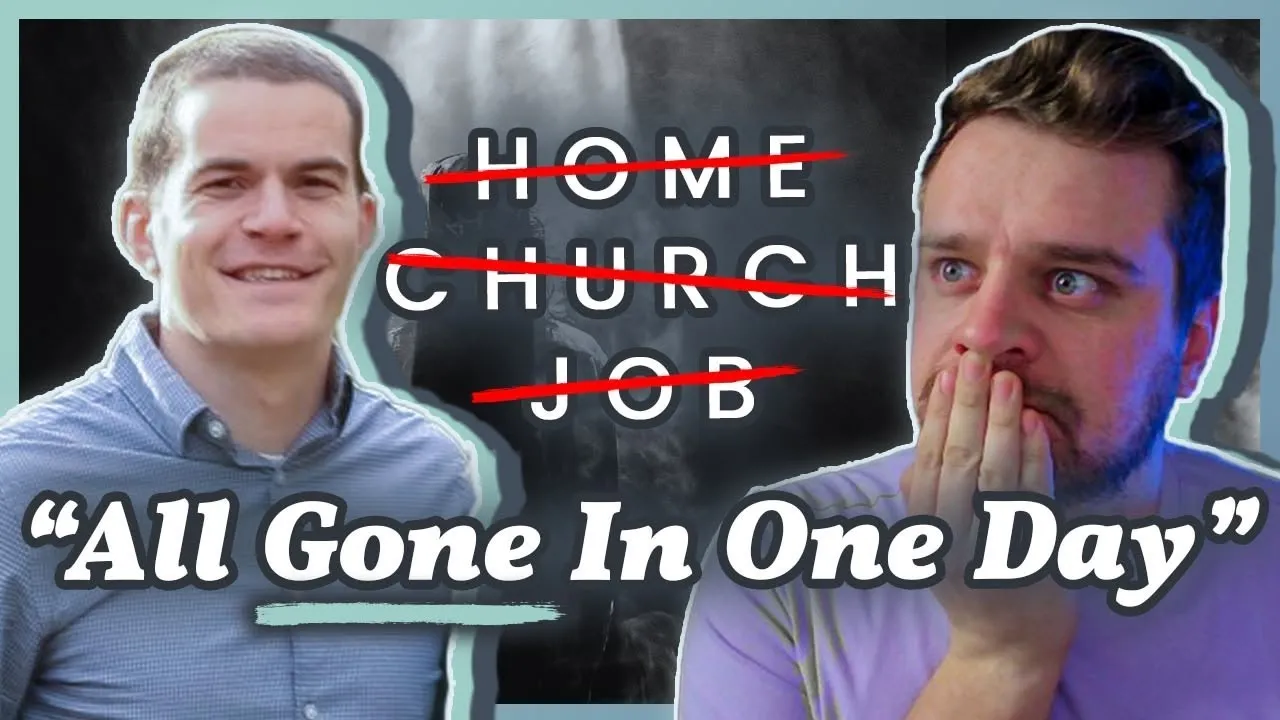
Healing After Church Hurt – What Josh Learned When He Lost Everything in 2 Weeks
Josh Ham lost his job, home, and church community in two weeks. Here's what he learned about healing.
By Tim Barber··Video·Updated
Chapters
- 0:00Introduction: A Story of Church Hurt
- 1:47Josh's Journey: From Ministry to Exile
- 3:31Rediscovering Faith and Community
- 7:10Navigating Doctrinal Differences
- 32:04The Mark of a Skilled Teacher
- 34:21Understanding Church Hurt vs. The Church
- 37:38Finding a New Church Community
- 43:28Healthy vs. Unhealthy Conflict
- 1:07:23Addressing Unbiblical Behavior
- 1:08:18Processing Ongoing Impact
- 1:10:35Healing Through Community
- 1:25:56Eternal Hope and Restoration
When the Church Becomes the Source of Pain
What happens when the very place meant to be a refuge becomes a source of deep wounds? It’s a question too many believers face—and one my friend Josh Ham knows intimately.
In our latest conversation, Josh shares his journey through one of the most devastating seasons of his life. In just two weeks, he lost his pastoral position, his home in the church parsonage, and his entire church community—all over doctrinal disagreements on secondary issues.
The Brutal Reality of Institutional Problems
Here’s what most people miss about “church hurt”: it’s not hurt from the Church—the body of Christ, God’s people. It’s hurt that happens within institutional church settings when organizations, buildings, events, or movements get prioritized over people.
Josh and I dive deep into this crucial distinction. When institutional priorities eclipse care for actual human beings—image-bearers whom Jesus died to rescue—that’s when damage occurs.
We experienced similar patterns in our own stories: doctrinal disagreements handled without grace, people misrepresented behind closed doors, relationships severed without conversation, and character assassinations that happened after we’d already left.
Biblical Terms Matter: Heresy vs. False Teaching
One of the most important parts of our conversation explores what Scripture actually means by terms like “heretic” and “false teacher.”
The Greek word hairesis (heresy) isn’t primarily about wrong belief—it’s about divisive behavior. You can hold correct doctrine in a heretical way if you’re using it to fragment the body of Christ over non-essential issues.
False teaching is different. It’s not just any teaching that’s incorrect (we all get things wrong). A false teacher in the biblical sense is someone who teaches falsehood with false motives—seeking self-aggrandizement, leading people away from Christ, denying core truths about Jesus.
This matters because many of us have been called heretics or false teachers simply for disagreeing on eschatology, Calvinism, or other secondary doctrines. That’s not what Scripture means by these terms.
How God’s People Showed Up
The most beautiful part of Josh’s story—and mine—is how the actual Church responded.
When Josh lost everything, believers he barely knew opened their homes. A retired pastor and his wife gave Josh’s family a place to live rent-free for months. Friends from other churches wrapped their arms around them. People showed up with meals, encouragement, and tangible support.
This is the ekklesia—God’s covenant people—functioning as they should. Not an institution protecting its brand, but a body caring for its injured members.
Finding Healthy Church Community Again
Both Josh and I eventually found new church communities characterized by:
Plurality of leadership – Multiple elders who actually disagree with each other on secondary issues but still co-labor for the gospel. No one-man show. No consolidation of power that creates opportunities for abuse.
Genuine community focus – Where spiritual formation and authentic relationships matter more than attendance metrics or giving reports. Where people know each other’s names and show up when someone loses a job or gets sick.
Freedom to ask questions – Where honest wrestling with Scripture is welcomed, not feared. Where you can think differently without being labeled dangerous.
Love that transcends doctrine – Where believers understand that what unites us in Christ is far greater than where we differ on Revelation’s timeline or Reformed theology.
The Eternal Hope That Changes Everything
Here’s what brings me the most joy when I think about those broken relationships from our old church communities:
If those people are genuinely under the blood of Christ—if they’ve accepted the rescue that comes from trusting Jesus—then I will see them again in the age to come. Every broken relationship will be restored. Every misunderstanding will be cleared up. Every false accusation will be set right.
The Day of the Lord isn’t just about judgment—it’s about God putting all things to rights. That includes relationships torn apart by institutional failures, gossip, and misplaced priorities.
Whether I dream about those dear friends three times a week for the rest of my life and never see them again on this side, I can celebrate now—in advance—their restoration and healing. Because I believe I’ll have eternity with them.
What We Can Learn
If you’ve experienced church hurt, here’s what Josh and I want you to know:
- Distinguish between institutional problems and the actual Church. God’s people are still beautiful, even when organizations fail.
- Healing requires both rest and exercise. Like a strained muscle, you need time away from heavy loads, but also gentle movement to regain full strength. Find safe people to be honest with about where you are doctrinally and emotionally.
- Look for healthy conflict. Good church communities have disagreements handled with love, where questions are welcome and grace abounds even in differences.
- Hold onto eternal perspective. This isn’t minimizing present pain—it’s recognizing that millions of years into the age to come, this season will be a distant memory, and all relationships in Christ will be whole.
- Don’t stay isolated. You need to be grafted into a healthy part of the body. The Church isn’t optional for the Christian life—but finding the right local expression may take time and wisdom.
Watch the Full Conversation
This written summary only scratches the surface of our hour-and-a-half conversation. Josh and I go much deeper into:
- Navigating doctrinal differences without creating division
- What makes a “church called tov” (using Scot McKnight’s framework)
- How to identify red flags versus green flags in church communities
- Specific biblical passages that brought hope in dark seasons
- Why teaching people how to think matters more than telling them what to think
Watch the full video to hear Josh’s complete story and discover hope for your own journey through or beyond church hurt.
Transcript
[0:00] Imagine giving your entire life over to a church community. The late nights, the sermons, the friendships that even feel like family, only to be told 2 weeks later, "Resign or we're going to fire you." That's what happened to my friend Josh Ham. There was no scandal, no sin, just disagreement over doctrine. And in a matter of days, his ministry, his home, and his community were all gone. But God was good to Josh. And that's not where his story ends. The thing is that most people think that when they're being hurt by a church, they've been hurt by the church. But what if those aren't the same thing? What if church hurt isn't a wound necessarily from the body of Christ, but a wound from an institution that claimed his name? Whatever you think of institutional church or anything like that, there has to be a difference there. Because if we're hurt by one thing, but then we get rid of the community of Jesus because we
[0:48] don't feel safe, it's going to shipwreck our faith and we're going to make a huge error. So for Josh and me, that distinction was life-saving. Because when something goes on in the nonprofit or the Sunday event or the system itself breaks your heart, you start to realize the church isn't a building or a brand. It's the people of God scattered and alive, still capable of love even when the structure fails. Both of us know what that exile feels like. One day we were leading worship or preaching from the stage or teaching youth and the next you're told you're dangerous, divisive, even a heretic and maybe even compared with the devil like I was. And then suddenly you're out. And in the silence that followed, God rebuilt something deeper in both of us. Deeper than a position, deeper than a platform. He rebuilt us. God teaches you to love his people again. Even the ones who wounded you. He gives you new family, new calling, and new eyes to see that what
[1:36] looked like rejection was really redirection. This is a story about how grace meets us in the aftermath and how you can find life again on the other side of church hurt. And ultimately, that's what this conversation with Josh is about. He was with us last year and what took place in this video that we talk about happened only a few weeks after we hit publish on that video. But this episode is about rediscovering that the real eklesia and learning how to trust Jesus again even when you can't trust the place that said it represented him. It's about what happens when faith and belonging collide. What it looks like to lose almost everything in the name of conviction. and how God somehow shows up in the rubble to start rebuilding a life that's as honest, as grounded, and somehow as alive as it can possibly be by his grace. I was so grateful for his willingness to come back on and have this conversation with me. It was deeply lifegiving for me, and
[2:24] I think it'll be deeply life-giving for you as well. >> Well, hey Josh, good to have you on the program, man. It's been a it's been a year. >> It's good to see you. It's been been a little while. Obviously, we've connected uh several times over this year, but it's it's fun to be back within your channel on a topic that's uh near and dear to both our hearts. So, looking forward to this. >> Yeah. Yeah. 1,000%. Yeah. I've I've been thinking about it a lot. There are so many people that I've gotten connected with as a result of doing this YouTube thing, and I'm still just so grateful. um you were a big encouragement to me and you have been throughout the whole past year. Um being active in the Facebook group, sending me stuff, all the all the psych gifts and memes, like everything that's just uh it's a shot in the arm whenever I get to hear from
[3:11] Josh. But uh but it has literally been over a year since the first video we put together uh and and put out on my channel. That was last September. Uh and now here we are in uh by the time this goes live, probably sometime in mid-occtober. So, it has been a year. We've both been through a lot of interesting things since then, but you in particular uh had some pretty interesting turns and twists in your story. Um, and I think they were appropriate for what we were talking about then, and it's appropriate for what we're talking about now. What are what are some of the things that have taken place uh in your life and in your neck of the woods in the past year or so? >> Yeah. So, it's uh almost ironic that we were talking about healthy church and talking about how God was working in our life and ministry and then not too long later, I'm no longer at that ministry.
[4:01] And uh long story short, there was several other things happening um within the leadership at our church that I was working toward and trying to keep moving things in a healthy direction. We had come a long way on so many fronts. Um but there was some residual things that kind of come up that we were trying to navigate well. Um and certain people that were being treated unfairly even within our church because of what I would consider very very minor uh things. And it kind of hit me well if they're getting treated that way because of that I'm working through, you know, several other things. and how is that going to be received well or not? and wind up looking into some of our church documents and recognized certain things
[4:50] on paper um that I was supposed to hold due to the wording of our church documents um that I was in trouble and so came to the other leadership kind of poured my heart out of like here's a we want to be here but I can't lie and you know say I believe something that I don't at least not 100% as I'm required to and long story short two weeks later I was told to resign or they would terminate me and it was going to be a big mess and just through prayer and counsel. Um, we felt I needed to resign and not drag the church into all that, which was something I did not want to do. Um, and it was it was quite the the twoe process. Uh, for sure.
[5:41] >> Yeah. No, no kidding. And yeah, the timing is just absolutely wild on that. Uh I know that what we were what we were talking about was healthy church cultures and we wanted to we wanted to have that conversation from a place of man, what can we do in whatever church context we would call, right? Like if it's if it's if if you would be using the word church as like yeah the the 501c3 nonprofit that puts on the event that I show up to on a Sunday like I would have a different definition but we could still say like how do we have a healthy church context in that kind of way. we can still have that conversation, right? Um but it was uh and it's it's it's remains to be seen if this was healthy or unhealthy, right? Uh what what went on in in your world and what went on in my world, there's there's some differences there.
[6:28] Certainly, I think um from my understanding, you could correct me if I'm wrong, some of the things that they were wanting to know about or things that they were wanting to talk about was it was it was doctrinal stances on certain things, right? And so, we definitely don't want to be wishy-washy on doctrinal stances. Um, but there there might be some ways it could be taken too far. So, I had I had a similar experience a year and a half ago. Uh, and I've landed in a different spot now. But I I I mean, obviously, we you still love your old church community. We still think fondly about the place that we were uh a year and a half ago. Certainly, not one word will pass from our lips in in criticism of any individual specific person or bringing up any names or or anything like that or even the names of those ministries. That's not our goal here. But I think that what we're going to both try to do is we want to and and you can tell me if
[7:16] you're on board with this plan. We're trying to look into um how to handle church hurt in a healthy way. How to navigate church, you know, doctrinal things. What is what is the uh the what is the nonprofit doing? Is it valuable? What's valuable about it? All of those different pieces. And then how we navigate all of that well in relationship with the church, meaning the eklesia, the community of God's people, and if there's any hope for us in the in the midst of what are some pretty crazy times. >> Yeah, definitely. >> Does that sound about right? >> Wonderful. Um, so we've got a little bit of what happened immediately after uh we put out our video and you had your your crazy two week stretch there. Um, but a lot of time has passed since even then.
[8:05] So, what happened in the weeks and months that followed even that? >> So, the initial fallout, for lack of better word, was pretty quick. Um, I thought it could have at first be more amicable where I could even still try to help in that transition and just due to how things were handled, it was very clear that I wasn't wanted there believing what I believed and you know that was so different. Um, which really wasn't but and so we lived in the parsonage in the same parking lot as the church building. So obviously that was very difficult especially you know for my wife and kids of you know my kids are like why can't we go to church anymore you know trying to have that kind of conversation and trying to
[8:54] >> you you know there's only so much you can explain to yeah our oldest was you know five at the time >> and so and then obviously my wife very emotional so we're trying to leave in the morning to go visit just other friends um in the area before people are pulling into the parking lot just cuz it was awkward and and difficult difficult on that front. And so the next three or four weeks we we packed up and moved. Um at first we weren't sure where we were going to go. We were our backup plan was just to move in with my in-laws or my parents just so we could figure things out. Um and thankfully God in his goodness in the midst of those two weeks brought a dear man into our life who was a retired pastor who was a chaplain at the camp Christian camp in our area. I was actually having breakfast with him
[9:43] just to kind of get to know him better when all this was taking place and kind of like this is what I'm going through and he was just like huge support and comfort and encouragement through that and just in a very short period of time he's like hey you have a house you can stay in for as long as you need on one of their camp properties and basically got to be >> their neighbor with him and his wife for the next uh three or four months or so just to give us kind of a breather um while we were trying to figure out what to do where to know they had a small group at their house. So, we got to be a part of uh just with them. Um it was just incredible just because of some of the relationships that we lost very quickly. We're very much like grandparents to our kids um and our church. And now God brought another dear family to help us walk through that and
[10:32] kind of be there for family to give some stability. And then we had many other friends in the area that were huge help. other pastor friends and things like that that we got to go and visit a few different churches and just kind of uh just sit in the pews for a while which was very weird for a few weeks especially instead of you know preaching almost every week. Um it was very different on that front. I had the part-time job I was working I was able to keep working at they're just a huge huge blessing. My boss there is a Christian just so many people God used to just wrap their arms around us. some of them were probably more upset than us due to the the situation. Um, and it was just just really neat to see the body of Christ just just love on us um through that time. Um,
[11:22] >> yeah, man. That's wild. So, and and so, you know, most people when there's upheaval, uh, it might be, you know, we lose our church community or our job or our home. Certainly not necessarily all three at once, right? Uh so so for a little while there, all you guys had to cling to was God and one another >> and he came through. And that's deeply encoura obviously it's difficult. It's not something I would ever wish on anybody. But I can just say for me in my scenario like we've had a wild six months even uh in our in our family and things that have been going on in our world as as well. And so just I whenever I hear stories of God at work in other people's lives, it reminds me so much of uh of Jesus's words to the people that John the Baptist sent to go
[12:13] go ask him if he was the one to come or if they should expect another. And what Jesus doesn't say, there's two things he doesn't say. He doesn't say, "Uh, yeah, John, 100% I'm I'm the guy. How dare you, you know, doubt me. This is ridiculous. We were cousins for goodness sake." Uh, he doesn't say that. He also doesn't say 100% John, I'm going to come and bust down those prison bars and come get you out like you're you're you got the right guy. We're coming. Thanks for letting me know there's a problem. I got you. Right? He doesn't say that either. Um, what he says to the to the delegation, to the guys to get sent back to John the Baptist, his own cousin in prison about to be executed. What he says to him is, um, tell tell him what y'all see. that the the the blind are given their sight, that the lame walk, that the deaf receive their hearing. Uh
[13:00] and then as they're turning around to leave, he pauses them and says, "Oh, and blessed is anyone who doesn't stumble on account of me." You know, and so it's good to see God at work in the world. It's good to see figuratively speaking, you know, the maybe even literally speaking, uh blind receiving sight to see, you know, lame lame people being able to walk again. uh and in your case, you know, cataclysmic upheaval in life being met with the faithful among God's people coming alongside you guys as friends, even if there is still disagreement on doctrine or anything like that. Just the the loving disposition of God's people coming around you guys and and lifting y'all up and helping you to be born forward and moving moving forward and still having having what you need and having your
[13:48] needs met. That's just absolutely beautiful to me. So, praise God for all those people, too. >> Yeah. And it was really neat even within the church, how many were supportive of us and a lot of them were confused or why do you have to leave over this? And I was like, that's a great question. I that was not my decision. That was not what I was wanting to happen. Um, I got a few of them in trouble for continuing those questions, unfortunately, but it just the way it happened. Um, and that was probably the hardest to see of people I cared about that got caught in the middle that they, you know, shouldn't have had to be in the middle of anything. Um, but it was just the reality of the situation and just how things >> Yeah, I know that guilt very intimately.
[14:36] Unfortunately, we I I can kind of call back to some parallels in our own experience as well where, you know, we were we were under the impression this would have been Father's Day, I think, of last year back in June. And so, we were we were under the impression we had had many lengthy conversations around doctrinal differences and things like that. And uh I had laid out essentially my my plan for most of that time was to say I I all I always was very forthright very forthcoming around like hey you know I know that this is what we have in our statement of faith and I wasn't a pastor so it was a different role. I did have kind of like a highle frequent teaching ministry. I was one of the two or three people that was most involved in the teaching there and did a lot of music ministry a lot of teens ministry
[15:22] kids ministry stuff like that. We pinch hit in a bunch of different areas. Um, but I, you know, there was a there was always the the forthrightness to say like, hey, so this is the way that I'm seeing this thing. Now, that's not an issue for me. Most people I know disagree with me about that. So, like totally normal if that's not that's not something I promise I I promise will not teach from the pulpit ever. That's not something I'm going to give in private, you know, pastoral conversations. If a teen comes and asks me something, we're not going to talk about it in that way. um I'll give them, you know, a better answer that's going to be more, you know, allowing for there to still be unity even if we disagree on this thing. Um and the problem was that happened like six times. So then they're like, what does this guy what does this guy even believe, you know? >> Um but our transition out from from that period uh was great in while we were
[16:12] there. It was a lot of smiling and waving and and everything's going to be fine. We're going to miss you guys. Take care. uh until our last day. Our last day, you know, the rest of the community was not informed that we were leaving. Uh we had our whole father's day thing at the end. I was under the impression there was going to be a conversation had with the church as a whole, you know, saying like, "Hey, this the Barber family is leaving. This is going to be their last Sunday. You know, say bye to them and and shake hands." Um because that has happened that had happened with other families. It didn't happen with us and I was a little confused there. And then by that was Sunday night. By that Wednesday, there was a an emergency leadership meeting called where a lot of things were said about me and my my wife in particular that were just flatout untrue. Uh including that um I said I was the administrator of the of the
[17:00] church, which sounds a lot different in Spanish. Uh because I was the admin on the Facebook page. So they were like, "Look, proof is he's the he's the guy. He's saying he's the one calling the shots." Uh and he doesn't think most of you were saved and I was compared with the devil and all kinds of things like that. Um, so it was a it was a pretty wild a pretty wild time, but we had the same experience of the eklesia coming around us and and surrounding us with their arms and and bearing us up and praying for us and and being there as a as a fountain of encouragement. And it was difficult because we also got to see again for me the most painful thing was seeing my mother-in-law go through that and say you are not telling the truth about what happened with my son-in-law. Like I read the letter that
[17:48] he sent. I read all of this. I've been here. We we know where he stands on this. I heard the conversations we all had together about this or that thing and he you're misrepresenting him. And then they were no longer welcome there. And it was uh heartbreaking. I had a lot of people reaching out asking questions like what happened here? Uh and I'm like I can tell you my side. I can tell you my part of the story, but if you have any intention of staying, then it might be more wise for for you to not talk to me at all because I'm I'm now persona nongrada there. Uh but that was more heartbreaking than than anything that happened to us. We ended up being just fine and I think that you had a just fine story too which is coming. Um but that was hard too for sure. And especially when as a whole it was a lot of support but there's a few key people that
[18:36] >> over time we realized there was more under the surface that wasn't said initially you know you know you can always beat yourself up you know if you known certain things you might have handled it differently >> you know and the the very next Sunday after I left they literally showed a video basically of the official church's position and why it is the only view on esquetology And there's a few people who are not happy that that took place. Um I was just kind of like, you know, um and then things said to us or about us that we, you know, heard through the grape vine and the Hearthston are the ones people to us. One of my closest friends basically called me a heretic, false teacher and just it got ugly pretty quick and it was finally it's like you're not hearing me. you're not you're
[19:24] not representing what I'm actually saying to you. And eventually I was like, if you're gonna treat me this way, I'm not going to keep responding to it. Um when you're won't even pick up the phone to talk to me. You just want to keep blasting. And uh that was tough to see, you know, especially for my wife because she's >> she's a fighter and you know, wanted to fight on my behalf. And it's just like, you know, time hopefully will heal. And uh so >> yeah, >> and again, >> we'll touch on that later. Here's hoping. >> Um yeah, I man, there's there's a lot that I want to touch on there to be honest. There's a million different directions we could take it. Um but the the key thing kind of like the the the main inciting incident for us in our
[20:14] story was also you know a family with whom we were just absolutely like hearts knit together intertwined lives integrated like our kids were in each other's homes five days out of a week and that's not an exaggeration like we would watch their kiddos so that they could go on on date nights and we did the same thing. Uh, and then they had a Friday night, you know, Bible institute thing that they were doing to kind of like brush up on some doctrinal stuff. We'd watch their kids for that. And then, of course, on Sunday, we'd be together. And then after Sunday, probably, you know, good solid, nine times out of 10 on a Sunday afternoon, they'd come over to our house and we'd watch the Broncos game out here in Colorado. And so, um, that family was the family that just like flipped on us. There was a there was a difficult
[21:00] conflict situation that we tried to handle. uh they made it clear they didn't want me in particular uh involved in any way in the kind of counseling capacity. Uh and that was when the first like inklings that there was some sus there was some suspicion on their part about my doctrine came out where they they had sort of slowly been apparently developing the conviction that I was not fit to teach. I was not fit to uh to give any kind of counsel or anything like that. And maybe I'm not even a trustworthy person was kind of the the tone and timber that it took. Like my character was in question there. Um and then I don't know how to say it other than a a lot of lies were told. A lot of things were were constructed out of whole cloth. Um a lot of like misrepresentations of our stances or even our our my relationship with my
[21:49] wife. We were said, Liv said that we had like an open marriage was one of the accusations that was being made and things like that and it's just like where in the heck did that come from? But it something in particular that you said um really stood out to me as something that I think people often miss the point here when it comes to two phrases, two biblical phrases. One of them is heretic or heresy and then the other one is false teacher. Right? So I also every other day am called a heretic and a false teacher. Just you know read my occasional YouTube comments or or things like that. Um but the I think that there's a problem. You can tell me if you've got the same understanding of what's going on in these terms. But when I read hyesis, the Greek word, right, hieresis, the the the word that we get
[22:37] heresy from or heretic from, it's not really about a false belief or like an aarent doctrine at all really. It's it's a it's a choice it seems to be divisive and to stand apart, right? Which is why seems like Pet I believe it's Peter can talk about the the false teachers who bring danable heresies into the church by their false teaching. It's as if they're separate things. It's like you're being you're being a divisive person who is chopping up the body of Christ and aortioning them out based on, you know, where you stand on X or X Y or Z doctrinal thing. And I think that that that was really interesting for me to go and study because it's like wow, you can have a you can have the right doctrine
[23:24] and be heretical about it. You can you can be so divisive even if you are correct if it's not a salvific doctrine because I agree we divide at the at the barrier where it is no longer this person is a is an actual follower of Jesus. But the things that make up that list are so few and so and so obviously central that we we need to look at those things and we'll talk about that in a minute too. Like you can have a doctrine that hey look got some good biblical warrant might be might be something that is true true other people disagree with you. They have their points too. Maybe yours is the best case that could be made. But you can have that correct doctrine in a way that is heretical because what you want to do with it is divide brothers and sisters who otherwise shouldn't be divided. >> Is that do you have the same understanding of that term or am I way
[24:11] off? And that's pretty much exactly what happened in in my situation where it was almost I think came across or at least they took it as I was trying to be divisive teach these other things and I was very clear in all the meetings and you know things I put together to give them like I'm trying to unite us you know I'm not trying to draw bold lines where it's not shouldn't be a bold line you know on churches have always disagreed on esquetology like this doesn't need to be a separation issue. for our church. Um, and it was those types of things and and I think that was frustrating because it was it was treated as we're not even going to talk about this cuz that was what I had thought was going to happen. They asked me to put things in paper and writing and I said, "Yeah, that's fine." You know, I I didn't even get into the weeds
[25:01] much. It was more kind of like sharing my heart of like these things don't have to be divisive. just thinking this was going to be the beginning of the conversation and then there was no conversation. I literally got it in a text. We disagree with everything you said. We're gonna discuss how you're gonna leave. That was how it was handled. And that was the probably the most frustrating part. It was like they would didn't even give me a chance to hear me out is how it felt, you know, on my end. And a lot of people kind of thought the same way, but there was a fear of, well, if you changed on these, what else are you going to change on? That was literally what was told to me. I was like, "Well, I'm going to follow whatever the Bible says." You know, I don't have it all figured out. I don't claim to have it all figured out. And it's like, "Well, you're in your 30s. You should have it all figured out by now." It's just like, "No one has it figured out. It's we're to be a learner,
[25:50] you know, and >> yeah, >> especially on, you know, very debated things, you know, of like I wasn't even saying we need to switch positions. It was we just don't need to have a hard position on this." You know, my esquetology is Jesus coming back. You know, do I have more thoughts on that? For sure. But that's that's that is the line of what I would consider heresy. >> What's to disagree about? Yeah. Yeah. Right. >> Exactly. >> So, yeah, >> man. Or or false teaching, right? Because maybe again, maybe it's that you have a heretical stance with correct doctrine. Now, you can have a heretical stance with false doctrine, too. But the hieresus is not necessarily describing the the truth or false claim of the doctrine held so much as it is the attitude and spirit with which it's held. But the false teaching is a different one because you can have a
[26:37] false teaching or false doctrine but not a false teacher. Right? So those are those are also unique where false teaching is any teaching that's false. Okay, that's wrap that up, tie it in a bow. That's great. We're fine there. Um, but that's not what is in view when a false teacher biblically speaking is in view. At least at least not it's not limited to that where you're also looking at this person's fruit and you're looking at this person's motives. What is this person doing with their teaching role? They're are they, you know, heaping up followers on themselves and not and not, you know, magnifying Christ, not pointing people in the direction of of Jesus. Are they denying something really actually central about Jesus that you know John might call uh an antichrist spirit or something like
[27:24] that? Is are they denying something about like his his coming in the flesh, his being God, his his his death being the way and the means that created, you know, rescue for us and his resurrection and then his coming back again. is are we denying something there or are we just saying well you know people understand Revelation 20 a little differently and they think the millennium part might be this they think it might be this right it's like there's a pretty so a false teacher is someone who teaches false things with false motives where they're wanting to like they're wanting to self arrandise they're wanting to pridefully lift themselves up even at other people's expense maybe there's a deception play there there's there's sinfulness hidden sinfulness of some kind or public sinfulness of some kind, >> right? Where that's that seems to me
[28:12] when I'm reading about false teachers and I get to uh, you know, I get to First John and I'm reading about, you know, in 1 John 4 where he says, you know, beloved, do not believe every spirit, but test the spirits to see whether they're from God. For many false prophets have gone out into the world. By this you will know the spirit of God, that every spirit that confesses that Jesus Christ has come in the flesh is from God, and every spirit that does not confess Jesus is not from God. It's like that's a pretty narrow, you know, narrowly defined stretch of things that might make a false prophet or a false teacher. Again, it's like, so maybe our doctrine in some ways is wrong. I don't think any of us has it 100% right. So, are we all are we all false teachers? Are we all false false prophets? or or or is there a is there a more strict standard as far as what counts as this
[29:00] person this is a believer this is not a believer this is a a false teacher this is not a false teacher this is a heretic this is not a heretic >> and I could have gone stealth Calvinist mode and like not said anything and that I understand the temptation now you know um but once I realized the letter of the law according to our documents I couldn't not say something and I think maybe that's why they perhaps took it wrongly because they felt, oh, you were working through this. You never told us and you just came out of nowhere. And I was like, why? I didn't say anything because I was still working through it one, but also knew that the church wasn't ready for those conversations. It just it forced my hand once I realized how explicit that it was of what I had to hold as the pastor. And I just couldn't I told him I was like, I just
[29:49] can't lie. And they even said, well, if you you can keep those things yourself personally as long as you don't preach differently from the pulpit. I'm like, well, I can't do that. Um, and again, if I come this past say, some people see it this way and this way. Here's how you And I had done that with other things. It wasn't like that was a new thing either, >> but it just that's what happened and how it was taken. But >> yeah, that that that skill in particular uh is is one of the things I I admire most in someone who is a teacher. Uh because you know there's always the I would I would call it a temptation, others might call it a strategy, but there's the the the temptation to tell people what to think. Uh because you're just that confident you've got it right. Uh and on some
[30:37] things again, >> Jesus coming in the flesh. >> I'm I'm going to say that one confidently. uh Jesus dying and then being buried in a in a tomb of Joseph of Arya and then rising again on the third day and then ascending up to heaven where he now reigns from the right hand of God the Father and will forever and ever before he and and then he'll return. Like those are things I'm going to confidently say yes, this is what you should think, but here's why. Here's the evidence for why. But but the there's so often not that same effort given in teaching people how to think especially about disputed things where it's like the church has been arguing about this. The people of God have been you know in disagreement on this with scripture as their guide. Everybody who has this has
[31:25] their biblical case that they make. I think the millennium is a good example. Um or esquetology is a good example. doesn't no view arises self-evidently from the text that has a full systematic clearly spelled out every view has its warts its problem verses and this is one of those things that I admire about for you know men like Steve Greg or or Tim Mackey as teachers where Steve Greg wrote a book on four views of revelation and half the reviews on the Amazon page for the book say this is a great book I have no idea which view is the authors he just tried to lay everything out so objectively it's so clearly and he just wants to leave it for you to decide. And it's like I feel like I feel personally as though that's a mark of a skilled teacher of a good teacher who wants to teach you how to think and how to parse the the the different aspects behind
[32:14] which view you're going to land on and can show you how prior commitments over here might lead you to think about this this in this way over here and how how to kind of navigate that rather than just being sort of dogmatically cramming it down. That's a person who at least is not going to be heretical in that way with with their views. They're not going to be divisive. They're going to be willing to accept on non-essentials. They're going to be able to give the charity to be able to say people people differ. Good men differ. >> And I was one I was thinking of Steve Greg as you were talking about that. >> Um but it was, you know, it was very much of a fear thing. At least that's what it seemed like of it's easier to put things in a neatly packaged box a pre pre-programmed here's what you think on all the things. Um and again to some
[33:03] extent you do need some parameter you know whether it's nice and creative whatever you want that gives you know here's the core essentials. Um but yeah, the how to think that's that's totally changed my life of the last few years of relearning how to think. Um and it's been lifealtering, but it is scary because then it's you have to apply that to everything. And um you know was the old saying, a truth that can't be tested can't be trusted. And that's a scary thing to do if you've believed something your whole life. And it's easier to say I'm not even going to open that box because that's don't know what's going to happen when I do that. And for me is just I'm not going to be afraid to do that wherever that looks like, whatever
[33:51] that takes me. And and I understand why a lot of individual churches struggle with that because of the it takes the right person to lead through that. if you've only been in a certain kind of box. Um, and I was hoping and wanting to to continue that journey uh there. Um, but it didn't happen. And uh, but again, God is good to us. So, >> yeah. Right. Well, and so, you know, I I want to I want to get into um the the concept a little bit of like church hurt, which for me, church hurt um because I don't think of the church as the nonprofit. And again, there's disagreement here. I've got dear friends
[34:38] who are Orthodox who think I'm crazy, uh whenever I say this, uh including people who are very active in my my Facebook community, and I I love them to dear I love them to absolute pieces. Um >> yeah, love you Amber. Um anyway, like so things like this where it's like I the church in in my view isn't a institution. It's not a 501c3 nonprofit here in the United States. It's not the event you go to on a Sunday. It's not the, you know, the place that you go to the building. It's not um a movement even. It's not any of those things. Um, the church might make use of some of those things, but the church is God's people in in the world wherever they may be found. There's the universal church is the concept we have from scripture where there's the church and you're
[35:27] talking about all people who form Christ's body everywhere on earth. And I would even say my Catholic friends have an argument that the ones who have passed away might be included in that uh might be included in that number still as a participating group. There's some some disagreement there, but they have a case to make at the very least. But if that's the if that's the actual church, that's the eklesia. I think of church hurt as mostly being the stuff that is done by the eklesia because of one of these other views of what the church is where it something comes up that that the institution needs to have done or that the institution thinks is important or that is important to the nonprofit for the nonprofit's reasons over and against what's good for the people and what's good for the community of followers there. uh or something happens
[36:16] where there's a big event that needs to happen on a Sunday, maybe there's a conference or there's, you know, something going on and and there's extra stress put on that event and then there's all these demands from the people to be able to pull that event off and something happens that causes an injury to a part of the body. Right? So, I kind of think of church hurt that way. That's been my working definition for a while. And that's why the eklesia, God's people, can be so and are and must be so centrally important to helping kind of navigate and heal after that. And your story told that beautifully. So if we can just kind of grant you can push back and redefine however you'd like but like if we start from that idea of church hurt like in your case there was it sounded like an impulse on the part of
[37:05] other people who were in leadership to protect what they thought was core to the functioning of that local assembly and that you know nonprofit with its statement of faith that it was going to be uncompromising about this in a way that caused harm to a member of the body and then gave another opportunity for other people in the body to come around and minister to that that piece of of that that part of the body of Christ, that member of the body of Christ. Do does that way of thinking through it make sense? Because that that helped me a lot when navigating church hurt for us. >> For sure. And it was interesting because that was the first time in mine and my wife's life that we were functionally church homeless. And cuz I grew up in church and even if I was transitioning, I was heading somewhere, you know, in
[37:52] our life for ministry. And so it was the first time we woke up on a Sunday and we're like, >> we don't have a specific entity that we are attached to. Um, and it felt very weird. Um, and in in one sense it was a little bit freeing just because we we could go and visit our friends at churches, things like that. Uh but it was very quickly immediately like for our family it's like we needed some semi grounding. So we visited a few but our one friend's church we went to the most just kind of as a home base we had several friends there and stuff like that. Um but yeah it was it was just interesting to walk through that season and God brought people into our lives to fill that role in different ways. um like the the dear couple that helped us
[38:42] with the housing and that you know we part of their small group like that in a sense was kind of our church during that time that community um and it was interesting >> and gave me a lot of insight of other people who walked through that um like I've had uh family who have gone through seasons where you know looking for that home you know as we think of it that way that specific Not the bill as we know. It's not the building. >> That branch of the family tree. Yeah. That branch of the family tree because that's where we ended up too. We we were we went through this whole thing. And what was the most jarring I didn't care about going to the building or not. I didn't care about, you know, being able to be in that place or stand in a piece of property owned by that nonprofit. That didn't matter to me at all. I was
[39:30] jarred by my my sudden disconnection and and lack of family relational harmony with a group of people that we'd really grown to love. >> And that was the that was the hardest part. Um, you know, I could I could give or take a lot of what happened on a Sunday. I you know, you study enough at some point you're not necessarily going to be learning anything new. You might be exhorted to take seriously what you already know from a message, but you're not likely to learn much new after a certain period of of study. Um, and that's still the case for me, even though I I really love uh hearing the word of God taught and and and preached. I do enjoy that so deeply. But like that was the jarring part. And so we were in we were in a similar boat during our walk through this whole unfortunate process where um I I definitely got to
[40:20] sort of the the most toxically I'd ever held my view of what the church is to where I uttered I'll never forget I was in the middle of my living room and I uttered the sentence, I am never setting foot in an institutional church ever again. And that was my that was my response to our experience there. Uh, and the the two people that were in the room with me at the time when I uttered that were my my wife Marimar and my best friend Nate. And we were just all sitting together and Marim just said like ba basically never say never, Tim. Like if God called us to do that, we would obviously do that. If God invited us into that and it was clear that his hand was at work, we would do that. And I said I had to say you're right. Like it's just how I'm feeling right now. It's how I'm feeling. I don't ever want to step in foot in
[41:07] another one of those places again. Um, and I was laying out my plan, which my plan was I'm going to lean on the eklesia, which I still, you know, I'm thinking about this this way. I feel this I feel this way. I was like, I I you know, we have so many friends that we we would be able to like do life with and we want to we want to be invested in one another's lives and helping one another grow and and I know that person I view that person as an elder. I think I I have skills that I can bring. I have I have a gifting that I've been given that I can bring to bear in intimate kind of like interpersonal relationship with these people and we can all move forward and as a community of people where we're actually one anothering one another and we can bring each other meals when somebody gets sick or you know get cover someone's rent if something goes wrong with them and they they need help and they need a community to come around them. Um and I was I was
[41:56] walking through that whole thing and I still feel that way. I still think whenever I'm doing those things, whenever we're in relationship with each other, those are the things where the church is at work. God is at work in the church. Wherever two or three are gathered in his name, even though that's a discipline passage, it's still true in other contexts. God is there with his people. Um, but my friend Nate just says, "Well, you know, you know where you would have a real easy time finding a whole bunch of those people on a on a on a random weekday." you know, it's like as if you went to one of those places on a Sunday, you'd get to know so many people. And they were both 100% right. And we we also were, you know, we're like, "Okay, fine. You're right. I I want to reapproach this entering into kind of an institutional context with a healthy understanding that that thing
[42:44] isn't the church, but the people here are. how can I find more people to love, more people to to get into contact with and and grow to get to know and find ways to help out that community and all those things. That ended up being what what happened. And we had kind of a a speed bump along the way where we stopped off at a church where there was some stealth cal Calvinism going on. And uh I sniffed it out and I was like, "Nah, nope. Nope. Not nope. That's going to be a problem. I'm debating James White in a month. That's not going to not going to go." Um, so we we ended up going from there, but we've been with our same church community now for a year and and some change year and almost uh almost a year and a half now. And it's been completely the other direction. So, we'll kind of that's where we've landed and then we can even unpack where we've landed. But there's a part of your story that we haven't gotten to yet, which is
[43:32] the like after the you're living in the the home. There's this this the small group with the this awesome couple and you guys are neighbors and you're in each other's lives and the eklesia from all kinds of different sources has come around you guys and lifted you up and supported you. What happened after that? And tying into that, I I had the opposite initial reaction as you where for me it was we were so close to like having that where we were at like if we had just got through this work through this doctor stuff like I think we would have been set like that community was there um doing all those things. Um, and so it's like I want to find that as soon as I can, even pastorally. Um, and it didn't lessen my desire for ministry at
[44:22] all. It, if anything, it fueled it because of, okay, now I know what I'm looking for um, much more than I ever had before. And one book that was super helpful that my friend recommended is a church called Tove by Scott Mcnite. And that book was so helpful of finding and you know what is a healthy church culture look like and whatever form that is um whatever denomination or what you know it's what is the culture there and how to um find that and so I was working through all that and trying to figure out okay what am I going to do from here you know vocationally with this and have stability for our family and long story short. I had gotten reconnected with a friend of mine from undergrad who had his own journey because of the
[45:11] background I was in. Um we both kind of had separate journeys away from some of that and he had we just somehow got in touch and just kind of sharing stories and he was just kind of just a good sounding board uh with that several close mutual friends that kind of connected us and they were looking they needed more help at a church staff-wise and he's like would you be interested and I was like at this point everything so we have no idea >> what's going to happen like this is all like within a month or so of things happening and but just as I talked to him kind of heard what was going on there I was like well I want to go somewhere like that and uh it was just not geographically where we thought we would be um and just but it was like man something like that sounds great well
[45:58] fast forward two months you know nothing's happened I was getting frustrated I was trying to you know make things happen on my own you know putting resumes just all this stuff just trying to make it work finance like I need to stop and just, you know, spend more time praying and, you know, letting God open the right door at the right time. And we had a crazy two week stretch over Christmas. We're going down to see my family. We found out my mother-in-law had had a want of a seizure. Some big health stuff happened. A lot of things changed very quickly in a short amount of time. And but through that, my friend had reached back out and said, "Hey, where you guys at?" just the other guy we looked at hired fell through and just thought of you, you know, just throw it out there just hail Mary if you're interested. And
[46:46] we began to talk more and God just kind of put it all together. Uh just timing, logistics, just even just just the role fed even some of those doctrinal things that is at last church. He's like not that I would have to agree with you on all those things, but he's like I'm on the same page with you on all those things, specific things. And it was just like God just kind of confirmed everything. >> Um we were able to go just kind of visit for a little bit, just hang out with him and his wife. And then >> after just a day or so just doing that, my wife was like, "This is where we need to be." And I didn't think she was going to be excited about being part of a church for a while due to just how things happened. >> Yeah. >> And it was like >> understanding myself. >> It's like if she's in, I'm in. And God took care of all the details. And uh we
[47:36] came on in April here at church here in Georgia. And it's just been uh it's just been awesome. And obviously there's challenges every go and things we knew up front we were going to have to help work through. And uh but it was a team there just just some amazing people who have loved on our family so much from day one. Um and it's just it's just been what we needed. This is where we needed to be. um just to have stability or taking help come help take care of my mother-in-law uh my in-laws live with us you know just a lot of things came together uh that were not what we would have planned but God knew and and brought it all together and still figuring things out and obviously my wife is expecting again with baby number four which all happened through
[48:23] this and so that's coming up here in the next month or so so it's just >> it's been one thing after another and God has just >> been so good over and over again. Uh bringing the right people, the right opportunity, just everything just came together. As soon as I took my hands off and let him guide it, he did. So, >> it's shocking how that happens. I know we we were in the same boat where Yeah. As soon as we had that open-handed posture, really unbelievable, almost unbelievable things started to happen. Um and so so that's where you guys landed. And then there's also a piece of the story after that in our world again just kind of retreading that same part of the story. The two things that were most important to us when we started hate the phrase church shopping was not at all how I think about it. Um, the two
[49:13] things that were really really important to us as we were going out as kind of like a minimum basic non-negotiables for whether we're going to be able to coexist in this space helpfully or whether I'm going to continue to have to, you know, write letters of saying like, well, look, we don't agree with this, we don't agree with this, and and all that. Like, what can we look at as these are the things that are likely to set us up for success in the future um to where we can be there. we're not going to cause them any problems and and they're not going to, you know, we're not going to wear out our welcome. They're going to want to get rid of us or or something like that. What do we need to have in place? Um, aside from the basics of like they believe as a principle on a principled level that the Bible is God's word and it's the source of truth and um the Bible is how we ascertain truth. It's how we find the
[50:01] right path forward. Uh it's it's the uh the you know the the sources. It's the way that we uh figure out what doctrine comes from God himself and it's the source of it's you know all that stuff and obviously central truths about Jesus is God and all this stuff. There was no we're not going to be wishy-washy on those things because I do think those are the non-negotiables. But as far as like stepping into a stepping into a new community um where things are done a certain way uh what were the things that we needed to see in order for us to feel confident that we'd be able to be there? Well, there were two main things. Number one was we wanted to see a plurality of elders, ideally a plurality of elders where they disagreed with each other on things. Uh and so we had been just in a scenario where there was a lot of abuse and I think of you know abuse and
[50:51] toxicity and power as kind of the when you're talking about a church called to that's a lot of what they have kind of in the crosshairs that they're trying to help deal with is the way that things can go wrong when power is consolidated into the hands of one or two or a few people and what sorts of abuses and and destructive behaviors can come from that. I did a whole video on this comparing it to the one ring. Um having that power in hand, how dangerous that is as a temptation. Um but but especially one where they're not all of one mind on these are the non-negotiables, we have to view things this way. like if if they're amongst themselves able to co-labor and able to be together and work together for the good of the gospel, for the progress of the gospel, um while disagreeing on esquetology, while disagreeing on this
[51:42] or that secondary thing that was super important to us, I can almost like in retrospect I can almost not believe how much of that is present in the community we've landed in now. um where one of the guys is a one of the guys leading is a Calvinist uh and another one is decidedly not a Calvinist like a very very much just we'll call it not Calvinist. He's he's uh he's a fan a fan of like Leighton Flowers and his work and um watched my debate and said yeah I think you made a lot of really good points whether he agrees with my ultimate stance on like open theism or not. Um but they all know about all my stances. What I what I did was maybe a little weird but I came in and just said this is where I'm at. I'm gonna lay my cards out on the table. Um, we are not going to be weird about this. This is where we've come from. These are some of the things that I believe. Um, I
[52:30] completely respect when people disagree with me about that. Most of my friends do. You know, I I see things this way, this way, and this way. I'm never going to make that an issue. I'm not looking even to have like any kind of a teaching presence here. That is not necessarily even our goal. We want to get to know other people who genuinely love Jesus and be in just community with them and do things like take each other food when someone loses a job or gets sick. Like that's that's our goal which was the second thing which was honest to god community focus where it's it's not just not everything is revolving around having people in the pews on a Sunday as the northstar metric or having having uh a a major giving budget that came in for this or that day where we're trying like the the the things the KPIs that we as an organization are moving forward are
[53:17] this or that thing. Um it was man how many people in here are like what percentage of our people are actually actively being more formed into the image of Jesus in the world and are we being a light in our community? Are we being a a city on a hill? Um and are we growing together more because you know love is the way that the world outside is going to know that we belong to Jesus and that he is who he says he is and that we're his disciples. It was like, if we can get on the same page about, yeah, there's there's more than one guy in charge. They tend to disagree about things and they still love each other and we're actually trying to like have relationships with each other and that's a main goal. It was like we were going to be h we were going to be able to find a place that had those things, we were going to be over the over the over the moon about it. And I was, you know, I reached out to one of the guys who led
[54:06] one of the small groups in our uh in our community uh at at the church community out here. And he kind of coordinated me getting together and grabbing uh grabbing some coffee with one of the guys who is in the small group. And I again maybe a little forward and awkward about like, hey, this is where I'm at on these things. Um and he was like, yeah, sounds like that was probably a pretty difficult season for you guys to navigate. I could see why you'd be hoping for that. Um, you know, this place might be the right this this might be the right community for you. And we've just been feels like we've been there for 10 years now because of where we're at now, you know. >> Um, so we we even did things like last night we had a instead of doing our normal small group stuff on a Wednesday, last night we had a like a whole gospel presentation thing that was going to be a a thing you could invite people to.
[54:53] And they asked me if I would be one of the uh like question discussion group leaders and I'm like, "Yes, absolutely. I love discussing things. So, um, we're just over overjoyed. I go back there every every month, uh, on Sunday mornings and make about a hundred lattes because I, you know, we have a whole thing where we make people coffee in the mornings as a as a hospitality thing that we do and it's just, it's awesome. It's a very different environment and we're thrilled to be there. So, that's where I'm caught up to even today. There there is I feel like I found a church you could say is is a church called TOE where it is good in that way. there is not that abuse and there's checks in place to prevent it from happening because the the the men know that they're fallible and we don't want to have consolidation of power and one monolithic vision crammed down and make
[55:41] everybody follow and obey and it just led to so many difficulties for us and they were like yeah we don't we don't want that. So you guys landed in a community where you guys are now contributing again and the point that you said where it's like I like it's not that I have to be on on the same page with you about these things but I am on the same page with you about these things. That's super refreshing and it sounds like you guys have had kind of a similar a similar landing spot. >> Yeah. And there's other people who are key people who don't see eye to eye on all those things. In fact we have a >> awesome guy in our church. He's a retired pastor. He helps out with like the older the older folks group and uh we we cut up together every time they have their monthly lunch and he always get he's like I'm dispensational but your
[56:28] pastor's covenant theology we give each other a hard time and and and it's just like it's normal that who cares if we disagree on this and it's not something we have to avoid either you know he jokes about it all the time you know just to poke fun and uh but the what unites us is way more than that and it's been so awesome to to see that heart with so many people here you know when you're seeing just coming in for the first time and like oh here's this person over here they just became follow of Jesus they just got baptized you know a month ago and here's what God is doing in their life and that's multiple multiple people where that's happening we just had a guy this last Sunday who just got baptized who had been coming for a while connected through our basketball outreach that we do and he's like he told pastor he's He's like, "I've never been around Christians who I
[57:16] didn't feel like were judging me is basically what he said, that idea." And he was just like, "When you have a place where that's happening, it's so life-giving." And it so many people in our church, that's what drew them to our church. And we have a good friend of ours, one of our former teens from years ago at our first ministry who is moving here to to be a part of our church community. and he's like coming from a a place where he's there's been some struggles and he's like I want to go to a place like that and this is and it's just been really cool to see God um work even as you know there's always challenges there's always things especially you know we have property and facility you know to keep up which is a blessing and curse you know it's there we can use it for things but it's also you know it doesn't pay for itself
[58:02] either um and just overseeing some of that um >> but it's It's just been awesome where the the heart of the people from the top down is this what we're here to reach people to be a light. Um and it's it's just been fun to be a part of and to breathe that air again and to and to contribute again, you know, and to bring our experiences, you know, where I'm not just another person. It's hey, I'm part of the team. I'm part of what's going on here and valued. Uh and that's that's been awesome for sure. So >> yeah, praise God for that, man. And and like my my more the more extreme expression of my views, which I think is still accurate that I hold it, but like
[58:49] how hard do I hold this view? How strident am I about this view is like it's softened a little bit in this in this environment where I'm like, look, I know the building isn't the church. I could tell you all the reasons why I don't think the building is the church. >> But having a building and ours has paid off and we're really grateful for that. But like >> having a building that this community can use for things does present some really neat opportunities for us to be hospitable in a unique way to a larger group of people. It allows us to have, you know, more kind of interesting opportunities. We we run a a resource center for, you know, people who are under underprivileged communities who don't have as much. And you know, we run a donation center and we have people in there who can speak both English and Spanish to kind of navigate because there's a lot of people in our area who who are primarily Spanish speaking who are on the lower income side of things
[59:38] that need some help. And it's like that's a unique opportunity we have because we have a building where before I might have said like but we really ought to find a way to just do that with just like the people getting together somehow and doing it. It's like okay yes but we we have a building and we can use it for that or um even you know like a sermon. It's like I don't think I don't think that this has any I don't see any in the New Testament any like captive teaching to the same audience every week. I see you know most of the sermons seem to be kind of impromptu public proclamation in front of unbelievers right Peter stands up on a roof on the day of Pentecost and delivers this thing that's your paricopy in your Bible says Peter's sermon and it's like okay but it's not like to the the church but teaching happens and teaching is dialogue. Teaching happens in a bunch of different ways. But hey, if there's a
[1:00:25] teaching conference where we're going to go through Philippians and that's like what the event is on a Sunday, I think of it like a teaching conference that has like a little concert before that. Um that's not something that the church shouldn't do or couldn't do. It's just it's something that's still beneficial. Um, as long as we're not forgetting the main things, which is >> life as people who want to, you know, who desire to be more and closer followers of Jesus being ever more transformed into his image as a community as a witness to the world around us that Jesus is who he says he is, so that they see our love for him and for one another, and they want a part of it. Yes. >> Um, and I feel really grateful to be able to say that that's where we've landed. Um, it sounds like you're in a similar boat. >> So, The key thing for me is like again we
[1:01:12] there was the the whole finding eklesia in church hurt and then finding a church culture a church community where it's it's not set up with the the things that allow for the one ring to tempt people to to be able to consolidate power and then cram down a vision for how things are going to go. Uh, I'm not even saying that that's exactly what was happening in our old church communities because again, I love those. I love the people that I was connected with. I know you love the people you were connected with, too. But, um, there's there's sort of like a healthy version of conflict, especially when there's doctrinal disagreements and things like that, and there's an unhealthy version. Um, and as far as I'm concerned, a lot of the unhealthy stuff is the stuff that misses the point of the fact that you're talking to another human being who's either a believer and therefore your
[1:02:00] brother in another part of the body that you exist as as a vital part of someone that Jesus especially loves that he died for that he he died to rescue that is currently a citizen of his kingdom or even if not that nevertheless an image bearer that God loves and wants to rescue. Right? Like if we lose sight of the fact that anytime we're in a disagreement with a person, a human being that has inherent dignity and worth in favor of prioritizing something else because I've got this event that needs to go on or I've got this movement that views this as like the non-negotiables. These are the mission critical things we think the the Christ followers need to have or we have this event or we have this building or we have this nonprofit or this institution. Like if we're prioritizing those things, that's when people get hurt. But like what are some things that you would say have looked like healthy conflict? Because I've certainly had conflict
[1:02:47] since we've come come into this new community. But if the the tone of it, the feel of it is so much different because the disagreement is still met with love. But like what are what are some things you would say make unhealthy conflict and what are some things that you think make for healthy conflict or good conflict that leads to people growing in Christ together? >> Yeah, I think a huge thing for me is learning how to ask questions. you know, if you're in a place where you're not allowed to ask questions or there's certain questions you're not allowed to ask, you know, that that's a big red flag. Um, even if even if it's something like, well, who is Jesus? Is he really God? Like, I'm glad somebody asked that question because I have an answer for that. Um, hopefully if you don't have an answer for that, that's a different problem. Um but the all the questions are are welcome for people who are seeking and I think that's be especially
[1:03:38] as you know in a leadership role whatever that looks like even just as a father um and a husband I I want those questions to come and to have that open dialogue where people feel like they can ask questions about anything and there's not going to be a judgment there's not going to be shame of feeling less than or you know to whatever it's having that that continued open door and then on like the leadership side you know as we're figuring things out we're planning things or trying to navigate difficult situations is we're doing this together. It's not like you said it's not one agenda. It's here's an idea. What do you think? Um you know we're trying to was something we had in our last meeting. It
[1:04:28] was a it was a good thing, a potential opportunity, and it was something that like, man, this would be great, but it's, you know, we're able to share like this just not the right time. We're not ready for this. And everyone's like, oh, yeah. And we're able to to talk through that. And I think a lot of that comes from a leaders or leaders who are willing to be disagreed with, you know, in the right way. Um, and to model that, that vulnerability that, hey, I don't have it all figured out. Hey, this is a, you know, situation we need time and care to to figure out and to get a multitude of counselors to to speak into this. And I think that's that's a big part of it that's helpful for me because I'm not >> I laugh. I could be the wet blanket
[1:05:16] sometimes. I'm like so logic brain and my wife has helped me a lot um with having more grace and sometimes she'll say something and I just shoot it down very quickly without even thought cuz like oh well that'll never work. So uh try not to do that. Um, but also if that's how I'm wired and gifted, you know, there's, hey, what about this and what about this that we may not have thought of that, you know, we want to get this, but we want to do it well. How do we manage that? Or this person has this need, how can we best, you know, meet that? Um, and just keeping that door open as much as possible. So, >> yeah, and letting all that you do be done in love, right? I think for me like the things when I look back are it was always so surprising when someone's
[1:06:05] outright obviously demonstrabably sinful behavior was tolerated or or even justified because they believed the right things, right? They believed the thing that was towing the party line. Um, and so like there was a person who on in terms of the church's doctrinal statement, it was a, you know, fairly fairly, you know, vanilla Southern Baptist kind of an approach. Um, that was the what was on the statement of faith. So like they they they covered all of those things. They towed the line there. They were like same views on alcohol, same views on modesty of dress, same views on all these other things that I would say are it's not that they're unimportant, but it's not like missionritical. This is everybody who disagrees with this is not a follower of Jesus or something. Um, and yet like
[1:06:55] there were outright like blatant lies told by that person that were demonstr like that were proven false and there was no no repentance expected or or uh there was no apology as like a precondition for being in good standing in the community or something like that. It's like when we start to make does this person have the same beliefs that I do, the litmus test for whether they're good or not or they're in the right uh and we excuse behavior that we shouldn't be excusing that is unbiblical that is the kind of thing that Paul would be writing you a letter about if it it was happening and he saw it it it happening. Um that's that's where we get way off course and I don't limit that because I think of the church as all believers everywhere. Um, I I don't limit that to
[1:07:45] the to like what happens in our local community. I I do that on YouTube, too. If if someone agrees with me on this or that other thing, but they behave in a way, they make it an action in a way, they say something in a way that is backbiting or destructive. I I have zero problems with pointing out, hey, you shouldn't do that. Like, that's wrong. You shouldn't be doing that. Call We should be calling balls and strikes, I guess, is what I'm trying to say. Um, and that would be like, man, how do we how do we break out of that even in our own lives? It's obviously there's a unique temptation when there is an organization that has an official document and that there are people's jobs on the line if there's like disagreement on some of these things. How do we navigate those difficulties without tolerating stuff? But like even
[1:08:34] in my own personal life, it's like how I really want to always be cultivating the attitude of I'm not going to give that person a a pass to just blank check act however they want and I say nothing if just because they agree with me, right? Like we can't just limit it to the we believe the same things therefore they're right about everything or they're in the right about everything. And I think that's another thing that we need to keep keep track of >> kind of a similar on the other side is giving people the benefit of the doubt on not character issues you know sin but of hey you said something that whether doctor or whatever that I didn't agree with or that sounded wrong to me and rather than you know broadbrushing this person with all these other things of actually what do you mean by that and having that care
[1:09:23] enough cuz that some how some of the people that we were with the situation those certain things said and I was like if you took five minutes to actually have a conversation I could have dispelled almost everything you just said if you had given me the benefit of the doubt to actually pick up the phone to talk to me or have a meeting with me and I think that's a dangerous thing you know at a in a church community when that is not the case where gossip and you know accusations and slander and all these things are going around by oh this person did this and that and it's like why not actually go to that person you know find out what's going on >> you know or if you're confused just find out and least at least then you can know if there's a disagreement and what to do
[1:10:11] about it >> um but that's love prefers others and gives the benefit of the doubt in those situations in 1 Corinthians 13 and uh it >> like I said you can have all the right things right? You know, teaching all this stuff, but if there's not love coupled with it, what's the point of it, you know, then you're >> Yeah. You're just a noisy symbol or a creaky gate. There's what power is there, you know? Yeah. I I I have I have unique thoughts about this because unfortunately I will still occasionally, you know, o overhear more or less uh that like my wife and I are still being brought up in that old community uh and people who inhabit that old community on kind of both the English side and the Spanish speaking side. And there are, you know, stories being told. I haven't
[1:10:59] I haven't had contact with any of those people in a year and almost a year, almost a year and a half at this point. And nevertheless, it's like whole stories are being invented about what must be going on in our life and what must be happening and what's what's taken place since then. It's like you haven't spoken a word to me. And you know, I was this is kind of a unique thing that you're helping me process right now that I hadn't really thought about that is is painful to to kind of recognize, but I'm glad we're doing it. is like um in that community the number of people who reached out to me to to see what was going on from from our side. I there were two people total that that reached out to talk to me about what was going on afterwards. Um I think you know a good portion of the people who didn't reach out that might have were uh people
[1:11:47] who like didn't consider it worth the risk we might say to be associated with me or to be seen conversing with me having conversations with me. Um, but that's that's concerning, right? Where it's if there's no ability, like you said, uh, no ability to ask questions or asking certain questions is going to give you, you know, get you looked at a scance, um, that's a red flag. Having, you know, the measure, the litmus test of whether someone is in the right be we agree on these doctrinal issues, that's also wrong because it's not, the Christian life is not reducible to having all the right answers on the scantron test. It's also it maybe and maybe more importantly the the inner character and the the focus that we have on being a a follower of Jesus whose aim is to be more like him. Um but then yeah it's like what do we do when there is
[1:12:38] gossip? What is the what is the response that we have when there is slander and gossip and people being misrepresented and is that something that we want to get out in the open or we want to keep in private hushed conversations behind closed doors like is it that I don't think of that as a measure of a of a real healthy community. So these are things that maybe even an answer to questions we were asking way back in our first video. Um it's like those are things that we could probably with a fresh perspective having now gone through some experiences ourselves be able to say yeah I mean that that makes the difference in a healthy community that we're already feeling for ourselves is the difference between you know can it be reducible to the golden rule of of Jesus saying you know treat others the way that you would want to be treated is it is it reducible to the proverb of of you know one man states his case uh you
[1:13:27] know one man one man states a convincing case until someone comes along and examines it you uh or or even what I think is what I call the platinum rule of Jesus to his disciples saying a new commandment I give to you that you love one another as I have loved you so you are to love one another and uh if it's not behavior that's becoming of Jesus or uh someone who claims to be uh being conformed more into his image or at least desiring to then we should call that out too if it's not present. >> Yeah. So anyway, um so there there's another angle to this, unless there's something else you'd like to cover before we get to the kind of the last thing. I know we both wanted to talk about. >> Um it's been good to catch up on your story, my story, where we've come from, what kinds of experiences we've gone
[1:14:14] through, and how God's been good to us through it. Um, but is there anything that you'd like to cover? >> I think and I think it will segue into this last part and >> yeah, >> it's interesting and I'm cur I'm sure you probably have similar thoughts of once you go through that kind of situation where the exit is not ideal to put it mildly. >> Mhm. >> There's always that thought in the back of your mind is this going to happen again? that temptation is there whether found it or not um to process through. And I was curious if you've had thoughts and had to process through that. I was talking with a pastor the other day and just some other friends of, you know, just like there's no reason here why that thought
[1:15:03] should even be there, but there's like that 1% that may be there for the rest of my life. and until we get to the, you know, the end of all things when that won't >> be there anymore. But maybe that's just part of >> the story of your life, if you want to call it emotional scarring, whatever it is, where it's going to be part of your life for good or bad or ugly that you can use to help other people, but it's always going to be a thing. always be that temptation to not attach where you're at fully because of the more you attach, the more you can get hurt again. Um because that's who hurts you the most, the people you're closest to and and even just recognizing that this may not be a forever place for us, you know, long term. You know, I don't
[1:15:52] know where the next five, 20 years, you know, what will change. You know, we're we're not looking to go anywhere. We're very content and hope God keeps us here for um as long as he wants us to be. But even you know and maybe that's my planner brain that's like you know run through contingencies you know if this happens what I do you know that you know >> anyway I kind of rambled there but curious >> no that's between the two of us I'm the one rambling don't worry about that. No, I I definitely man I I thought about this in some pretty unique terms where I was I was thinking of it as an injury. >> Um because again the body the body metaphor in the New Testament is just so front and center >> as a way of thinking about this and and Paul just making so clear that if if one member of the body is is injured then the others are supposed to come around
[1:16:41] it and and you know aid in its healing at least that's what a healthy body would do. And if I think Jesus wants to have a healthy body then that's what I'm that's what I'm expecting to have happen. But there's a sense in like, you know, you can always, you're a preacher, you know how this works. You can press a metaphor way too far. Uh, but like sometimes there's some helpful things you can go along the way if you kind of like look at maybe some different nuances of that metaphor. So, for a bodily injury, there's definitely ways in which you can be so injured, you tear a a full like fully tear a muscle, you break a bone, you like tear a ligament, something really bad happens there. um then there is a serious break and if it's a bone it needs to be reset first in order for there to be healing, right? Or if there's a tear in the muscle, then sometimes there's surgery to reattach
[1:17:30] things, right? Like some someone needs to come in who is a professional who knows what that thing is supposed to look like and can aid in putting that part of the body back together again for there to be healing. Um and and that's when there's something really really really serious, right? Like infidelity would be something I would consider like that is a destroy like an absolute destructive break in the body's function. Something awful happened there and it needs to be set right. And so that's going to require you know who who did the breaking is there there's got to be repentance there. There's got to be so making right and how do we make this whole if it's I can't give you back a a whole marriage if there's infidelity, right? I can't give you back this thing. Um, but then also you can't force forgiveness. So,
[1:18:17] there's all kinds of things there that need to be navigated. Um, but like I personally feel like what we went through didn't quite meet that full standard. Um, and I just am trying to be objective and say like I've heard stories and experiences that people have had where there was abuse that was a whole order of magnitude worse than anything that we faced. Um, and so I I want to I want to leave space for that to say, yeah, man, that's you know, sometimes I don't ever want to like you're never going to be amputated from the body of Christ. >> Yeah. >> Ever. But sometimes like if there is if there's such a brokenness in that part of the body like you just
[1:19:06] think for example if there is a a cancer growing on this on this part of your arm and it's it's nec it's going necrotic and it's it's going to metastasize and there's all kinds of danger to the whole body even if this part was healthy before >> like we we were hurt maybe we were the fingers but I if we needed to get removed as as well as the cancer in order for the rest of the body to be healthy. I don't know. I >> again, maybe you can press a metaphor too far, but I think that us leaving was a necessary part. We were we were injured in a in a way that wasn't going to make it so that we could heal in that body anymore. >> Um, and then there was a cancer that unfortunately wasn't removed uh and was still there and still seems to be spreading and there's a lot of danger for the the rest of that body there. And that's that's a hard thing, but like you
[1:19:55] still need to be a part of the body. You can't remain an amputated body part. You need a transplant. You need to find a place where you can plug in and be part of a healthy and functioning body. Um where people can be together and and and be in in healthy relationship with one another. And so for a for a minor injury, this is kind of how I came to think about it. for a minor injury, like if I strain my back, I'm going to need a combination of work and rest to get that part of my body helping again or healthy again and functioning. So, I'm going to need to have rest where I'm not putting a bunch of heavy weight upon it, but I'm also going to need to use it. I'm going to need to stretch my back and move my back around and slowly work that part
[1:20:44] that part back up to being loadbearing. I need to have my the whole muscle run from its full range of motion from all the way expanded and all the way contracted and and that's going to be an important part of its its healing. So, for example, like for us, what I thought I needed to do because we I felt like we were kind of a minor injury there and we wanted to get it back into place in another community was like I I leaned into what I thought I needed to be doing, which was being forgiving, being loving, and being really honest about where I landed doctrally. that was the muscle that I needed to work. You know what I mean? Like and and then viewing how that is met in the body I'm trying to see if I'm a transplant fit for, right? Like if me stretching and and contracting and being like honest and
[1:21:33] working the muscle of laying out all my doctrinal stances and being super clear about where we're coming from, if that's what I needed to do in order to heal and I was in a community where that was met with suspicion, it's like I can't heal here. I'm not going to be welcomed here for doing the thing that I think I have to do as a in order to heal. Um, but I found a place where no, like the the the body we found ourselves part of was able to look at the at our situation and say it makes complete sense and I'm really thankful that you're being so honest and so forthright. And to a person, everyone around us, you know, even like there are people that I met and we were there right before like even two weeks before I was going to go and debate James White who, you know, told me that they were Calvinist and we had this this great conversation. And I'm like, "Yeah, so I'm debating James White here in a
[1:22:19] couple weeks." Just like the leg out there, uh, because I'm an open theist and I disagree with him on this or that thing. And there were a couple of moments where they're just like, >> you know, "Oh, whoa, really?" And it wasn't, "Whoa, really? You're an open theist? Oh gosh, we better call the, you know, better call the authorities and get this guy taken out here, run out of town on a rail or something." It was more like, "You're you're debating James White? How did that come about?" You know, like a whole other a whole other feeling. But we were rewarded. I guess the point because now I'm rambling. The point was that like we were rewarded in that sense. The community was there for us through what we needed in order to heal, which was laying out our story and being super forthright and being super honest. That was what we required in order to be able to heal. And they were there for us and we were a a transplant match. Now I'm mixing metaphors because it's like you're taking a kidney. It's not like working a muscle, whatever. But
[1:23:06] um >> I don't know if any of that was helpful, but that's how I've come to think about it. And the challenge as we know is there is no perfectly healthy body in every facet and there's always the risk of >> attaching you know and trying to make it better but you know things can happen in time you know Satan that's what he does he gets in where do most problems happen it's within the body you know to attack and that helps to be more aware of it for ourselves you know and as certain things we may be able to pick up on quicker than other people maybe perhaps just because of to sniff those things out as quickly as possible. Um, and like going with that, you know, the back metaphor, sometimes you need a professional help. >> You need a chiropractor. >> Um, I don't think my wife would be upset
[1:23:54] me sharing this. She's >> was going to counseling over this last year with a Christian uh counselor and it was super helpful. Her >> her layers are much deeper than mine. She grew up in a pastor's home in certain circles and things like that. So certain more layers she's had to work through that this kind of re-triggered um and that's good you know whatever that looks like for people to find that place where you have the space to do that um and your body you know local church body >> and it and as an as the eklesia it can come from anywhere right if that I don't know if that person that was there in that counseling capacity for your wife was part of a church community you all ended up but it was a member of the body of Christ. And that's that's something that is so comforting to me too is like
[1:24:42] I meet people I'm currently working a sales job and I meet people frequently who are believers and it's like it's almost the same feeling as like I found another you know Nuggets fan or Broncos fan. I'm on vacation in Florida and I see I see a guy with a Broncos hat on. I'm like hey like we have that thing in common but at so much more fundamental a level. It's like we're not even in the same like neighborhood, but I know a person over there now who loves Jesus. That's amazing. And they can come around you in so many different ways and from so many different places. Um, of course, having a local version of that is so important, too, in your day-to-day life and wherever you do your life and whatever you're doing. But, um, yeah, I I absolutely agree that having people who are professionals is sometimes a requirement. It is sometimes a requirement. Um, and and that's sort of the stuff that I would think of as like
[1:25:30] your your wife seems to have had a more serious injury >> than I did or than you did and needed some of that help to come come alongside and make sure that she was in a position where she could heal and and that it was >> Yeah. going to be able to move forward. >> Yeah, dude. So, so rich. There's so much there. I would I could talk to you for hours, I'm sure, but there's kind of one last thing that I think we were both wanting to to touch on. which is something that still brings me a lot of joy when it comes to this discussion is uh is kind of the escatological piece. And um knowing ultimately that the eternal status in relationship of ev everybody who has been a part of the
[1:26:19] body of Christ is uh we might say with kind of a double meaning a glorified body with no spot or blemish where there's nothing broken and nothing is out of joint. you know that there is hope for broken relationships that you know in our in our context the people that were so deeply integrated in our lives I I dream about them probably three times a week and I miss them terribly. They were our closest friends in that season of life and like their kids, their daughter, you know, their son, their daughters were just precious, precious to us, like as close almost as close as our own children. And I know our children felt the same way about them. And there's just this there's a brokenness now that we grieve, that we mourn, that we recognize it's not the
[1:27:07] way that it should be, as all death is um for a believer. But it's like there is a promise for newness of life. And that's just brings me so much hope and so much joy to know that the even if I live a hundred years and this never gets fixed in that time that uh there's going to be a time where millions of years into the escaton, we're just going to look back on it like an old story, something that happened that we just can't even remember what it felt like anymore, you know? >> Yeah. And that's been a big >> What does that look like for you, man? >> That was a big thing. The word hope was kind of our word. through this. In fact, our daughter who's soon going to be born, that's going to be her middle name is Hope. Um because of that and uh >> the the people in that community that we're no longer with that we miss that our kids still ask about, hey, I miss this
[1:27:56] person. you know, we're going to have all of eternity to have that, you know, and I'm curious how the initial beginning of that will be if there's going to be some awkward of hey, um, and but there will be that healing and that time. And then there's also people that in our local community outside the actual church, but our friends stuff there that we don't get to see anymore either, you know, um, and that there's probably a lot we may never see again on this side of eternity, you know. That's been a grounding thing is >> yeah, >> as rough as that is, >> I'm have all of eternity to have those relationships again and they're going to be perfect in its fullness. And in a similar way, people like you that I've not met in person, and I hope to one day, but I don't know if I will on this
[1:28:44] side of it. There's several other wonderful people that have been huge helps >> just that I've only met online. Some I've gotten to meet in person, which has been fun. But it's like we're gonna have all of eternity to fellowship together, to, as you said, reminisce and remember different things that happen and catch up on all those missed details in that lost time. It's not lost forever in that sense. Even though it's like we wish we could have it now, but now we're in a place here and we have people. We're their people now. >> Um in proximity and that's that's our current phase of life and to be able I can enjoy that more fully knowing that I'm still going to have that other one day. Um and time won't be an issue. So that's that's been a very grounding
[1:29:33] thing for me personally. um where the esqueological part of it has been so helpful and even I'm getting closer to finishing my masters. I can finally write on it as I'm hoping that exciting >> to be able to do so I can >> life calms down a little bit finish all my classes but I'm still looking forward to developing that >> more um in a more tangible way. But it's it's been super helpful and I'm super grateful for connecting with you before all this happened to start having some of that um thinking change toward the future and what that's going to be like and it it just brings me hope. Man, I'm I'm so honored. And God, it's
[1:30:22] so beautiful. Yeah. Everything you just said, it's like it's not just it's just not broke. It's not only broken relationships being restored and made whole. It's it's um thin relationships being allowed to like really get connection and and even um unestablished relationships being able to have an establishment and and have like a long-term because like I've I've thought often I'm like I don't know how much time he would want to spend with me but I technically have an unlimited amount of time to spend with the Apostle Paul if he wants to like if there's questions I have for him or or like I I want to get to know him a little bit. I'm like, I, you know, it's possible he doesn't want to have anything to do with me. Uh, even even there, like it's fine, you know. Um, but to know that like there's technically no limit to the amount of
[1:31:10] time that I'd want to spend with any person that'll also be there uh is so comforting. And like most things, having an eternal perspective is is something that can be so transformative for how difficult it is to maintain. Uh because like the circumstances of life and the day-to-day things, they tend to just beat down our understanding of things and they tend to to rob us of our ability to see beyond our circumstances or beyond the things that we can perceive because we're so finite and we're so weak still. Uh not not withstanding the fact that we have the spirit that guides us into all truth. We are still human beings who have faulty memories and and short memories and a propensity to hold on to that which feels most painful rather than that which is uh most a gift and most
[1:31:59] life-giving from the hand of a a good father who gives gifts to his children for them to enjoy. But I I I think about those things a lot. Um you know I it's too it's dangerous to get too deep into the weeds in terms of what you think is going to happen timing wise in the escaton, right? Uh but I think for sure like we've got the the the judgment happening pretty early on. It's all connected with the day of the Lord biblically speaking, right? So the the day of the Lord is the transition event from this age into the age to come. And the day of the Lord is always connected with God bringing judgment. Judgment not in the sense of, you know, angry Zeus throwing lightning bolts from from Mount Olympus onto people who crossed him, but more God setting things right. or as NT Wright might say, putting things to
[1:32:46] rights in his fulminating blunderbust with a British accent. Um, but like if if that's where things start, putting things to rights, I believe, is going to involve putting right relationships that were broken, >> making us right, healing us, putting us the way that we should be, where right now we're a shadow of our, you know, Antright's always pointing out like people are uh if you're sick or or injured or withering away or you're you're old age, you're a shadow of your former self, >> right? But there's a sense in which even at our best, we're a shadow of our future selves. >> Um when we're made into who we're going to be for eternity, who we were designed to be, who we were intended to be, who God had in mind when he made us in the first place, um before sin and the wreckage of of being in a world that is no longer like Eden because it's sin and
[1:33:36] death and war torn. Like I think that a major component of that very early on in the in the events is going to be a setting right of relationships. And in my view, again, I don't want to get too dogmatic about it. Good men differ. Uh but I the way that I think about that is that that probably has to be done before the wedding feast is completed. And we're all sitting at the we're sitting at however the seating arrangements work at the wedding feast of a lamb where uh you know Jesus is inaugurated in full as king and ruling and reigning over the world and uh heaven and earth are one and that's kind of the consummation marriage image right like just I think it has to be done before that I think that uh however long that takes the the
[1:34:26] right tell the right retelling of every story the right uh you know vindication of every of every you know wrongly placed motive the re the restoration of every broken relationship I think is a major part of God's uh transformative work at the very beginning of that thing so that we can enjoy it for all for all eternity and whether that takes an instant or minutes weeks months years decades however long it takes for that all to happen I think that that has to happen before um before the escaton as it was meant to be is going to be able to uh be kicked off in earnest. And so for me, where I usually place my thinking is after all that is set right, where where I'm usually like putting my focus is not even on like the transition into that into that age, beautiful as
[1:35:15] the what what little concrete imagery the Bible does give us, as beautiful as that is, what what it talks about way more is what it's going to look like on the other side of even all of that transitional stuff. It's like the details about the transition is not even that important biblically speaking. It doesn't seem to be like the main point of emphasis. It's like yeah, the day of the Lord's going to happen. Uh and then every, you know, enemy is defeated. Uh the last enemy to be defeated is death and then life unto the age, right? The the age to come is there in fullness. And I think that that's where the Bible's training us to put our thinking. And when it comes to this relationship piece, man, brings me a lot of joy to know that um because these people are believers and I believe they are believers. And you know there's there's a conversation there about like once saved always saved and apostasy and things like that. Uh which would throw a whole big wrench big spanner into the
[1:36:02] works here. But like if I believe those people are believers and that they've accepted the rescue that comes from trusting in Jesus then I can celebrate now in advance of their restoration and healing and their being set right and they're being put right because I believe I'll see them there whether I see them ever again on this side. the people who uh ended up, you know, spreading really crazy lies about me and my wife, I do believe are believers. Crazy as that might sound, it's not. They weren't acting very Christlike when it happened. But it brings me a lot of joy. A lot of joy to think about the fact that well, even if I even if I dream about them three times a week for the rest of my life and I never see them again, I never see their kiddos again. My kiddos never see their kiddos again. And even if they keep like inventing stories about me and my wife and you
[1:36:52] know poisoning people against us as people and uh and all that, even if that continued on, if they are under the blood of Christ and under grace and and destined for that eternal rescue and they will be saved forever in that sense, I'll see him again. It's really really joyful for me. So, bang. Well, brother, um, man, that's a good place to end on, so I hate even to do this, but is there anything else that we haven't talked about or covered that you'd like to look into? Uh, or or just break I'm sure we could again talk for another hour or two. >> Man, I feel like we covered so much and uh maybe maybe eventually we'll have a part three and uh always more stuff on this topic. And uh yeah, it's just been
[1:37:40] a it's always helpful to process things out, you know, with friends. Um that's been a big part. I'm very thankful for you and several others. I won't even try to name them all because I would miss some that were huge part of helping us walk through that. um we went through that season and it was so so lifegiving and helpful knowing we weren't alone, we weren't crazy and that there was hope uh through it all. And so I'm >> extremely grateful for your friendship and uh the community, the Facebook community um with with others that are in there and and so many beyond that God has brought into our path. So it's uh it's humbling and uh exciting. So >> yeah, right back at you, man. It's I'm
[1:38:29] so grateful to God safet to to cross our paths because you've been a major encouragement and shot in the arm more than a few times to to me. And uh I've I've benefited greatly from having known you in that way too, for sure. And uh grateful we have eternity ahead of us, too. But I guess if we're going to wrap this up for people in a takeaway, um there is hope. uh there is hope for even broken relationships that uh it's not the end of the story that if you're going through a hard time if you've been injured it's not the end of the story. Um but hopefully we've given people some things to chew on as far as deciding do they stay or do they go? How do they stay if they stay? How do they go if they go? Uh if you've been injured, how serious is the injury? Do you need a professional to come in and help you get to the place where you can start to heal
[1:39:16] even? um what does a community look like where you can go and and be a part of it and and heal and continue to grow because like neither you neither you nor I has arrived. We don't pretend to. I still have so many areas in which I need correction and character growth. Um, but that's going to happen in a community where that doesn't have an autoimmune disease that breaks you down when something gets hurt or that that cuts out healthy parts of the body and favors unhealthy parts of the body. If you're in a healthy body, it's going to be looking for its own, you know, mutual growth and and healing whatever is whatever's hurt and whatever is broken. Um, so hopefully we've given people some tools uh at least that have been helpful for you and me and our families when navigating this stuff. But, uh, I'm
[1:40:04] grateful for your time, too, man. It's been an absolute blast. And I would love to do a part three. I don't know what it'll be about. Hopefully, we don't have any, uh, other crazy twists and turns in the story, but I know that there's a lot that we could talk about on other things, too. So, you'd be welcome back anytime. >> Looking forward to it. >> Um, wonderful. Uh, I got to do the the kind of weird YouTubery thing. I know you are local ministry and you're operating in a kind of a local capacity, so it's not like, hey, where can people go find you and you know what you're working on? Um, but if people did want to know where Josh Ham is and what what Josh Ham is working on and even how to pray for Josh Ham, what are some of those things that you'd put out there for people to look at? >> You can find me on Facebook. I'm in the the Overlap Life Community Group and a few others, Church Split and Trinity. I'm working on my masters at Trinity Theological Seminary. Oh, and Dr. JP and
[1:40:54] Braxton Hunter and all those guys. And Will House is around there too, you know, give him a shout out. So, uh, just some awesome people. um >> friends of the family over here for sure. >> And >> we we love those guys all. So, um, you I'm not hard to find, uh, on that front and we're we have baby number four on the way here soon. And, uh, so our we ran out of hands already, so we're just going to figure it out now as we go. And, uh, so looking forward to this next, uh, chapter of life and as we're still getting settled here in Georgia, we're just in the Atlanta area. And, uh, maybe I'll even be able to cross paths with a war one of these days. That'd be fun. But uh >> so I know he's somewhere in this vicinity but
[1:41:41] >> it's so we're >> any anyway can be helped to anybody reach out anytime. So >> beautiful, beautiful, beautiful. Well, thank you man. Always as always been a massive pleasure. Uh and look forward to seeing you posting more psych gifts in the group >> for sure. Sweetness.
Tagschurch hurthealingchurch communityekklesiafalse teaching