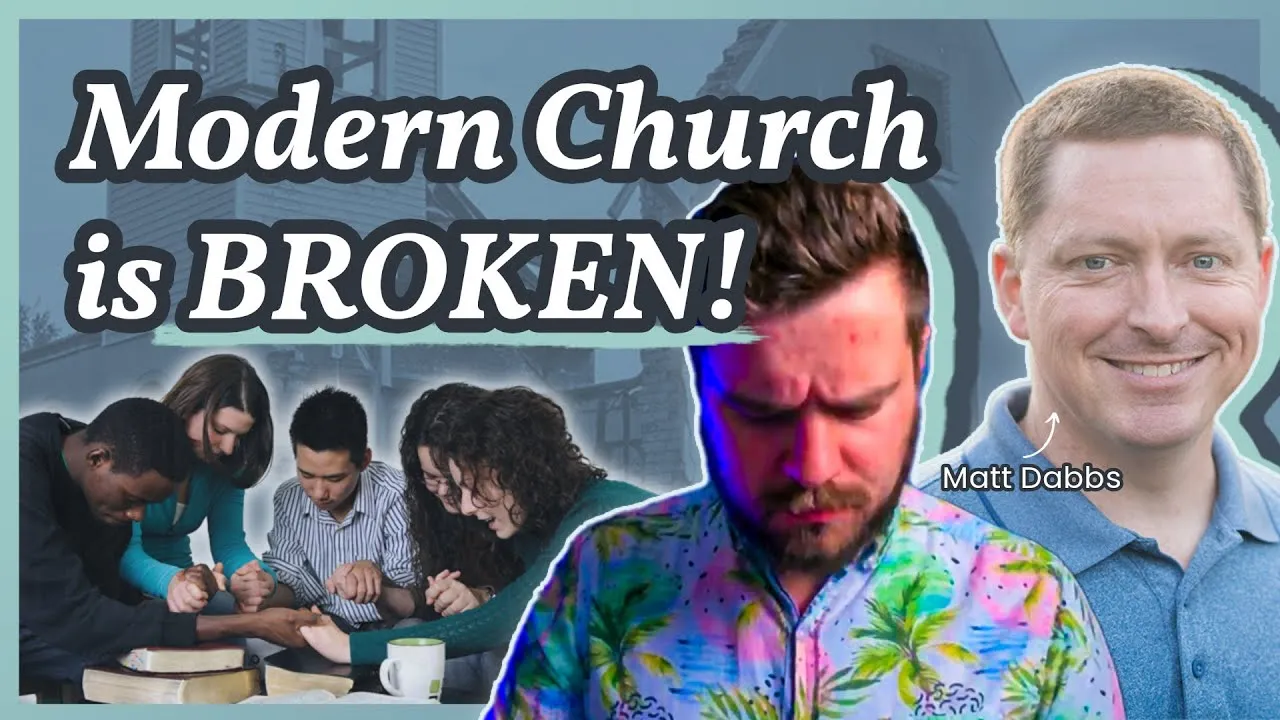
Why We Need to Return to Home Churches | with Matt Dabbs
A talk with Matt Dabbs on why home churches might make better disciples than big programs.
By Tim Barber··Video·Updated
Chapters
- 0:00Introduction: A Personal Church Journey
- 0:37Interview with Matt Dabs: From Traditional to House Church
- 3:28Matt's Background and Ministry Evolution
- 5:32The Shift to Discipleship and House Churches
- 7:24Challenges and Insights in House Church Ministry
- 9:17Scaling Discipleship and Building Community
- 15:21Biblical Foundations and Modern Church Practices
- 27:28A Child's Prayer Request
- 29:13The Two Churches Under One Roof
- 30:01The Willow Creek Reveal Study
- 38:40The Institutional Model of Church
- 45:39Practical Steps for Discipleship
- 48:01Final Thoughts and Resources
Why House Churches Might Be the Future of Christianity
In my recent conversation with Matt from Revolution of the Ordinaries, we explored a question that’s been stirring in my heart for years: Is our modern approach to “church” actually what we see in Scripture?
Matt’s journey from traditional ministry to house church planting reveals a profound shift happening across Christianity. After serving in institutional churches for years, he found himself increasingly drawn to the discipleship-focused, reproducible model we see Jesus establishing. When COVID hit, what started as backyard gatherings with neighbors evolved into a thriving network of home churches.
What struck me most was how house churches naturally solve problems that institutional settings often struggle with:
Children experience real discipleship. Rather than being separated and entertained, children in house churches witness adults praying for healing, sharing testimonies, and living out authentic faith. Matt shared a beautiful story of a 9-year-old boy who, after three years in this environment, demonstrated remarkable spiritual maturity by initiating prayer for his teacher’s family.
Every believer’s gifts are activated. In traditional settings, the professional clergy do 90% of the ministry while most members remain passive. House churches create space for everyone to exercise their spiritual gifts, fulfilling the Ephesians 4 vision of the whole body growing into maturity.
Accountability happens naturally. When you share teaching responsibilities in a living room, anyone can ask questions or offer perspective. The barriers between “clergy” and “congregation” dissolve, allowing for mutual discipleship.
The focus shifts from programs to people. Without buildings to maintain or Sunday services to produce, house churches can invest their energy in making disciples who make disciples – the core mission Jesus gave us.
To be clear, this isn’t about condemning traditional churches or the sincere believers who serve in them. God works through many expressions of His church. But Matt’s testimony challenges us to honestly evaluate whether our current practices are effectively making disciples who make disciples.
As Matt emphasized, the key is prayer: “Pray about everything.” When we truly listen for God’s direction and move where He’s moving, He will guide our steps, whether that’s in a traditional congregation or a living room gathering.
What are your thoughts? Have you experienced both traditional and simple church expressions? I’d love to hear your perspective in the comments below!
Transcript
[0:00] You may have noticed that I've been on something of a church kick lately. This could just be an ADHD hyperfixation, but I also do think that this is something that is very deeply personal and important to me as a believer, and I think it should be more important to all of us as well. So, this is why I'm going out of my way to go and find people to share what their experiences and their perspectives are when they cracked open their Bibles. Many of us have grown up with this mental picture of the church that involves buildings and professional clergy and Sunday services. But when we read the New Testament, we often find something that looks very, very different. Today I'm speaking with Matt Dabs from the YouTube channel Revolution of the Ordinaries. And his journey from traditional ministry, the way that we think about it, to more of a house
[0:48] church model offers some pretty fascinating insights on how returning to a simple reproducible model of the church that Jesus came to establish might be better at facilitating the kind of disciplehip that Jesus modeled. What I appreciate most about Matt's approach is his balanced perspective. He's not out to condemn traditional churches, but rather to try to help all of God's people rediscover the dynamic and participatory community that we see in the book of Acts. This conversation touches on themes that are pretty central to what we talk about at the overlap life. Living in light of eternity, embracing the biblical model of the kingdom life here and now. And when we understand that the new creation will involve restored relationships and communities centered entirely upon Jesus, it changes how we approach church in the present to be more faithful to
[1:36] what the New Testament describes. But again, the church can be found everywhere in the buildings that gather on Sundays, in house communities, and in coffee shops and in just interpersonal relationships with people that I know online. These are people that I consider the church and I gather with regularly. So, I hope this conversation challenges and encourages you as much as it did me. We need to focus on disciplehip. And unfortunately, the statistics and the data don't look very good for what we're doing right now in Christrysendom as far as disciplehip. So, without further ado, my conversation with Matt Dabs. Super thrilled to have you here. How are you doing today? Yeah, it's all good. Yeah, thank you for having me, Tim. I appreciate the uh the invitation to really talk about what we see God doing at the end of the day. That's that's the most important part is I just want to be where God's working. I
[2:25] want to find see where he's working, go where he's working, invite people into it. Like that that's the most important. 100% sweet 100% agreement. And that's that's an interesting thing because it brings us to the nub of this. We we see something going on in first and foremost I would say and you tell me if I'm wrong about this. You and I see something going on in our in our Bibles that's very interesting for how it reflects differently on what we tend to do as Christians here in the west in the modern age. Right. And that that was kind of an interesting thing that you noticed that I noticed separately of one another. Right. I discovered your work about probably about a year ago. There's a sense in which God is making moves in this space and you're you're working on these things. You're kind of boots on
[3:13] the ground digging some of the trenches to get this thing moving forward. So, I would love it if you could help us understand uh tell us about your ministry. Tell us a little bit about, you know, your background and and what you're working on. I know that there's a new book out. Uh tell us about all of those different pieces. give us kind of the the Spark Notes version of your background, your ministry, and what you're working on today. Yeah. Well, I mean, I grew up a Christian. I grew up in going to church. I grew up in restoration movement churches of Christ and ministered in those churches. I actually wanted to be a clinical psychologist and went to school for that and then decided partway through a PhD that it wasn't for me and withdrew and went into to get a masters of divinity from Harding School of Theology in Me at that time in Memphis. So at that point getting the MD, we were starting to minister in traditional
[4:01] congregations and uh doing all kinds of stuff, you know, youth ministry, college ministry, just all kinds of things, education, small groups, all that. So you know, did that from part-time O2 to 06 and then full-time 06 to 20 uh different churches in California, Tennessee, Alabama, Florida, and uh really enjoyed it. There there's a lot of good to what happens in churches. uh and not have no animosity to traditional churches. I think God called people to that and I think we need have have unity and not get divided over too hardly over our paradigms but started off in the traditional church mindset and again still value much of that. But when uh when when CO came, right, really just prior to CO, there were kind of some seeds planted for us that got us looking
[4:50] at things a little differently that began to kind of misalign us a bit with the traditional church um concepts or or paradigm. And so part of that for me was that I had kind of come to this conclusion that I knew how to like make a good convert, right? like what are the passages to study, you know, repent and be baptized and all that, which is, you know, fine. It's Bible says what it says. Uh, but it also says go and make disciples. I was feeling like that was not exactly what I was doing. I didn't really know how to teach someone to follow Christ in any, I'd say, organized way, but I had no plan. I had no path to make disciples. And I didn't feel good about that. So this was about 2018 I guess about two years before co and I I prayed about it and this that was a a
[5:39] big thing at that time but there were certain presuppositions about God and the way he worked that I didn't hold at that time like I knew God was answering prayers was active and involved but I kind of had a pretty limited view in reality like hypothetically a big view of God but like in reality a pretty small view of God and so I was praying and I just said God I want to learn to make disciples and I have no one here to teach me. So, if you would bring somebody along to show me what to do, I'll do it to the best of my ability for as long as I can. And it was about four months of praying that that I ran into Bobby Harrington who runs discipleship.org and renew.org. Referdine lectures and I was teaching a class. He was in my class. It was not on disciplehip because there was no way I was qualified to teach on that. And after the class walked up to me and said, "Do you know how to make
[6:26] disciples?" And I was like, "Oh, wow. That's oh, okay." Uh, I said, 'Yeah, I've been praying that God would send somebody to show me how to do that. And he said, 'Well, I'll teach you how to do that. Wow. And he he did. Uh, it was great. And we started I started doing that in the context that I that I was used to, which was I was employed by a church. And I thought, well, let's start making disciplehip groups amongst the people in the church. It kind of to say misaligned me from congregational ministry because like as a paid staff person there's certain expectations that you are teaching certain classes and doing certain things and all of a sudden I had kind of reshuffled some of my workload to be more disciple focused and uh not to any problem with my elders in the sense of they were just doing what they always do but I was doing something different. I don't think I could convey
[7:15] what I needed to convey to them at the time and they were kind like hey just kind of get back to doing what you're normally doing you know and I was like well God's kind of called me to this and we were kind of started to really pretty seriously misalign when co came uh we decided to meet in our yard in our backyard or church as of March of 2020 we were gathering in our backyard and inviting neighbors and friends to come and worship because we were just so isolated at that time during co and uh we had more and more people coming. We had some neighbors coming and the misalignment from the traditional church paradigm was just like growing, right? Because disciplehip was kind of taking me over here and traditional churches like you know come gather, worship, give, go to Bible class, teach like it was like no there's actually more, you know, like can I can see a bigger
[8:03] picture. I can see more things that the Bible actually talks about that I really want to engage in, right? And so we were doing home church really outside and decided that it was a church that God had started a church. We had several other couples that were kind of leadership couples that we all prayed about it and decided that we had planted a church and uh decided to resign from my ministry position, raise some funds and figure it out. And so I've been part-time employed through home churches and just learning how to do it, how to reproduce them, how to help other people start them. And so we've been doing that since 2020 on the house church side and now on the training side. And so I'm shifting trying to get more money, more employment from like the training side and less from the home church side
[8:51] because I I want the home church thing to be scale like I'm a scalable model and I don't really want to get paid anything from that, right? So I'm kind of tapering that down and making that happen because I don't think that's the right long-term path. I think it made sense short term, but I don't think it makes sense long term. for our our own personal security and transition. That was okay, I think, but not a good long-term plan. So, now we're training people in disciplehip and home church planting. I've created an online platform to onboard people into training uh in coaching resources, tools, online courses. Uh we have people from multiple nations who are in there and from several places around the United States. And we're telling God stories constantly. the view has expanded as to like and there's hundreds of prayer stories I
[9:39] could share of how we see God working and anticipating miracles anticipating like the hand of God just like doing things that we can't do ourselves wonderful ah it's so cool yeah one of the things that I really love in your story that I think is a necessary corrective I don't want to say both sides but really there is a conflict there is a conflict actually the way that we handle discussions around what the church is, right? One of the things that it struck me uh as a necessary corrective for both sides from your stance is the balance, the willingness to say, well, look, sometimes God will call a person to what looks like sort of an institutional model. Even though I don't know if you would say this, I think I would say this and I may be I
[10:26] may be more radical on this point than you and I'm open to that. But the idea is this this isn't actually scriptural. It may be a model that allows us to build a company that can go and do things, but we, you know, I wouldn't say we should necessarily call an institutional, you know, organizational 501c3 nonprofit structure of that kind a church, right? I would be I would be pretty, you know, reticent to do that. But still, I find the church there. The people of God nevertheless occupy the pews in that building. They they go to the event on a Sunday. They certainly I mean, I know many elders. I'm going to have lunch uh with one later today. I'm part of one of these things. I go and attend one of those events on a Sunday. Um it's there's sometimes a real uh violent disagreement or like an angry, you know, it gets it can get
[11:15] embittered almost disagreement between those who are in the house church movement or who have some sort of a it's funny to say non-traditional because what do we mean by traditional? Uh but you know the the the western modern western church folks, institutional church folks have an idea of what it should look like and the house church or non-traditional church folks have an idea of what it should look like. They're both trying to use scripture and bring it to bear and it's not fair often how we have treated each other. You know how we've talked about the the motives of the other people and the other side. So, I'm really grateful for your your desire to bring balance to find helpful practical ways forward for people. That's one of the things that I really appreciate most about your work. Uh, and there will be links below for and for people to go into, you know, the
[12:02] description and and find your stuff because I recommend it implicitly. Um, your channel is called Revolution of the Ordinaries, right? Sorry. Go ahead. Go ahead. Yeah. YouTube channel. Perfect. Perfect. Perfect. Revolution of the Ordinaries. Where did that I'm just curious where that title came from. Seems like a story. So, um, one of the things, one of my influences is a guy named Shank Johnson. He's from Sierra Leone, the Global Harvest Ministries. And they had like 100 Christians 15, 20 years ago in Sierra Leone. And now there's almost a million. and the way that they disciplem movements, DMMs and church planning movements, CPMs, they mobilize ordinary people to do the work because the traditional church model,
[12:50] the western church model is not scalable. Uh and not only is it not scalable, it's in decline. So even if it was growing, we can't build them fast enough and staff them fast enough to meet the need of the people in the world who need Jesus. And so if you're going to actually fulfill the great commission or attempt to fulfill the great commission, you have to mobilize the everyday people to do the works. That means that they need to be taught and they need to be trained in actionable skills, simple actionable ministry skills to be able to do the work instead of relying on a paid staff person who is trying to do the work of 400 people. That's not a scalable, reproducible, effective model for commissioning. Like the great commission, it's not. It's foolish. It doesn't take that seriously.
[13:38] It I could I could talk on that for hours, but yeah, Peter once said that the this every system is is perfectly designed to get the results it's currently getting. And so if we're upset about the results we're getting, the bill Yeah. Well, we we have to pay the bills. And we figured out a way to box it up and get the bills paid. get the staff people paid on staff. Don't have, you know, let them lose their jobs and and and hopefully grow the thing. But still, you're still not reaching your community like that, right? Like the whole build that they'll come. People don't, but they may come to your living room, you know? And this is what attracts me home churches. You're not building a third space with a separate power bill, a separate mortgage. It's like we already pay our mortgage. We already Yeah. We're putting church already. Yeah. Yeah. It's decentralized. They're already comfortable coming. They
[14:26] know what a living room is. They don't want to go sit in a pew and all this weird foreign stuff. Am I going to stand up? Am I going to get called out? Am I going to, you know, that's not going to happen in a living room. So, so the ordinary thing came out of out of that influence of like seeing that in other countries that the ordinary people are doing the work of making disciples and starting simple churches. And I Yeah, that to me is the path forward. It's Acts 4:13. They had realized these were unschooled ordinary men. They had been with Jesus. That's their qualification. And we have all these qualification systems. You have an MVive. Are you married? You got two kids. Are they faithful? It's like that's not ministry qualifications. Biblical. Amazing. Amazing. Yeah. It's answering ourselves. Yeah. You you get into you get into Ephesians 4 and Paul says that God gave the gifts of apostles, prophets,
[15:16] evangelists, pastor, teachers to the church to equip them to do the work of the ministry. Right? It's not so that these guys do the work of the ministry. It's to equip everyone else to do the work of the ministry until we all reach the fullness of the measure of the stature of maturity of Christ. Right? And then I think it's in Mark 5. This is something that struck me years ago. If you pick Mark up, you know, starting in the Gospel of Mark verse chapter 1 verse one, you know, and you just read through, um, every person that Jesus interacts with and then heals and and speaks to, he tells them not to go out and tell people about him yet. The first person that he tells to go and what he says is go and tell demoniac, right? It's the demoniac. Exactly. Uh you know he he says go and tell them all that the Lord has done for you. is the first
[16:04] person he commisss to go and do this. And it was right after he had been delivered. And he had this crazy past, literally filled with actual demonic activity, living in a graveyard, breaking the chains, you know, doing all kinds of crazy crazy stuff, violence, uh, literally inhabited by Legion. And that's the first guy you open up the pages of the Gospel of Mark, that's the first guy that Jesus says, "All right, go tell your story. Go find some people who need to hear." So when you say this revolution of the ordinaries, um I think that one of my biggest complaints and again I'm trying to temper it with some of your balance and some of your your kindness about this is I want to see the rest of God's people mobilized really recognizing that it actually scripturally speaking is their job to go and make disciples to go and find people
[16:54] who don't yet know about Jesus and have a winsome way of re of of recommending of helping them to understand that it would be a good idea to to abandon the kingdom of darkness and join the kingdom of of God and his son. Um, so anybody that is moving that forward, that's that's a positive thing for me. Well, that's what I've committed myself to is moving that forward. And and the only way to do that is, I think, is to create a community. So, if you don't have a local community that's on board with that, let me back up one more step. If you say, "I'm committed to that." For many people now, you're on your own because not many people are going to understand that. They're not people are not problem aware and if they're not problem aware they're not solution aware. So once you become problem aware and you start to become solution aware then you're like hey I want to do this but you have obstacles because now you're solo there's probably
[17:43] no one to disciple you to show you how to disciple somebody. And so I was like well man how do I put together like how do I give people what I wish I could have gotten which God God sent me like God sent me Bobby but not everybody gets sent that person. So I'm like well I want to be that Bobby to as many people as possible. So, how do I scale that? Like, how do I scale what we've learned? How do I scale? And I was like, well, man, I had written some online courses for a couple of Christian universities on disciplehip. And I owned all the rights to it. And I'm like, why am I not leveraging this stuff for ministry? I own it. So that's when I started building the platform, started building community place to pray together, to connect together, get on Zooms every week and coach people and help people through making disciples, starting simple churches, reaching your neighbors, how to not get burned out, how to find rest, how to be a disciple, how to make disciple by the work. So I
[18:31] just put it all online.org. We have a whole training platform, a whole community of people who are who are doing it. And I just went all in on this. This is where I'm just I'm going all in on on helping people. But but to the demoniac, I think the reason Jesus told him he could go and share was this is that theory. But he sent him to the dicapus. Yeah. The 10 cities. And that's the 10 cities. That's so that's a Greek spot. Mhm. And they don't have all the presuppositions that the people back in Israel had on this side of the river, whatever. And it makes me think that I think that Jesus was concerned that he would get misconstrued because of all the expectations of what a messiah was supposed to be. But the decapist doesn't have those expectations. So that guy's welcome to go and share. I think uh and and and the same is true with church and
[19:20] the same is true with disciplehip home churches is that we have these presuppositions of what church is supposed to be which prevent us from making it what it's really supposed to be or embodying what it's really supposed to be. So like Wolf Gang Simpson wrote this little book called the house church book. Yeah. He has several outstanding books. One called Houses that change the world which is that's a phenomenal book. Yes. Wonderful. Yeah. and you should definitely uh interview interview him sometime. So he says in the house church book he he basically and I played off of this in one of my videos on on leaving legalism to find freedom in Christ but it's like you kind of leave Egypt which is like the institutional church and then because you see the promised land over there and you're like oh I'm going to get in the promised land and then you
[20:07] start this journey but you got to go through the wilderness. And this is something that for your listeners, your watchers, your viewers, it's important to know that if you leave the traditional church paradigm and go into simple church, it's hard to get Egypt out of you. Yeah, that's that's more negative than I am about the traditional church. You're right. There's some truth to it, though. Is there hard to get Egypt, you know, they they kept wanting to go back and because all these things that were done for you are not done for you anymore. and all the resources that were there, all the volunteer base that was not there anymore. Guess who has to do it now? You have to do it now. And he says that's going to take at least a year or two to get through the wilderness to really embrace the freedom of what church is supposed to be. And then he says, "And if you're on staff at a
[20:54] church, double it." Yes. Right. Oh, goodness. And that's right where we are. We're at five years right now. And I can tell you it's taken me this long to feel like I'm not just carrying that stuff around anymore. Yeah. Goodness. Okay. So, this is something I want to really dive into a little bit. So, there there's a lot in there. I agreed with everything that you said. I want to emphasize right at the outset before I start asking this question and move into this direction of conversation. Emphasizing 100% that we don't we don't question the motives of the people who are operating institutional churches. You know, we want to trust but verify. The the goal of most people who operate in that system is they are doing everything they know to honor God as much as they can and to do what they believe he's called them to do. And that's the first thing I always want to
[21:41] say. I then want to open my Bible and have a conversation with that person if they're open to it and say like, can you point out to me where we where we have, you know, youth groups, Sunday school classes, whatever. But I don't want to get confrontational, right? The first thing to start with is this is not a question about the motives. It's not even a question about the people themselves. It's really questions about the system and the structure and the strategy and the approach. Right. But you mentioned kind of like a how we do church and then like a simple church and simple church isn't like a a new thing. Really the claim is that simple church is a return to the original kind of a New Testament descriptive model of what the church did, what it seemed to be spending its time and energy doing, right? How those things were structured,
[22:28] how it all worked. And it's really trying to go back to kind of a radically biblical concept of what the church is. So, can you unpack both of those two things a little bit? kind of what is it that makes the the way we do church tick and then how does that contrast against the simple church model or kind of the biblical model man that could take hours right okay so spark notes fly over for us man I'll tell you this like I have sat in a thousand elders meetings and I can tell you one time that I saw a Bible get pulled out now I love the elders who I worked under I love them they are good people I'm not angry. I'm not grinding axes, but in in probably a thousand elders meetings, I can remember a Bible getting taken out one time and it was because the worship leader had done
[23:15] something and they're like, "Where is the Bible?" It was like, "Oh my goodness, are you seriously that's you're going to pull the Bible out of that? There's just so much there." That's an unfortunate truth. Yeah. It's I think part of what that's doing is like it's the New Testament isn't set up to give answers to the questions we're asking it, right? Like if we're asking how to run a good leadership meeting, how to be a good visionary CEO for a nonprofit in the United States in wealthy and affluent country, it's not really set up to help us do that. There's no chapter and verse you can point to to give you guidance on it. It's not set up to help with those problems. So the best thing I could say is, hey, they're dealing with stuff that the scriptures aren't really going to be able to help them get guidance on. So why crack it open? Well, let's really be let's really be fair and say that the average church is 70 members. the preachers probably working two jobs. I
[24:03] mean, we get this thing of the mega church and all that. Those exist and, you know, they certainly have some specific issues. Uh, here in Alabama, there's Church of the Highlands. They've got 26 campuses. They're rocking and rolling. They've got a whole university or something for ministry training. They do incredible stuff. It's not my cup of tea. I wouldn't ever attend there, but I I can look at it and go, I do see fruit. I do see goodness. I do see well-intended people who are executing on some kingdom priorities. I see it like so that's why I'm kind of point at that thing and say, "Hey, that's a that's a that's a Christian organization that is doing good work uh in teaching ministry, you know, putting together some really good teaching ministry and then also creating Yeah. like maybe creating good music, right? creating
[24:52] arts and and and beautiful music and then also working on some other kingdom related initiatives helping the poor and the disenfranchised in their cities or whatever that looks like. And we call that something other than a church. I have a lot fewer problems with it. The the things that we do on a Sunday are really only problems in so far as we say, okay, then that's what the church is. But I love a good concert. I love a good teaching or a good, you know, message, you know, delivered to maybe maybe even thousands of people. I don't have any problem with that. It's simply then saying, "Okay, so that's the church." When you don't see weekly sermons delivered by pastors to captive audiences in big buildings anywhere in the New Testament. Yeah. There's no accountability in that. Uh that's one of the things that comes up is if the guy on the stage says something that's not
[25:40] biblical, how many layers you have to get through to have a conversation about that? Whereas, if I'm in my living room through that door right there and I say something that you don't think's scriptural, you can walk right up to me afterward and go, "Hey," or in the middle of it and say, "Are you sure?" Like, "What about this for?" Yeah, that can. So, there the living room brings accountability. That stage does not bring There's a few stories I'll tell that maybe answer this question. Uh, so one of them is is that in in house church, we don't really silo our kids so much. Um, we do have them taken out at times for age appropriate disciplehip focused material on their level or if there's topics that maybe we don't necessarily want them in on. But by and large, our our kids are in 80% of the time of anything that we're doing. And
[26:27] that means that they're hearing testimonies. They're hearing prayer requests. We're praying about things. We're talking about how God answered the prayer. And some big stuff, big big stuff. I mean, the healing of terminal cancer. And a few months ago, right through that door right over right over there on that couch, uh I finished some some instruction time in our gathering and I said, "Anything that you all need that we can pray about?" And this one little boy raised his hand. He is about nine and he had a really hard time in school last year. He had gone from home school to public school last year and he was not transitioning well. And every day he would get out of the car at this at the school drop off in the morning and he would run away and they had to get the resource officer. I mean it was just really bad. So we had committed last year as a as a church body to pray
[27:17] for him at like 7:18 or whatever the drop off time was, right? We knew we had like a little alarm in the phone, pray for this guy. So by the end of the school year, he's changed. We were praying for him. He just changed. His aspect was different. His feel was different. Much more calm. So, here we are in the living room and he's been hearing testimonies of the power of God now for years, three years. And he says, I go, "Anything we pray for?" Little hand goes up. I go, "Oh, well, what what do you want us to pray about?" He goes, "Well, my teacher at school from last year uh was going to have a baby, and I think she's probably had her baby by now, and that means she's probably back to work as a teacher at my old school. And she had another kid I know that's now an older brother. And that kid is probably having a hard time being an older brother with the new baby in the
[28:04] house. And so I just think we need to pray that God would help her get back to work and with this baby and help the other. He went through this whole list like he would not have done that a year ago. It was like, oh, and this was the coolest moment. I think this was the Holy Spirit. I normally just would have said, "Would you like to pray about that or would you like us to pray about that?" But I didn't. From a human perspective, I took the wrong turn and I said, "Let me pray about that." and he goes, "No, I want to pray about that." Wow, that is awesome. That was like, oh, dude, I mean, in a children's in a silo children's ministry, that would have never happened. But he gets the operating system. He gets King Jesus, the kingdom of God, that we've surrendered in submission to him, that we are following his lead, that we're living in obedience to Christ. He has
[28:51] learned that God can do anything, and that God answers prayers, and we need to pray about everything. He gets it. He's nine. Yeah, it's He gets it like by organic example and osmosis. Yeah, exactly. That's amazing. Yeah. Where would he be if if he had stuck with a traditional church and traditional children's ministry being pulled out every possible moment because what happens, my friend Eric Brown said this 2013, we were going out to speak at a lecture. He and I were co-eing and he said, he said, "There are two churches meeting under your roof." I was like, "What? What are you talking about?" He's like, "You got a youth ministry? There are two churches meeting under your roof. That's weird. He's right. And then he's like, yeah, when they hit 18, they're gone. You know why? Because you never had them. I was like, yeah, he's right. And then the Aana people say Matt Markin says that the number one
[29:41] predictor of faith development and longevity of faith for children is the number of adult relationships they have in the church. Yes. Now, tell me how many they're getting if they're not in the life of the church. Yeah. And no real ones, right? No. only superficial ones with their teacher. If it's a regular person they see every week, that's one thing. But yes, very different. And then, have you have you ever heard of the Willow Creek reveal study? I have. Yes. Oh goodness. Oh goodness. Yeah. There's some data in that one. You got to go dig it up. Uh I will simply say for my my viewers, you better buckle up because this is pretty amazing. Yeah. Yeah. It's not good. It is not good. Willow Creek was like the church that every church wanted to be. Yeah. Yeah. There there there are ministers in town I've talked to that said, "Oh man, we wanted to be Willow Creek. We want to be Willow Creek." So
[30:28] they said, "Hey, let's go to our own people and see how we've been doing." But people have been growing or they've been discipled. And what they found out in in the nutshell was that the more you invested yourselves in volunteering for the programs of the church, the less you were growing. Yeah. Because you're burnout. You got no time. You're just perpetuating the the machine. and and and and nobody ever says the more you volunteer the more you'll grow. But I you and I both know that that's implied. That's the implication. That's exactly right. That's why it's held up as kind of the telos. That's why it's held up as the pinnacle of the serious Christians. I I would say it is explicitly said, frankly, that the pe the serious Christians are those who do they'll say it's kind of a bait and switch. And again, I'm not impuging anybody's
[31:17] motives. a system and and an institution's job is perpetuating itself. Any body, its job is to perpetuate its own existence. My body's job is to nourish its own life. Right? So then the church body, if that's the corporation, which means the it's a persona. It's a body of its own that's separate from I would say the body of Christ. Okay. But this institution is its own body. A company is its own body. It's a corporation. Its job is to perpetuate itself and ensure its own survival if necessary at the expense of other things that may even be good and noble and right and moral and that deserve to be prioritized. And so I've known so many people who were chewed up and spit out as cogs in a machine to
[32:07] further a set of programs and and budgets and all this thinking that what they were doing was serving the body of Christ. And maybe there's an element of that that was true. But, you know, handing out bulletins and then going to do the sound system and then stacking up the chairs afterwards and running a running a, you know, the mustache broom across the floor aren't actually spiritual gifts. Uh, you can do those things out of love, but it's not actually an exercise of your spiritual gifts in your ministry that you've been given by God. And so, yeah, people get chewed up and they get spit out in pursuit of institutional goals to further we need to we need to make sure that all of our numbers look good. Does our attendance look good? Does our giving look good? And and those are the institutional goals often rather than the goals of the kingdom of God of which the citizenry is his church. Yeah. So
[32:56] once you move into the big room, the dynamics of everything change. Now the quality has to be here and that means the control has to be here. Mhm. If the so if if I want a certain level of performance, that means I have to control who gets on on the mic. That is not true in my living room. But then what happens is you start limiting the gifts and you start siloing people off into other things. And and and then like you said, Ephesians 4:11, if the gifts don't get used, then all the things he says the gifts do don't happen. He says you will grow in maturity. He says you'll grow in the likeness of Christ. He says you'll know what false teaching is. You will not be blown around. But if you don't let people participate, if you limit participation and you you limit the usage of the gifts and you professionalize it and you silo it, when you stage it and then you control it,
[33:45] the spirit has a very hard time working in that environment. So we have to identify the gifts and leverage the gifts and use the gifts and value I participation where everybody should be participating in edifying others and all those kind of things and and so the big room does big room stuff and when it's not intimate it's not transformational. It's it's so frustrating for me. I've learned to see this again. My route into this was scriptural first and foremost. I sat through and read Matthew and Mark and Luke and John and Acts, first five books of your New Testament from beginning to end. And I just got through that taking copious notes and said, "My goodness, why am I not seeing anything really resembling the priorities, the the value system that seems to be forwarded by
[34:35] Jesus and then furthered and lived out by those who were following his commands? How how come I'm not seeing these things in the way that we're doing stuff? So then when I learned to see this, oh well, what we're doing is this is a this is a conference. This is a weekly mini conference and and a concert. Okay, it's a week. You know, that kind of stuff is appropriate for a concert. You know, I've been enjoying uh I'm a classic rock fan and over the course of the past few days, I've just been kind of hyperfixating on the uh the Eagles live 1977 concert. It's one of my favorite bands. just this awesome concert that they put on and uh it's a lot of logistics, right? There's the lights, there's all the different instruments. They they switch guitars every song. You know, one guy's leading the singing here and then another guy. These guys are doing a guitar solo rather a guitar duet on uh on Hotel
[35:24] California. It's Joe Walsh and and and Don Felder. And that's a lot of work. And it takes that much work to pull off an event like that and to do it well to do a good job at that event. It requires that level of control. or if you've ever been to a conference or if you've ever organized a conference that's, you know, that's a lot of work. Takes some logistics. But the problem is when we get ourselves into the habit of associating that thing with what the church is. So if that's not the church, the way that I the way that I've phrased this before, and I'm starting to get my dander up a bit, but and this I I may have gotten this from somewhere. This might have been like a Richard Jacobson thing from Unchurching. I'm not sure if you're familiar with his work. That book is phenomenal. Um, but there's a there's kind of a three, you know, a triangle of things that you might expect to be describing the activity and the focus of the church the way the Bible presents
[36:12] it. And it's very simple. There's a lot of ways to flesh this out, but it's it's three things. It's loving God. It's loving others, specifically the those in, you know, loving one another, the rest the people who are in the body of Christ with you. And then loving the lost. And it's going to involve those things. And it's going to involve going to look for for ways to do all of those things better. And then what we've done is we've put we've put that triangle inside of a box. And that box has four corners. It's programs, the thing needs to do, the professionals who pull those things off, budgets, which is the amount of funds it's going to take to pull all those programs off and pay the professionals to do it. And then it's a building. All that stuff transpires inside of a building. And it's kind of like we take the love God, love others, and love the lost, and we we put it inside of this box where all of those
[37:00] things need to get taken care of first before we really get to the loving God, loving others, and loving the lost stuff. And often that just it just doesn't happen. So would you say that that triangle I just put put forward, is that an accurate description of simple church? Like there may be more to it than that, right? You might have there's obviously in the Bible itself there's more um specific commands than simply love God, love others, and love the lost and then go figure it out. There's more to it. But what would you say describes simple church the way that you would would frame that up? Is that an accurate starting point and then we can fill in some corners? Um yeah, I think it's really helpful. Uh I would go back to one thing that you said real quick and that is when you talk about scalable models. Jesus created a scalable model. In other words, he's a disciplemaker who makes disciple makers. It's not just a disciple making a disciple. It's a Jesus
[37:47] was a disciplemaker who made disciplemakers. So that's a scalable model. You could take what was done and do that for the next generation, the next generation. And but if you if you said that the only way to do it was that the Eagles had to get on the stage. Yes. For everybody and do it every time just like that 1976 or whatever it was. And if you do if you if you do it like 1986, it's not right. And if it's somebody other than the Eagles, it's not right. And then all of a sudden, you have you do not have a scalable model. How are the Eagles going to reach the world? And how are the Eagles going to do that for you as a concert goer? Whereas you're just there screaming and shouting and all this. It's not the same thing, right? So we we have to have Jesus create a scalable model for us to follow that's generational and it's international and
[38:35] we just said, "No, we're just going to box this thing up and do it another way." But I I think those three parts are are solid. I think the institutional model of church tends to focus on loving God and loving each other pretty well, but not loving the lost. And so sometimes I'm an introvert and so sometimes I have to pray that God will increase my love for the lost because sometimes I'm not attracted to the lost like I should be. And so I have to I have to pray for that. And God's answered those prayers uh pretty dramatically at times. I mean, I was praying a few months ago, maybe 6 months ago now, and I was like, "God, I you're you're the most important thing in my life, but I don't talk to you about people as much as I should." And so, I'm asking for opportunity, and I'm asking for boldness. And I was like, and I feel like I need to be discipling one more person. And so, um, that week, I looked
[39:26] out this window that's right here and there was a car parked in front of my house. And we live on a culde-sac. And so, people don't really just park over here. you're kind of in and out. And I thought, "Okay, well, it's different." And so I looked out a while later, still there. So I walked out there, talked to the guy, and he's like, "Yeah, I was delivering something, but I ran out of gas." I was like, "Oh, I got some gas." And so I I'm pouring gas in his car with my gas can. And it's like, "You asked for someone to talk to God about, right?" And I was like, "Isn't it cool that you know you run out of gas right here and that God had somebody right here to give you some gas? Like how cool is that?" He didn't say anything. I was like, "Wow, okay." And so I'm wrapping up. He's about to go. He goes, "Where do you go to church?" And I go, I'm like, "Uh, you're there. I want to answer that." Yeah. Right. Yep. Like
[40:14] you are 20 feet from where we gather. Like this is my house and we gather right here. So you already know how to get. And then he goes, "Yeah, I just, you know, I'm trying to learn about more about Jesus and I'm trying to get serious about faith, but I just need some help and I don't know where to start and all." I'm like, "He's talking disciplehip." And I was like, "Oh, yeah." I said, "I'll help you with that, dude. That's what I do. That's what that's that's my calling, right? So, let's go." Met a few times, baptized him into Christ, and uh he's in the military. He's going to go to to Europe here shortly. But, you know, here's a prayer like, "God, I want to disciple one more person and I want to share more about you." And then a guy runs out of gas right in front of my house. It's like God does this stuff and we have to tune in to what he's doing. We we got to pray and we got to listen and we got to pay attention and we got to pray big and
[41:02] bold and specific. But if we don't love the lost, we can love each other all day, but if we don't love people out there, we're not going to see it. We're going to we're going to miss the whole thing. Now, great commission. Yes. Yes. So, here's the three things. If we get three, here's another set of three. This is from Curtis Sergeant. I I don't know if he originated it, but he said he said a growing disciple grows in knowledge of scripture, grows in faithfulness, obedience to scripture. Am I doing it? And is growing in your ability to share the word with other people. That is so important because our mark for maturity has been if you show up enough times, you will not hear from us. Yeah. you will not get unless we track
[41:50] your giving and you're not giving frequently enough that it might be those two things. That's what a church is all about is what will get you a letter. Yeah, that's when you know and if you will never get a letter that's going to say you have you been you know sharing and this sounds this is hyper manipulative like there are movements that have manipulated disciplehip. I'm not for I'm not I'm not advocating that. It's bad. Yeah. Our crossroads movement bus movement these guys did this for years. It's very toxic, but you know, all I'm saying is is that no one's going to check on you. You share your faith. Are you living in the scriptures? Is there accountability? Like, as long as you show up and give, you're probably cool. But that's important. So, so it my last thought on that is you really need to be in the word. But don't just understand. You really need to live out what's in there. And once you're in that, you really need to share that with
[42:39] people. They need it. And if you do those things, you grow. This is why we have people that are like 80 years old in the church where you're like, "That person is vicious. That person is mean, but you're like, you know what? You want a good Bible class teacher, have them teach their great Bible class teacher, but they are mean. It's because they're they grew in their knowledge, but they didn't grow in their faithfulness or their ability to share with other people or love people." Yeah. And people get away with that. Yeah. There's a conversation around, you know, spiritual formation, which I think, you know, we're talking disciplehip. John Mark Comr before him obviously you know John Orborg Dallas Willard there's this whole world of talking about being formed into the likeness of Jesus but John Mark Comr's book practicing the way was actually phenomenal you're right yeah right exactly and I would say it goes
[43:26] back to Jesus but you know that's just me being cheeky but um practicing the way it was a book by John Mark comr and he here's another three-part you know hey I guess I don't know we can't get away from these things but his the his way of framing it up very simply is be with Jesus us, become like him, do as he did, right? That's another that's another way of looking at these things. But the point is that it can't just be it can't just be head knowledge. It can't just be kind of we're at an event where the idea is for all of us to now know more and then we all check the I know more box and then we drive home and live as if nothing really changed for the next six days until we go do the concert thing again. We've got five minutes. I want to maximize them. Th this conversation I have found becomes very daunting for people because let's
[44:14] say they've con they've become convinced they recognize there is a lot of Egypt there is a lot of kind of pharaohic thinking you know slave driving it's it's not really the way the kingdom of God is described as operating more bricks less right in my church community we're not saying cut ties with people we're not saying try to blow blow the system up. We're not saying become a revolutionary inside that thing and try to reform it. I don't think that that's the path forward. That's contentiousness. That's divisiveness that doesn't lead people forward. But it might mean you leave that system and there's that wilderness period. And that might be scary. It might feel it's kind of like the hero's journey. It's difficult for people to want to strike out if they've become convinced. I don't
[45:02] think that my church institutional community thing that I've been doing for the past however many years, my default understanding of what the church is, I don't think that it's biblical anymore. And they're they're on the precipice of kind of stepping into that wilderness wandering period in search of the promised land. What are the first like just bits of advice that you give to a person who is considering doing that? Uh I know you've got materials. I'm going to recommend people go check out those materials as well. But just word to the wise having gone through it yourself and coached other people through it. What what are the things that you you ask them to prioritize for their own sake? So the first thing is prayer. Pray about everything. And as you start watching God answer the prayer, not only do you pray and talk, but you pray and listen because God can tell you things. God can
[45:51] inform, but you got to be still and you got to listen. And then when God gives you an answer, you move in the direction of his movement. And and that's going to solve most things right there. And in fact, that's relationship. If you want to sum the whole thing of this disciplehip up in one word, it's really relationship. It's like I want to spend time with God. I want to hear what he has to say because I love him. It's like my wife. I love my wife. I love my kids. I want to spend time with them. I want to hear what they have to say. There's some things I want to say to them and we're going to we're going to have conversations and we're going to get time together. Well, if you if you want that to happen, you want a new operating system, uh it's called the Holy Spirit operating system. It's like the spirit is moving, the spirit is informing, the spirit is empowering, but we have to dial in. We have to ask and pray and then pay attention and then
[46:40] move in that direction. And then the second thing, so pray and then fast. Get get yourself a good little fasting rhythm going like once a week on Tuesday breakfast. something you can do every single week and it will give you so much peace because you'll know that God is in control and you're surrendering everything over to him on a regular basis. So once you start praying, listening and following his lead, you begin fasting. You begin releasing control. You begin that that fasting is that surrendering to him. God, you you are more important than bread alone. Every word that comes from the mouth of God, that is key. So uh prayer, fasting, don't do it alone. He said he sent them out two by two, right? Don't go alone. Find a find a buddy. You got to find a buddy. You will not sustain if you don't find a buddy. And then be that disciple who finds a very simple way to make
[47:29] disciples to help other people follow Jesus. Go to Robert Coleman, master plan of evangelism. Go to disciplehip.org. You you got to Google it now. It's not on their homepage anymore, but Google discipleship.org. Revisiting the master plan of evangelism 60page book and and it will show you a simple little way. I've got stuff on homeurchesources.org or that will give you simple paths to that. But start making those disciples. Start prayer walking your neighborhood, meeting people, encouraging, praying, living this stuff out because as you move, as God's moving, you're going to start seeing the pieces come together and God's just going to show you what to do. Incredible. Just incredible. No more visiting God like he's in in prison. And we got to trust the uh the prison system to handle all of the logistics of us being able to go and meet him. We're the bride and he's our bridegroom and we ought to be able to relate to him
[48:15] directly. Yeah. Yeah, brilliant, brilliant, beautiful. Matt, thank you so much for your time. This has been uh very life-giving conversation. Again, I I' I'd be thrilled to have you back. I'm not sure uh there's a lot still to talk about. Like you we both said a couple of times, hey, there's probably like a couple hours more of discussion around that alone. There's a lot there, but it's been uh it's been a huge pleasure and I'm really grateful for your time. And I'm going to put all the resources we talked about down in the description so people can go and check your stuff out. I hardly recommend your channel. It's a great watch and your book and really everything that you are are putting forward I think is the stuff that the spirit's breeding on and I'm hoping praying uh and doing my part I suppose for the spirit to be getting more and more exposure on on people's hearts on this stuff and to talk about it as much as possible. So thank you so much and I hope you have an amazing rest
[49:02] of your day. Thank you. Thanks for being a blessing. Appreciate you. God bless.
Tagshouse churchesdiscipleshipmatt dabbshome churchchurch community