
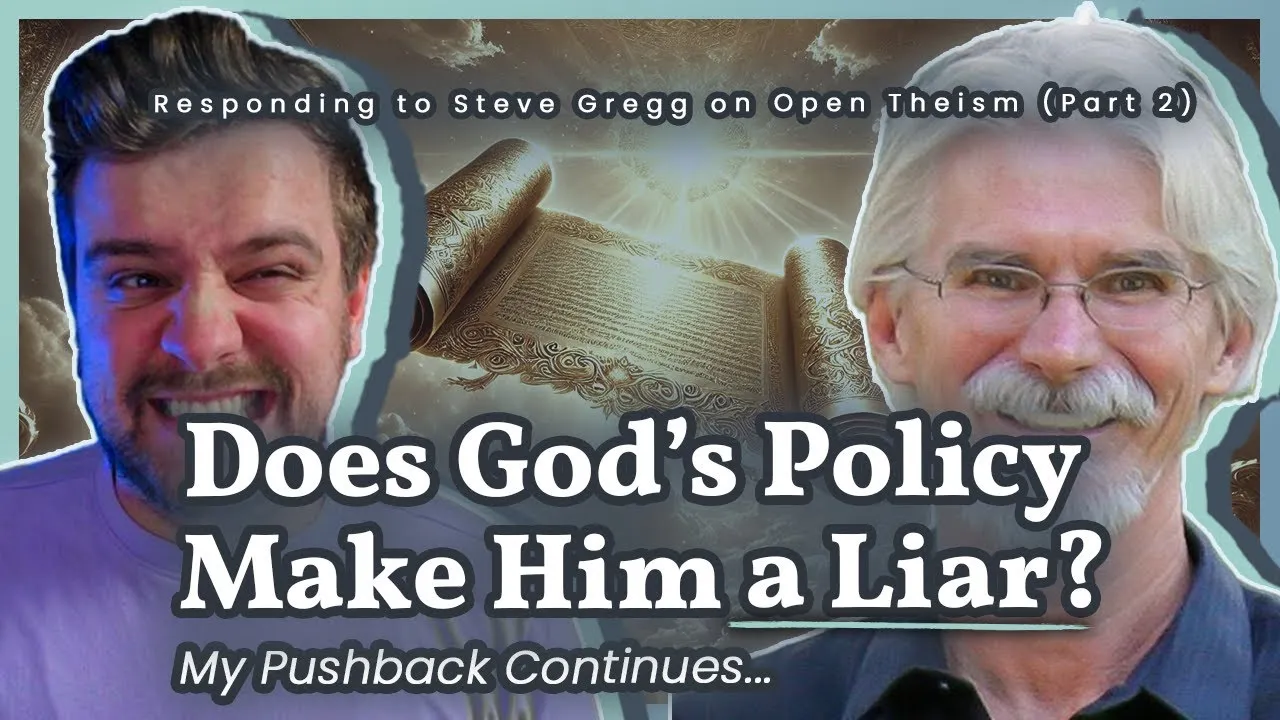
Steve Gregg DOESN’T think God is a liar… right?
A second look at Steve Gregg's case against open theism, starting with Hezekiah.
By Tim Barber··Video·Updated
Chapters
- 0:00Introduction and Recap
- 0:25Misunderstanding the Prophets
- 1:08Hezekiah's Prayer and God's Response
- 2:04Theological Implications of God's Actions
- 3:07Debate and Discussion Highlights
- 8:02Jeremiah and God's Conditional Promises
- 17:24Exodus and Moses' Reluctance
- 21:11Moses and the Signs from God
- 21:53Jeremiah's Mission and God's Warnings
- 24:07Hezekiah's Story and God's Response
- 26:35Ezekiel's Prophecies and God's Policies
- 29:13Theological Reflections on God's Foreknowledge
- 31:18Anthropomorphism in Scripture
- 37:42Concluding Thoughts and Reflections
Wrestling with Theology: Understanding God’s Foreknowledge and Human Interaction
In my ongoing series of discussions about theology, particularly in the context of open theism, I take yet another deep dive into the complex theological explorations related to Steve Gregg’s response to open theist proof texts. This blog post is a written companion to my latest video, which you can watch on YouTube for a more dynamic discussion.
Introduction: The Challenges of Theological Debates
I embarked on the second round of exploring Steve Gregg’s perspectives, particularly in relation to passages that open theists frequently discuss. Engaging intellectually with someone as renowned as Steve Gregg certainly brings its share of challenges and discomforts, yet it’s a necessary endeavor for me. I am driven to lovingly critique and debate with those I hold in high regard, like Steve Gregg, to advance my understanding and perhaps even influence their perspectives.
Re-examining Scriptural Interpretations
Throughout the video, I revisit several biblical episodes, prominently featuring the story of Hezekiah in 2 Kings 20. This passage, among others, raises intriguing questions regarding God’s foreknowledge and his interactions with humanity. For example, does God truly change His intentions in response to human actions, as seen in the story of Hezekiah’s illness and extended life?
I argue that these narratives, which portray God altering the course of events based on human prayer or repentance, suggest moments of divine flexibility rather than a strict adherence to an eternally fixed plan. This viewpoint challenges the traditional understanding of God’s exhaustive foreknowledge, painting a picture of a more interactive relationship between the divine and humanity.
God’s Policy and Human Response
Exploring various scriptures, I discuss how these accounts could potentially reflect God’s standard practice or policy of dealing with humanity, emphasizing that He operates within the framework of human free will and choices. This highlights an image of a God who is responsive to sincere human appeals and who may adjust His original declarations based on new circumstances or the repentance of people.
The Anthropomorphism Argument
A significant portion of the debate centers around the concept of anthropomorphism—language that attributes human characteristics to God. Steve Gregg posits that many biblical descriptions of God are figurative, designed to make divine actions comprehensible to the human mind. I explore whether this argument inadvertently diminishes the sincerity or honesty of God’s interactions as depicted in Scripture, questioning whether these portrayals mask a deeper level of predetermined divine action.
Conclusion: Continuing the Dialogue
In the video, I admit that these discussions are far from settled. The interpretation of scriptures concerning God’s knowledge and our responsiveness remains a deeply nuanced topic. Despite the debates and differing viewpoints, my admiration for Steve Gregg’s theological work remains unshaken, and I invite you to join the conversation.
This video is more than an academic exercise; it’s a heartfelt endeavor to probe these grand mysteries further. To see the full exploration and join me as I analyze these timeless theological questions, I invite you to watch my latest video on YouTube. Together, let’s delve deeper into understanding the interaction between divine sovereignty and human agency. Thank you for engaging with this discussion, and may we all continue to grow in wisdom and understanding.
Transcript
[0:00] I am back for round two of my discussion about Steve Greg's response to the open theist proof texts and I can tell you that it is just as uncomfortable this time as it was last time for me I know that it is a weighty proposition to go intellectually and theologically toe-to-toe with the great Steve Greg but there's nothing I can say I have to do this I'm compelled and it's the one thing that I have to do is lovingly push back on people that I respect as much as I respect Steve Greg today we have adventures in misunderstanding the prophets with a couple of other verses sprinkled in here and there but for now I'm going to take us right back to the same spot we were before when we ended the last video and I did learn my lesson I am going to slow down my speed listening just for you guys because I listened to pretty much everything at like 2.5x speed so I'm so sorry that I was just blasting these guys at you at
[0:48] full speedx or 0x or something like that so I've lowered it all the way down to the 1.25 1.5 range and hopefully that solves things uh I'll just put it down to 1.5 to be safe but I heard you guys loud clear that was not intelligible last time so let's see if this works better and let's Jump Right In uh so then we move on to Second Kings uh chter 20 veres 1-6 and that says in those days Hezekiah became mortally ill and Isaiah the prophet the son of Amos came to him and said to him thus says the Lord set your house in order for you shall die and not live then he turned his face to the wall and prayed to the Lord saying remember now oh Lord I beseech you how I have walked before you in truth and with a whole heart and have done what is good in your sight and Hezekiah wept bitterly before Isaiah had gone out of the middle of the courts the word of of the Lord came to him saying return and say to Hezekiah the leader of my people thus says the Lord the god of your father David I have heard your prayer I have
[1:36] seen your tears behold I will heal you on the third day you shall go up to the house of the Lord I will add 15 years to your life and I will deliver you and this city from the hand of the king of Assyria and I will defend this city for my own sake and for my servant David's sake so it looks like he was going to let Hezekiah die and then he hears hezekiah's prayer and says go and why say it looks like that's how it's written he was going to let Hezekiah die I don't know maybe it's just what it means tell him he's going to get 15 more years right this is another example of God simply turning around doing the other thing because of the man's response to the bad news okay really do you think it's because of because in this view really any kind of simple for knowledge view or of course determinist views but any kind of simple forn knowledge view God doesn't do anything he doesn't providentially arrange anything because of anybody's like that's not actually the cause of it it's not because of their response it's because he had already planned to do
[2:24] that knowing what they were going to do right so it's not actually because of we need to be very careful when we say because because of because because of means I'm just saying because a lot because of means you're attributing that thing as the reason why something happened and that's not the case here at least I don't think that's what Steve's saying about what's going to happen and the man either someone intercedes or someone repents or in this case the Man simply prayed uh and God says well okay I think that's a good ver so he changes direction again the word Shu which is translated repent in many cases but not always in fact it's translated by different words more often than not in the Old Testament but it is one of the main words for repent and sometimes said God repented uh it means he turned around he changed Direction and uh but that doesn't mean that he didn't going to happen he's doing what he typically does but he says his a policy M with him you know that he will change his direction if people change or respond in a certain way and I want to say a couple of things real quick one is we have Chris date in the chat and said tell
[3:12] Steve before we go on from this I have a couple of thoughts here's the real issue I have with that whole interpretive setup the passage itself says Yahweh says set your house in order for you shall die and not live and this word in this case is actually kind of supposed to be read as if it's in the present tense it's like you're a dead man I'm a about to die was dead that's that one's even in past tense right I'm about to die I'm dying um not one of them died but it's like it it's it's as though it's a foregone conclusion it's a certainty it's what's going to happen so my contention and I brought this up in the debate with James White is that if God meant this irrevocably and he knew that Hezekiah was going to ask and that he was going to Grant the time the extra 15 years of life to Hezekiah then this was a lie when he said set your Affairs in order you're going to die you're you're a dead man it's only not a lie if he changes his mind if he has an
[4:01] intention to do one thing on the basis of his assumption that Hezekiah is going to continue in the same path and then changes his approach based on Hezekiah changing his sure this is a policy God has but it still the way that it's written makes God a liar if he said what he says here knowing full well that in a few seconds Hezekiah is absolutely going to repent and turn to the wall and ask for more more life interestingly Steve refers to the word Chu and it occurs in this passage four times but not one of the is actually attributed to God so here it occurs where the word of the Lord appears to Isaiah in the middle of the court and then says return like turn back around go backwards and we're going to see why it's go backwards in a minute and tell Hezekiah the leader of my people thus says Yahweh the god of David your father I've heard your prayer I've seen your tears surely I will heal you and he says I'll add to your days 10 and
[4:49] five years and from the hand of the king of Assyria I will deliver you and the city I will defend upon the city for my own sake for the sake of David my servant what's important is that I've gone ahead and put the strongs Hebrew concordance number up here and we can go look for it then God asks Hezekiah and Isaiah which sign would be more convincing and it's the shadow going forward 10 steps or backward 10 steps and he uses go backward which is yes Here We Go Again Oru the B sound in this is kind of like a V sound really more in Hebrew we think so go backward 10 degrees right let the shadow go backward you know and here we go and he brought like turn turned the thing around backwards 10 steps so just kind of interesting but that's not actually applied to God that word so when he's saying oh this word is sometimes applied is used to mean repentance well it doesn't actually say that it simply portrays God wanting to do one thing and then doing a different thing based on hezekiah's interaction in which if God had followed through on the original
[5:37] thing that he promised irrevocably if it was an irrevocable thing and he knew that Hezekiah was going to repent then he lied the first time it's kind of an interesting little tidbit there that he says hello hi Chris we have probably the one of the most watched debates on this channel is between Steve and Chris on the question of the church and Israel and so check out the debates playlist for that the other thing I want to say is that there's someone in the chat who's a student at Trinity College and Seminary who says they're taking Steve's course through revelation right now and it is a fantastic course I was in the room when he was recording the video supplement for that course and um I want to to say if you like to become a student at Trinity um I hope Steve Sor just skip in Steve Greg's classroom would probably be an incredible experience and his material and Revelation is fantastic as is his material on the church in Israel just throwing that out there 15 1 Chronicles 21:15 says and God sent an angel to Jerusalem to destroy us but as he was about to destroy it the Lord saw and was
[6:26] sorry over the Calamity and said to the destroying Angel it is enough now relax your hand and the angel of the Lord was standing by the threshing floor of oron the jebusites I I had no problem seeing this as another anthropomorphism what God had done he brought a plague on Judah because of David's numbering the people and thousands already at this point and Jerusalem was kind of in line to be going down next and God was approaching to destroy it and then God just it says he decided that he' done enough you know they suffered enough that he's not going to take Jerusalem out so I mean it's again describing God as somebody who thinks like people think as he does in many ways but not entirely I'm sorry that's bizarre to me okay I think we've got our causation of thinking shape Direction mixed up here we don't God doesn't think like humans do we are the only rational creatures gifted with God's Own moral nature and intuition and his own wisdom and
[7:14] intelligence and rational capacity and we think after the pattern he does so I think it's really strange when we biblically when we are assessing the Bible and then we say that God is pretending to think the way that we think here when it seems like the Bible's claim is that we think like he does because we are designed after his own image to Bear some smaller more finite version of his attributes and the way that he operates in the world and it does not seem as though that was a glitch in The Matrix a bug in the programming because it was that way before the fall as well it's just a really unflattering place to pause Braxton I kind of feel bad about that that's just really strikes me as weird so I just see it as describing this action of God as as a human liking action gotcha now here's one that looks uh that is very familiar in these discussions Jeremiah Jeremiah 18:7
[8:03] through1 says at one moment I might speak concerning a nation or concerning a kingdom to uproot to pull down or to destroy it if that Nation against which I have spoken turns from its evil I will relent coning the Calamity I planned to bring on it or at another moment I might speak concerning a nation or concerning a kingdom to build it up or to plant it if it does evil in my sight by not obeying my voice then I will think better of the good with which I had promised to bless it so now then speak to the men of Judah and against the inhabitants of Jerusalem saying says the Lord behold I am fashioning Calamity against you and a plan against you oh turn back each of you from his evil way and reform your ways and your Deeds yeah I I really love that scripture I use it a lot in talking about Israel and the promises God made to Israel uh I mentioned earlier n and that'll be coming up too here I believe the first part of this God says when I say I'm going to destroy a nation if they repent I will repent of the destruction and evil that I do to them that's exactly what happened in Jonah's case he went and God said he's going to destroy an in
[8:51] he didn't say there's any conditions attached but there are there always are and the subtext is the condition unless you repent and so we see in Jonah an example of the first part the second part is and whenever I say I will do good to a nation build them and plant them well if they turn against me then I'm going to repent of the good I said I do to them which is of course what Deuteronomy 28 says about Israel but it's not just that he says he will do destruction on these people it says that he plans to do it he plans to do it or a different translation might render it as he thought he would do it if a nation against which I have promised destruction turns away from their foolishness and chooses obedience to me and my commands then I will turn away from the punishment I thought to bring upon them and similarly if a nation towards which I have promised blessing turns from me and instead turns and Embraces chaos and death and
[9:38] Disobedience and whatever then I will recant I will reneg I will back away from the good I had intended to bring that I thought I would bring and Nineveh is a fine example but it's not just that he said he would do it and he's going a different direction it's that he thought he would do it he was planning to do it and then he moved away from the thing that he planned and thought that he would do of course that particular Hebrew word is a little flexible in some instances it does say said or it could be planned it could be thought Hebrew in general is much more flexible than this but more often than not it just means thought planned considered and a declaration by God about what he's going to do really isn't in view there he's backing away from a plan not a statement based on a mergent circumstances and then he makes an appeal at the end of it I don't know there's just kind of this weird thing whenever exhaustive forn knowledge is assumed that just makes all these things feel kind of duplicitous it
[10:25] it doesn't actually if God said this in any kind of a way then it's dishonest really it's frankly not him representing the State of Affairs in the way that they actually are you have to make an apologetic case for why these verses read differently than the way that they were written by the spirit inspired scripture authors like why if you can understand it if that's really what it means and it doesn't say that but that's really what it means and you can understand it why not have written it in a way that it would more straightforwardly communicate what you're saying it means I think that that was well within the capability of the spirit to write something that sounds much more accurate to what you're saying the situation is but instead we have this where God planned to bring Calamity on a wayward people that then repents and then he turns from that Calamity and Spares them so forn knowledge in the exhaustive sense makes all of these
[11:14] things sound duplicitous God is not accurately representing the State of Affairs here he had all along planned to not punish them because he knew that they would return it's just not honest on God's part and that's the last thing I want to say about God Israel here he's talking about the Babylonians coming to destroy Israel so I mean this is a stat about Judah Israel at the moment uh but again the only thing helpful to open his Theologian would be to say well God must not have known what he's going to do turning and and sparing Nineveh even Jonah knew God was going to do that before God told told remember when Jonah at the end was upset because God I knew you'd do that before you ever told me to come here I just knew you'd do this I mean if Jonah knew it I don't know how God didn't know you know well sure but that's a different context in a different book do I think that it's possible that God knew all along when sending Jonah to Nineveh that they would have this radical conversion experience and that he would pardon all of them and that they the whole place even the cows
[12:02] had soft Hearts just waiting for repentance of course sure and he has a policy in which case if they turn then I will repent of the Judgment that I thought to bring upon them great Jeremiah 18 is not about Nineveh and Jonah that's a different context it's all well and good that God has that policy but it's stated in indeterminate terms because it's indeterminate until something happens and it can only be truly indeterminate if the outcome hasn't been settled yet and it depends in some way on a choice that someone has yet to make there may even be enormously high probability judgments leading one towards believing hey it's going to be this way instead of the other way and God would know those things better than any of us but Jeremiah 18 and Jonah are not the same context that we're not saying When God says I will repent again it's the word I'm going to change direction I'll do the opposite thing I think the thing that makes it difficult for those who interpret it then as in an open way the reason they do is because there's two things God says he's going to do something and then he does
[12:49] something else and the assumption is if he said he's going to do it he must not have known that he's going to do something else maybe he did maybe he did know he was going to do something else but ins Saye he' do something that this is the thing he gives to impel repentance or tell intercession by making the actual threat the threat exists with the subtext unless there's repentance we know that because of the Jal situation and he says this here too I don't have to say that I'll do this unless you repent if you do repent I'll change and you know he's basically saying whether I say so or not whether I mention conditions or not in a given statement the issue is that this is a lot of conjecture if you can find me and look I'll back away from this particular line of reasoning if someone can find me something in the comments to help me parse this out the way that I'm going to frame it up I don't think that there are that many instances of God saying that the thing that he was said was a strategic lie intended to evoke a response in the person that then gives
[13:37] God the ability to do what he wanted to do I I don't know I don't really I think it's morally gross when I act that way if I want my child to obey and to go and clean up their room because what I really want to do is to be able to bless them and to give them a thing that is a gift that maybe let's say it's a guitar and a guitar stand and they don't have room for it in their room and I want them to be responsible and care of the space of their room it would be really weirdly duplicitous of me to say now son you'd better go clean your room or I'm going to go and get rid of all your toys so then my son in fear my fearfully spoken words elicit the right response in my son who then goes to his room in fear and trembling and cleans up all his toys so that I could do what I had planned to do all along which was to say here son here's a guitar and a guitar stand that you can go and put over in the corner that is now freshly cleaned
[14:24] since you cleaned your room that is me intentionally misrepresenting the nature of a situ ation with I would say careless and unkind duplicitous dishonest speech in order to elicit a response from a person in order to then go forward and do the thing that I intended to do in the first place I mean aren't we supposed to make our yes yes and our no no aren't we supposed to be honest because in God there is no light of Shifting Shadow and there is no treachery and there is no falsehood at all I don't want to ascribe a lie to God even if it's a white lie so I'm going to destroy you Nation who's disobeying me only to then turn around and say but I know all along that you're going going to listen to this warning that I just gave you and now you're going to repent and we're all going to be fine at the end of this but I'm really going to destroy you that's misrepresenting the nature of the situation just full stop and if I did that you would call me dishonest and you would be right to call me dishonest and I don't think Steve
[15:11] Greg wants to say God's dishonest there's always the sub of the conditions and so he's not changing his mind or his policy he's just changing direction in response to his regular policy it doesn't necessarily say he didn't know he wouldn't do it or that he would do it yeah speaking of that subtext it reminds me I think it might have been you it could have been somebody else that was talking about our marriage vows and how we make this Covenant and nobody says in the wedding vows if you cheat on me then that's going to dissolve the marriage but everyone sitting in the audience is aware of that right it's a condition right yeah all right Jeremiah 2 okay but having an unspoken condition and having a policy those are things that are intended to pre-plan and approach to a situation that may arise indeterminately in the future ahead of that thing ever arising and including in the possibility that it never does simply so that there's a framework of a plan in place having a policy of any kind does not
[15:59] make sense if you exhaustively know all things that are coming in the future certainly not if you determin all things that come in the future having a policy makes no sense at all there because you're just going to work ad Hawk to do exactly what you had already planned to do from eternity past and everybody else is going to do the same thing and if it's simple forn knowledge there are no emergent circumstances that are unknown so why have a policy ahead of time in the first place I think the whole thing just kind of doesn't quite fit well 63 says perhaps they will listen and everyone will turn from his evil way that I may repent of the Calamity which I am planning to do to them because of the evil of their deeds now this this perhaps seems like it would be a real sticking point because it really does seem like there's some sort of hesitancy or uncertainty about things yeah that's again that's God speaking to a man as if he himself is man he's he comes to our level and he talks I mean like I said he acted like he didn't know what's going on in s you know he acted like he didn't know about the Tower of bab he had to
[16:45] come down and see it I mean this is the way the narrative regularly talks about God and we says hey do this germa it could result in them repenting perhaps they will you know and yet we know that God tells Jeremiah again and again they're not going to listen to you don't even pray for them you they're beyond the point of recovery and yet fascinating example so let's go and check out Exodus 3 in the story of God and Moses sort of collaborating on the plan to go and rescue the Israelites God's initial pitch to Moses is back here verse 12 so he said I surely will be with you and this shall be a signed to you that I have sent you when you have brought the people out of Egypt You Shall Serve God on this mountain like that's the sign that he's supposed to give to to convince the people so Moses pushes back not supposing for a second that this is a determined set and say yes God this is going to work great awesome you clearly know the future exhaustively I'm going to go and do this
[17:32] he pushes back and says suppose I uh I come to the sons of Israel and say to them the god of your fathers has sent me to you and they say what's his name so the suppose is which is more like look behold it's the words that that gets translated as behold so it's like look God I mean I I could come to the sons of Israel and say to them look the god of your ancestors has sent them to what do I call you and God says oh uh I am who I am not Yahweh by the way Yahweh as he is interestingly enough and he said thus you shall say to the sons of Israel I am has sent me to you yeah and said moreover God to Moses th you shall say to the sons of Israel Yahweh he is God of your fathers the god of Abraham the god of Isaac and the god of Jacob has sent me to you this is my name forever and this is my Memorial to all generations go and gather together the Elders of Israel and say to them he is God of your fathers has appeared to me the god of Abraham of Isaac and of Jacob
[18:20] saying surely I have visited you and what is done to you in Egypt and visited would sometimes be translated as seen anyway he says I'll bring you up to the land and there's the perizzite not and they will heed your voice and you shall come you and the Elders of Israel to the king of Egypt and you shall say to him he is God of the Hebrews has met with us now let us go please Journey three days into the Wilderness that we may sacrifice to Yahweh Our God so and then he says but I am sure that the king of Egypt will not let you go unless by a mighty hand so I will stretch out my hand and strike the Egyptians with all my wonders which I will do in its midst so God already knows like again he knows Pharaoh's setup he knows his heart he knows all that stuff and he's like look but that guy's not going to listen but the people will listen to you when you say he straight up says and they will heed you they will heed your voice and y'all shall come you and the elders
[19:09] because they will listen to you is that what happens no they don't listen Moses anticipates them not listening says I'll stretch out and strike my hand with Egyptians with all kinds of Wonders I'll give you favor with the people in the sight of the Egyptians when you go you will not go empty-handed you'll ask every neighbor and every woman stay in your house for articles of gold and silver and you'll put them on your sons and your daughters and you'll plunder Egypt because they will listen to you is that what happen happens no they don't listen Moses anticipates them not listening when you go you will not go empty-handed you'll ask every neighbor and every woman stay in your house for articles of gold and silver you'll put them on your sons and your daughters and you'll plunder Egypt that's true and that happens but Moses comes back and says look now this this one is not hen it's it literally says what if I okay God I mean like I suppose but what if they don't believe me or listen to my voice like suppose they say y's not appeared to you and God God said to him uh your hands is that a staff cast it on
[19:58] the ground so Moses cast it on the ground and it became a we don't have time oh my goodness there's so much here and Moses fled away from it and the he is said Moses reach out your hand and take it by the tail so Moses reaches out his hand and catches it and became a staff in his hand that they may believe that Yahweh has appeared to you the god of their fathers God of Abraham God of Isaac and the god of Jacob and God says now furthermore put your hand in your bosom and he put his hand in his bosom and when he took it out then behold his hand was leprous like snow and he said put again your hand in your bosom so he put again his hand in his bosom and Drew out of his bosom and hold it was restored like his flesh and it will be if they do not believe you nor heed the message of the first sign that they may believe the message of the sign latter the second sign the next one and it shall be if they do not even believe the two signs or listen to your voice that
[20:45] you shall take water from the Nile and pour it on the dry land and the water which you take from the Nile will then become Blood on the dry land and then Moses is like I'm really not that good a speaker God could we get I don't like I'm I'm slow of speech and slow of tongue says I'm with you I made your mouth I made your tongue I'll go with you and then Moses still pushing back says Lord please so was Kindle anger of Yahweh against Moses and he said is not Aaron your brother the levite I know he can speak well look he's coming out to meet you he's like God is portrayed almost as being exasperated and he looks around he's like fine Moses okay where's that Aaron guy okay Aaron let's rope that guy he can talk right you don't want to obey you don't want to listen that's on you the anger of the Lord was kindled against Moses so there's a whole bunch of indeterminate stuff here too where God's like look I mean you know you can use this sign the sign will be that you will serve me you will serve God on this mountain and that's the sign
[21:33] unto you Moses is like that's not going to cut it I don't think that's going to work can we get some other signs and God says okay well sure uh here's this sign do this thing do the staff thing okay and if they don't listen to that one then you here's the second one um where you do like the hand thing and the lepis you know it turns out white and then it comes back all normal again um if they don't believe either of those two here go get the Nile water and then do the blood thing and he ends up having to do all three to convince them but I don't know again this whole thing just seems dishonest if that's not actually the conversation God was having with Moses and it's the same thing here it's like perhaps they'll listen can you say perhaps they will listen if you have known from eternity past that they wouldn't why even send Jeremiah on this wild goose chase in the first place if they're just utterly hopeless you could be really confident that they're not going to listen to you God could be extraordinarily confident that they're not going to listen to Jeremiah nevertheless he needs to warn them they need to hear the warning he hopes they will he's pretty sure they won't but it
[22:21] just it's he's very very clearly saying perhaps they will listen I don't want to make God a liar and he says well perhaps they will I think what he's saying is let's give them reason to and leave the ball in their he's not saying i' know whether they will it's again it's speaking in a human way anthropomorphic way uh which you know if this was the only case of that we' be we say wow that really throws me for but when we see continually the whole Narrative of the Old Testament God's anpr prom mariz in his dealings and Communications with men sometimes even taken on a human visible form that's pretty weird holda um if it were only this one time it sounded like God was speaking in an indeterminate way well then we'd really be in trouble but since there are dozens and dozens of instances where God speaks in an indeterminate way it gives us all the clarity we need to know that he does not speak in an indeterminate way honestly really I think it's the preponderance of the evidence that makes this case so good because there are over and over and
[23:08] over again dozens and dozens of instances where God speaks in an indeterminate way and acts in a scenario as if it were an indeterminate scenario where decisions still have to be made and it's an open case whether one person's going to do the thing they need to do or not and if they manage to go the right direction and do the right thing the right way well then he's really happy about it and if they don't it Grieves him again can you be grieved by something that you knew was going to happen exactly the way that it did from the foundation of the world I don't think that that makes sense so uh but in most cases speaking in human terms well even his speaking human language is is an accommodation and uh I don't think God speaks Hebrew among the angels in heaven necessarily he might but I mean when he takes our language to speak to us he's accommodating us when he you know talks to us in uh contingencies uh it's because our lives contingent and we have decisions to make and God deals with us in the realm we live in as if he was in it with us in fact I believe he
[23:57] can be in it with us uh you know you know Jesus certainly was when he came to her and I believe God can step into our world and live uh you know take on what at least appear to be the limitations of a man that's what we see repeatedly in these Old Testament stories all right I would ask you how you're doing running through these texts but you told me once that you actually get energized from teaching so oh yeah I don't get tired I never get to so Jeremiah 26:19 is next and it said did Hezekiah king of Judah and all Judah put him to death did he not fear the lord and intreat the favor of the Lord and the Lord changed his mind about the misfortune which he had pronounced against them but we are committing a great evil against ourselves so similar answer yeah same thing God changed his mind Chang his mind in you know Hezekiah I think this is talking about when the Assyrians surrounded the city of Jerusalem in Jeremiah doesn't specify I don't think but I believe it referring when the Assyrians had wiped out Samaran now they're coming down to wipe out Jerusalem they wiped out Judah all the Villages now they're besing Jerusalem and Hezekiah of course fled with God to
[24:43] spare the nation God did so it's again it's a case of God answering prayer all right so then we move on yes it is that but also it is an unfortunate result of God's decision to give Hezekiah 15 more years of life it's really kind of sad actually but the very next story after God says okay Hezekiah I'll give you 15 years of your life back is um at that time M baladan son of baladan King of Babylon sent letters and a gift to Hezekiah for he had heard about hezekiah's illness like so sorry to hear about your illness Hezekiah and then Hezekiah received the envoys and showed them all that was in his Treasure House the silver the gold the spices and the precious oil as well as his Armory all of this by the way not what God wanted for his Kings to look like he specifically told them not to bring gold and war horses from far away places and well here we are and they've got a storehouse of all this stuff there was nothing in his Palace or in all his
[25:30] Dominion that Hezekiah did not show them and then the prophet Isaiah the one who like four or five verses before was told by God go give him his 15 years of life back and here let's God and Isaiah collaborating what's going to be the sign that's going to heal me and you know what's going to be the one that's going to convince you more this will be a sign to you from the Lord that he will do what he has promised would you like the shadow to go forward 10 steps or backward 10 steps and Hezekiah says I would like for the shadow to lengthen 10 steps but not for it to go back 10 steps pretty interesting right mere verses later sentences later Isaiah says where did those men come from and what did they say to you they came from a distant land Hezekiah replied from Babylon what have they seen in your Palace Isaiah asked they've seen everything in my Palace there's nothing among my treasures that I did not show them then Isaiah said to Hezekiah hear the word of the Lord time will surely come when everything in your Palace and all your fathers have stored up until this day will be carried off to Babylon nothing will be left says the Lord and some of
[26:17] your descendants your own flesh and blood will be taken away to be unic in the Palace of the king of Babylon but Hezekiah said to Isaiah the word of the Lord that you have spoken is good for he thought will there not at least be peace and Security in my lifetime and then it leads to man who is literally one of the worst kings ever this whole episode leads to Manasseh taking over for Hezekiah after the rest of hezekiah's actions and life manasse takes over and it's this absolute disaster so that's just interesting a little tidbit there doesn't seem like that turned out the way God wanted it to let's see I think we're at Ezekiel sorry I was in the middle of doing something technical here Ezekiel 3:13-15 says when I say the righteous he will surely live and so trust in his righteousness that he commits iniquity none of his righteous deeds will be remembered but in the same iniquity of his which he has committed he will die but when I say say to the wicked you will surely die and he turns from his sin and practices Justice and righteousness if a wicked man restores a pledge pays back what he has taken by
[27:05] robbery walks by the statues which ensure uh life without committing iniquity he shall surely live he shall not die yeah I believe this is just the same thing as Jeremiah 18 Jeremiah 18 is talk about Nations if I say I'm going to Doom a nation because of their wickedness if they repent then I won't do it the same thing with a man if a man is evil and he's going to be condemned for his evil but if he truly repents and changes his ways well he won't be condemned it's again God's policy and God is saying I do something or if I am on the pth of doing something if I'm in the process of doing something I will change I believe he means he'll change direction and this is how God interacts with people if Calvinism was true there'd be no real interaction I mean there might could be interaction of some kind but it'd be all planned out every step everything's ordained whereas I believe it's not all talking to a puppet where God has his hand in a sock puppet and he's mouthing motions and making a Steve Greg voice and then he talks back to the Steve Greg voice and yeah that would be silly I think that what Steve is about to say is a little silly too
[27:52] and be all planned out every step everything's pre-ordained whereas I believe it's not all pre-ordained I believe that God knows but I don't think he pre-ordained everything and liken that too watching a movie for the second time you know if I watched a movie when my kids were little we didn't let them watch many movies so they'd watch the same movie over and over again they could quote all the lines and you know you're watching the movie for the 10th time you're so you know exactly what the next line is going to be you know what decisions going be made you know what's going to turn around you know what the hook is and the plot you know the future but you still enjoy the movie as you go through you still you enjoy the movie because it's an entertaining film but you're not dismayed by the sad things as much you're not heartbroken over the sad things you're not angry at the villain for acting villainously not in the same way and in fact a movie you've seen a million times can really get old it's like does God seem to really act that way on the pages of scripture I'm not convinced that he does I think that what you see is a god actively experiencing a timeline that he is operating through at
[28:41] the same rate that his creation is he seems present to the timeline all of the stuff that transpires in the Heavenly realm where God inhabits with a council of angelic beings that he is with all of that stuff seems to happen along the same timeline as what's transpiring on Earth I just again find that really interesting the relative emotions and so forth you know how it's going to end but you're in it for the moment you know and you can know how it's going to end without determining how it's going to end that was determined by the choices of others you know mainly uh and directors so oh man okay so is God also a screenwriter has got a screenwriter here uh who authored the future that God knows exhaustively how involved was he is he involved a weird thing that I feel when I think about simple forn knowledge is that it kind of feels like God is just passive Observer or he's he's
[29:30] determined where he will and won't intervene but he's kind of also Bound by the shape of the future that he perfectly knows he creates everything and sort of winds it up knowing where it's headed but it kind of makes God impotent to do anything other than what he has already determined that he'll do again he never responds in time to changing circumstances which I think is just all over the New Testament and Old Testament texts I don't get the sense at all that God is watching a film that he knows exactly how it's going to go at least not when I read the text it seems to be acting as a character in the story as it's going and unless we would just want to say that that's not actually true then I think that does massive damage to the scriptural witness and the actual shape the story takes so you know it's going to happen but you're not making it happen it's certainly going to happen but you had nothing to say about making it happen so to my mind we can't NE the future always means that you have determined it um something has
[30:17] determined U but it might not be G it might be the fact that people are in fact going to do this I'm not calling it fate I'm not calling this I'm just saying the fact is I'm going to do something tomorrow if I make that free choice I do that well it's going to happen and to say God knows that's going to happen doesn't mean that he's made choice and so you know these things do not mean that God's making these uh you know he didn't know what's going to happen he's saying if if this happens this happens you know uh this hell Nation well you know I'm watching I'm watching The Princess Bride again and Dad git if that viini character kidnaps princess Buttercup again I'm going to be so mad why have a policy if you know how the film is going to end I don't mean to laugh I'm not trying to laugh derisively I love Steve Gray I love Braxton Hunter but this line of reasoning feels really strange to me strange and strained and pulled apart and confusing I've seen this film a thousand times before but if that humperdink guy threatens Buttercup with murder again and tries to frame
[31:04] Gilder for it then he better die at the end wait I already know he doesn't die I'll be so miffed at this story that went exactly how I knew it would including my ability and or inability to intervene simple for knowledge really just seems to make God a passive Observer except for where he already knows he'll intervene meaning he tacitly approves everything else that happens because he knows about it ahead of time what I like about this Steve is I know that for many open theists it seems too convenient all the anthropomorphism answers but what's different about what you're doing is in multiple cases now you've given an explanation of why this really does seem to be an anthropomorphism because Jonah even knew you know and these kind of things and so I think that's really helpful yeah oh all right the whole issue here in deciding does do these passages indicate God of the future it it depends on whether these are these are literal or whether there's the figure of speech of
[31:52] morphism being whether they're literal or whether they're non-literal whether they're believable as written or whether their falsehood as written whether the entire Bible is to be interpreted as partly false in what it's seeming to portray or whether it is entirely true in what it is seeming to portray if you write me a letter and you intend for any of it to be interpreted literally at all and then i' just take the whole thing as figurative speech you'd probably be pretty upset with me perhaps my wife sends me a text that she literally wants me to put a can of beans on the stove perhaps my wife sends me a text literally Desiring for me to take a can of beans and open it and put it into a pot and then put it on the stove and if I interpret that literally and then she and she says put a can of beans on the stove and then I put a can of beans on the stove literally I just take out a can and I just put it on the stove and I
[32:39] don't do anything that would be me taking her wooden literally but it would also be a terrible error for her to say in her text message Tim I want you to put a can of beans on the stove and then I don't put a can of beans on the stove I interpret that figuratively and then say well it could mean given you know that my wife speaks in a certain way sometimes s that maybe you know if you just interpret it wrong she wants me to take a can of beans out and open it up and put it on the stove I suppose but really this is describing a policy my wife has about how dinner is cooked or how she intends to cook dinner or she wants to express that if I were to cook dinner I should do it in this way but maybe she doesn't literally want me to do it maybe it's not actually you know kind there's room for there's room for wiggle there's room for interpretation there it's not woodenly literal to say that if God says I will bring punishment and then if they repent I will turn from that punishment that's not woodenly
[33:26] literal you can only call it woodenly literal if that's intended as kind of a dismissive insult it's woodenly literal to deny that which is obviously figurative speech fascinating I don't it's endlessly fascinating and frankly a person could take any choice they want to an open theist can say I think this is literal I reject all suggestions of anthropomorphism well they can do that and they can arrive at at an open Theology of you I actually I don't object to that I just don't follow that I believe that there's too much evidence in scripture God that is what I love about Steve Greg though man you just I could never be mad at him because that's where he always lands on on anything that isn't outright you know damnable non-belief in Jesus or something and even then he's so loving and he's so kind darn it it's just amazing I don't object to that I just don't follow that I believe that there's too much evidence in Scripture A God does know future choices and B that anthropomorphic devices are replete in scripture even when it has nothing to do with future or just kinds of other things anthropomorphism yeah that's helpful all
[34:14] right Ezekiel 2021-22 says but the children rebelled against me they did not walk in my statutes nor were they careful to observe my ordinances by which if a man observes them he will live they profane my Sabbath indeterminate language again if a man observes them he will live so I resolved to pour out my wrath on them to accomplish my anger against them in the wilderness but I withdrew my hand and acted for the sake of my name that it should not be profaned in the sight of the nations in whose sight I had brought them out I suspect this may be referring to when Moses interceded for them because mostos said you know it would than God's reputation if he lefted out Israel so this may be just another instance of that same story that we've encountered several times and Steve probably doesn't take that story literally either where Moses says look what are the Egyptians going to say if you just wipe out all your people at the foot of Mount Si and then God cools his anger and decides not to destroy them all this is another one of those things
[35:00] about my son cleaning his room because I threatened him that God tells Moses something he knows is a falsehood knows is a lie knows is not the accurate representation of the State of Affairs to elicit a response from Moses that justifies God doing what he always wanted to do all along the internal monologue on that version of the story in God's mind would be something like well I want Moses to be on the same page with me so I'm going to threaten the people even though I know they're not going to repent but because I want to have Moses on my side I'm going to make as if I'm going to destroy them all and start over and that'll make Moses do this so since I have thusly manipulated him into acting in the way that I want him to in order to give me the moral justification in my relationship with Moses to do what I wanted to do all along this is the course of action that I'm going to take okay let me begin lying to Moses I'm going to kill those people if a human did that you'd call it
[35:48] beastly and you'd be justified in doing so am I crazy here guys please let me know if I'm just completely off my rocker on this and I'm sure many of you who disagree with me will go to the comment section to do just that yeah so we'll just refer people back to the passages earlier in the video for that answer all right Amos 7 and veres 1-6 says thus the Lord God showed me and behold he was forming a locust swarm when the spring crop began to sprout and behold the spring crop was after the king's Mowing and it came about when it had finished eating the vegetation of the land that I said Lord God please pardon how can Jacob stand for he is small the Lord changed his mind about this it shall not be said the Lord thus the Lord God showed me and behold the Lord God carries on into the other verses I think that's the relevant portion uh that section of Amos of course has a series of visions that Amos sees a horrible destruction which presumably are supposed to come I mean it's not even God says it's going to
[36:35] happen it's that he shows him this vision and Amos takes it for granted this is what God is threatening to do but Amos intercedes and God says okay I won't do that again it's God responding to intercession so therefore it could not have been really God responding to intercession but more God going until the exact moment that someone asked and he was going to stop at that exact moment all along again it's like let's say I'm just playing a bunch of of rounds against my son and Smash Brothers and I'm just absolutely brutalizing him three stocks eating him for breakfast he's crying fullon snot Bubbles and tear blubbering down his face and I've just been laying the smackdown for hours and then my wife says Tim that's enough you really need a let off of the little guy he's clearly going to just throw up from grief and I say oh I was going to stop exactly at that moment you said that you would probably be like hm okay if you
[37:23] knew you were going to stop at that moment all along like why did I have to say something I don't know man it just not what it says it's just not what the passage says anyway let's let him get to the end of this verse at the very well that might be the end of it actually again not something that surprised that he does it's what he does regularly that's what his policy is so I don't see it as a problem to this and as a policy of what he will choose to do given the potential arrival of an indeterminate scenario so that we're planning a response to it ahead of time this is what we will do if this scenario arises that's what a policy is if you know exactly what the scenario is well ahead of time there's no use for a policy just doesn't make an awful lot of sense to me man and we only got 21 minutes into this thing that's brutal there might have to be a part four ladies and gentlemen I was not expecting that but here we are love this man Love Steve Greg but in his view there are no indeterminate
[38:10] scenarios there is never a time that God speaks literally about what he intends to do or plans to turn frore there's not any actual policy it's a description of a policy that is really just framed that way for our benefit and candidly I would just say that it makes every statement of God in the moment for how he is responding at least a little bit duplicitous if not outright deceptive God's not dealing straight with Humanity he's not actually revealing himself and there's a whole bunch of ways that this could apparently be described and explained better than How It Was Written but by golly the spirit just couldn't get it written that way we just have to take it at its word we can't we can't take it at its word we have to take everybody else it there is when they say well it says that but really so anyway sorry I probably came across a little bit more snarkily than I intended to this does nothing to damper my love and
[38:57] my respect for Steve Greg it might damper his respect for me if he has any that's a bridge that I'll cross when we get there and I'm thankful we have eternity together to fix whatever damage my mockery of closed future views has caused for our relationship probably none he's far more mature than me and boy oh boy this is just a really bad spot to pause Braxton anyway you have an amazing rest of your day thanks for watching God bless you all if he has planned to as a policy for your obedience and your love for him
Tagsopen theismsteve greggforeknowledgehezekiahanthropomorphism