

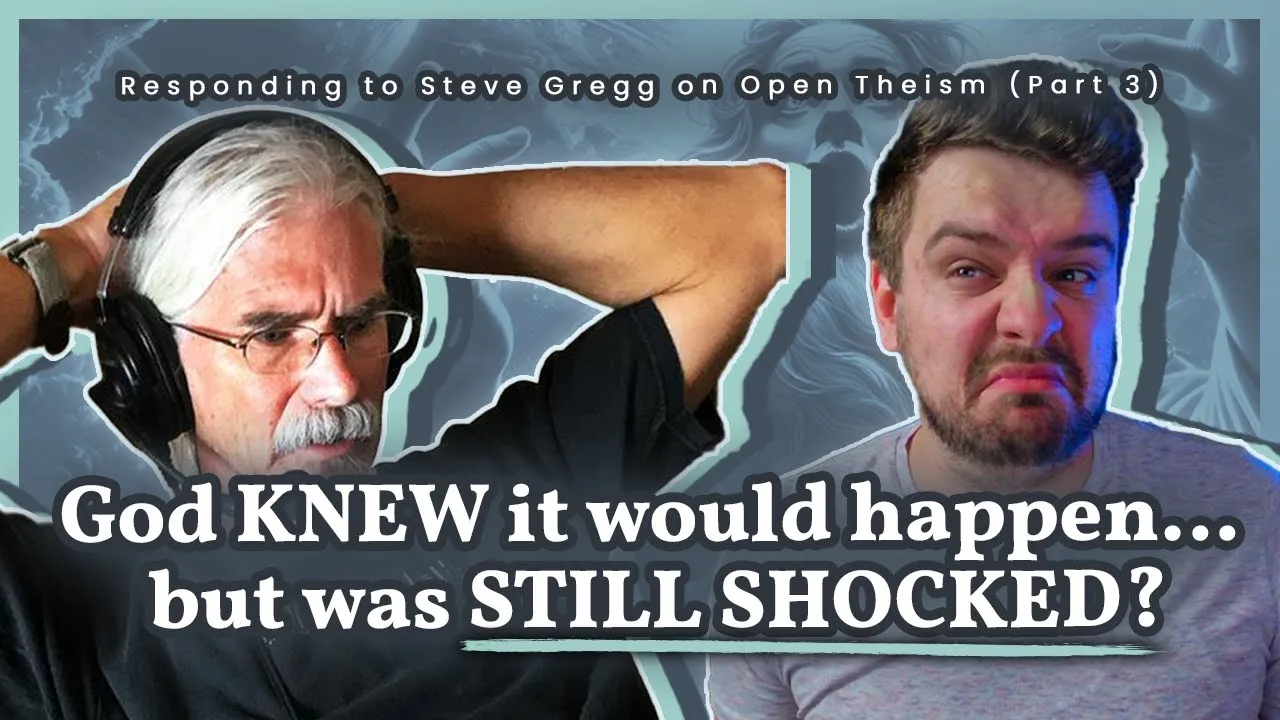
SHOCK & REGRET — is God upset by what He KNEW would happen?
Does God's regret in scripture mean he didn't see it coming? Tim works through the questions.
By Tim Barber··Video·Updated
Chapters
- 0:00Introduction and Video Overview
- 0:44Jonah's Story and Interpretation
- 5:16The Concept of Divine Regret
- 22:25God's Search for Righteousness
- 25:46Divine Surprise and Human Free Will
- 27:48Amazed by Unbelief
- 28:19The Power of Dunamis
- 28:43Shock and Regret
- 28:51The Vineyard Parable
- 29:48Justice and Righteousness
- 31:17Hope and Expectation
- 34:19God's Disappointment
- 35:37Anthropomorphism in Scripture
- 37:37Open Theology Debate
- 41:46Loving Disagreement
- 48:42Final Thoughts and Next Steps
Reflecting on Steve Gregg’s Theological Insights: A Journey Through Open Theism and God’s Nature
In my latest video, I dove deep into a month-old reaction to a fascinating talk by Steve Gregg, exploring the complexities of open theism and the nature of God. As I embarked on this journey, I tackled questions about God’s regret, shock, and true feelings as depicted in scripture—concepts that often spark lively debate among theologians and believers alike.
Understanding God’s Regret and Anticipation
One of the key themes I explored was the idea of God’s regret as expressed in various biblical passages. We often hear about moments when God appeared to regret actions or express sorrow over events, such as in Genesis 6:6. I delved into these scriptures, questioning whether God’s regret implies a lack of knowledge about future events or if it’s merely an anthropomorphic expression—a way to relate to us on human terms.
The story of Jonah was particularly intriguing. I suggested that Jonah’s prophecy to Nineveh was delivered with an ambiguity that left room for revolution rather than imminent destruction. This perspective on Jonah’s message opens the door to viewing the story as a satire, playing with expectations both for Jonah and for God’s message.
The Expectation versus Reality in Theology
As I scrutinized the texts, I posed challenging queries: How can an infinite, omniscient God experience unmet expectations or surprise? Analyses of passages like Isaiah 5:3-7 led me to consider how God’s expectations—expressed in hopeful anticipation—are often viewed through a human lens, leading to interpretations of disappointment or surprise.
In considering scriptures that hint at God being caught off guard, I reflected on whether these passages genuinely depict God’s surprise or have been framed for human comprehension. For instance, the narrative of Isaiah’s vineyard and Jeremiah’s relationship metaphor urged me to ponder whether they reveal deeper truths about God’s relational dynamics with humanity.
A Call for Theological Discourse
Throughout the video, I aimed to foster dialogue on these theological issues while recognizing Steve Gregg’s extensive knowledge and thoughtful discussion. Despite differences, these debates enrich our understanding of God and scripture, inviting us to consider our preconceptions and the broader implications for our faith.
I also touched on recent interactions within the Christian community, stressing the importance of love, respect, and unity among believers. Theological differences shouldn’t erode the profound love and grace we extend to each other as followers of Christ.
Join the Conversation
I invite you to watch my full reaction on YouTube, where I further dissect these intricate themes and share my perspectives. It’s a deep dive into scriptural analysis that encourages reflection on how we view God’s nature and the narratives that shape our spiritual beliefs.
Let’s continue this journey together, grappling with the complexities of faith while embracing the love and unity that define us. Your thoughts and insights are invaluable as we navigate these profound theological discussions. Watch the video, engage in the conversation, and let’s explore these themes with grace and openness. Thank you for your patience, and I look forward to seeing where our discussions will lead. God bless you.
Transcript
[0:00] hey guys I'm back with a fresh haircut and I'm still reacting to a month-old video what is wrong with me I intend to just Blitz through the entire thing from here and see if we can finish this whole thing I've got about another 50 minutes of actual reaction time left in the video itself so we're just going to have to see if there's something crazy that requires me to make a huge pause and have this big long conversation about what I'm seeing then we'll do that but otherwise uh we're just going to jump right back in from this awesome place that I paused my friend Braxton Hunter and uh his his very flattering face that he's making there and we're just going to let Steve Cook and see what we can what we can find to react to and uh I've noticed a couple of open theists in the chat saying are we going to have an open theist at some point and yes I'm going to have an open theist on to do a similar treatment uh so we get both sides of it don't think I've seen now we have some Jonah texts three passages
[0:47] here that I'm going to read uh first Jonah 1 says arise go to nin of the great City and cry against it for their wickedness has come up before me and you've kind of already answered the Jonah story but we'll get through this here uh Jonah 32 says arise go to n of the great City and Proclaim to it the proclamation which I'm going to tell you and then Jonah 34-10 then Jonah began to go through the city one day's walk and he cried out and said yet 40 days and Nineveh will be overthrown then the people of Nineveh believed in God and called a fast and put on sackcloth from the greatest to the least of them when the word reached the king of Nineveh he arose from his throne laid aside his robe from him covered himself with sackcloth and sat on the ashes he issued a proclamation and it said in Nineveh by I love the king's declaration Nineveh by decree of the king and his Nobles do not let man Beast herd or flock taste a thing do not let them eat or drink water but both man and Beast must be covered with sackcloth and let men call on God earnestly that each may turn from his Wicked way and from the violence which is in his hands uh who knows God may
[1:35] turn and relent and withdraw his Burning Anger so that we will not perish when God saw their deeds that they turned from their wicked way and God relented concerning the Calamity which he had declared he would bring upon them and he did not do it I love that he even commands that the animals repent here yeah and God mentions the animals at the end of the story too how that God spared them too yeah even the cows repented yeah we've talked about this is this is simply an example in an actual story of the principle that was stated in Jeremiah 18: 7 through1 that if God pronounces judgment on a people and they repent then he'll turn around he'll change his Direction and he won't destroy them I think it's important to note I guess you would agree with this that since we both believe that man has uh Free Will libertarian Freedom uh real free will where they could choose among options um if they had not repented if they had chosen not to repent then uh as God says there he would do as he said and the only Factor here is whether they
[2:23] repent or not and God knows ahead of time what they will freely do now as you've said there's different ways of conceiving how that might be possible but the point is it's you're saying it seems from the text that he knows what that free choice will be not that he determines the free choice he just knows what it will be and this is true again this is true sometimes this is kind of an interesting one I have kind of a hot take here when it comes to Jonah as a story in general um but there's something really interesting going on in the Hebrew for um Jonah's message in Hebrew it's only I think it's like five words it's a very very short message not even really you know as written not giving any sort of warning or possibility that there could be uh you know avoidance of the disaster coming it's just telling you hey 40 days and this thing's going to be overthrown or overturned and that's the interesting thing is that in the Jonah message the
[3:11] thing he actually says the word for overthrown or overturned is the same kind of word that you use to describe a revolution something revolutionary happening so I think that there may even be a subversive way in which God was using a pretty ambiguous statement that Jonah goes and gives which is in 40 days place is going to be overturned to kind of go Jonah almost into going and doing the thing and giving the message because what Jonah is hoping for is that these people are going to be destroyed they're not going to repent they're not going to turn and he wants them to be overthrown and instead it's like God's message that he gave to Jonah to go and speak got fulfilled in a really interesting subversive way that Jonah himself didn't anticipate except he did anticipate it in one sense because he says I knew it I knew this would happen I knew you would
[3:59] be merciful because you're so loving you have your loving kindness and your Covenant faithfulness and your love for people and he's almost taking God's self- description from like say Exodus and throwing it back in God's face so I have kind of a hot take when it comes to Jonah I think that Jonah is the more interesting part of the story than the City full of ninevites and even the cows repenting Jonah almost reads to me almost like satire whether it actually happened and history or not I think it's a story that takes the shape of satire it's really interesting to just watch that all come together but but I don't know Jonah is probably not my favorite open theist proof text let's say that's how I would see it okay now uh the last verse the last passage from this first section about God changing his mind is Joel 2: 13- 14 says and Rend your heart and not your garments now return to the Lord your God for he is gracious and
[4:46] compassionate slow to anger abounding in loving kindness and relenting of evil who knows whether he will not turn and relent and leave a blessing behind him even a grain offering and a drink offering for the Lord your God what do you have to say about this similar answer I imagine it says who knows whether God will do this sounds like the prophet of himself is saying you maybe God will do this I don't know that he's I don't know that God is saying who knows but if God is saying who knows the answer is well God I mean to ask a rhetorical question like that doesn't mean that there's no answer um anyway I don't see that one as as a strong one I mean age it could just be the prophet right it's just not a strong text all right now a new section here on uh places where it seems like God regrets and so something that he does so Genesis chapter 6 verse 6 I should put it up here before we really get into this um again we what we've talked about already is we talked in the last video about God having a policy and how it doesn't make sense to have a policy about what you
[5:35] will do in emergent circumstances if there are no emergent circumstances if all you know is all that will happen then there is nothing about which you have to prepare a policy at least not in any real sense you could communicate a policy to people who you already know what they're going to do but again one of the main things that arose out of our last video is that that entire method of approaching Humanity feels really duplicitous on the part of God in that same way can you regret something that turns out exactly as you always knew it would turn out I utilized this a lot in my debate with James White if it can be accurately said that you regret something it means that it turned out in a way that you are not happy about the outcome and you would have done something differently if you could go back and do the whole thing over again
[6:22] that's simply what a regret is now again maybe that's not a Hebrew word we' need to kind of see if that concept is in play in the way the passages are written and if it's not then we can maybe discard that verse but if that concept is in play that God is getting a result that he is unhappy about that he thought he would get a different result and if it's this isn't a necessary piece of the idea but if there is ever also the presence of he would go back and do things differently all of those things are a regret you don't need all of those things together in order for a regret to be present you just need one of them if you ask somebody hey do you have any regrets about your life they could tell you that they are sad about how Something Turned out that's an expression of regret they could tell you that they wish they could go back and do something differently that's a regret they may Express that they didn't see something coming they didn't see an outcome coming and that they are sad
[7:09] about the way that things transpired after a decision was made those are all regrets not doing something not having done something that you thought would go in a certain way if you had gone back and done it that's also a regret so if any of those things is present not all of them but if any of those things is present in any of these passages what we're describing is a regret and if God has a regret then we have to at least count the possibility that if it meant he would have gone back and done something differently then that is just completely nonsensical in a reality where the shape of reality is that God knows all things that will happen or even in a molinist scheme where all things that could happen like this subjunctive counterfactuals melanism has its own problems too but that's neither here nor there we're going to let Steve start and we're going to see where it goes with this whole theme of regret Genesis 6: 6 says the Lord was sorry that he made man on the earth and he was grieved in his heart how can God be
[7:57] sorry for something that he does if he knows that well let's face it doing something on purpose can still make you sorry I mean I think of this uh when my ex-wife and I uh when we decided to have children we knew we were bringing human beings into the world we didn't know exactly what ways they might grieve us or break our hearts but we knew that children do that from time to time they disappoint they can bring disaster into the family in many cases we don't we didn't know exactly how they would but we weren't unaware that such things would happen but that didn't prevent us from being really sorry when they did have it now to say I I regret that I did it may sound like he's saying if I had known this I wouldn't have done that again I I take that just as another anthropomorphism certainly when God made man and someone in the comments and someone in other um other areas of my like online social theological circles said that we should do a drinking game surrounding the anthropomorphism thing in this video and I told them that I
[8:45] don't want to do that um both because a I find it disrespectful and then B because I don't want alcohol poisoning that would probably set in pretty quick in this conversation if I took a shot every time anthropomorphism was invade we'll go back and we'll go and look at the actual text of Genesis 66 and just see what's going on there but if you say that you regret that you did something then again like we framed before we started this whole conversation of regret that has a certain range of meaning and it's pretty narrow and it generally means that you wish something turned out a different way than it turned out or you thought it would turn out a different way you anticipated it turning out in a different way than what it has and the way that it has dismays you in some way so we'll just go and see if that's what's at work in Genesis 66 here in a minute and gave him free will he knew kind of thing would happen and I mean even if we take a open Theology and say well God didn't know this would
[9:33] happen I agree with that you certainly know he was creating the circumstance that would make this a real contingency that this could happen he could say Well it disappoints me I'm disappointed I'm grieved about this uh or humanly speaking you know have regrets about this but he is not saying at least I don't believe he's saying if I had known this would happen well I would have never done it I would it's not humanly speaking though again it's this is God speaking this is Yahweh the god of Israel revealing himself to humanity and explaining to them and revealing to to them who he is and what he's like via his own Spirit inspired word so if we're kind of mucking around with that or if we're taking shots at that we're kind of undercutting the limb that we're sitting on I don't know I'll let him keep going think that is how God is about it because certainly again if God's purpose for making man would have been uh you know eliminated by knowing that it's bad uh well then what was God thinking why
[10:21] did he make man capable of doing this kind of thing you know um certainly I mean if if I took an openness View and I don't know if God even knew that Adam and Eve would sin I don't even know if God knew knew things would get this bad uh I still have to say well he certainly made it possible he certainly knew was you know one of one of two outcomes and you could flip it co I mean I just don't think well and this is this is another one of those things I I don't ever want someone to think that in an openness theology you don't have God prognosticating accurately into the future at all that's not in any way humans are very predictable we've talked about this before humans are very predictable it's difficult to predict what a single human will do sometimes but it's very easy to predict what masses of people will do you can kind of look at our political climate right now and you can pretty well understand if one powerful person does a thing then a
[11:08] group of people that are all ideologically motivated in a certain way are going to do something in response they're going to feel a certain way and that will lead a group of them to go do something in response those kinds of things humans are very easy to predict on an aggregate high level especially when there's some kind of like Collective identity and and thing set of values set of ideas that unites them all that's that's pretty easy to predict but I again one of my favorite openness sort of passages is I believe it's 1 Corinthians 2 1 Corinthians 2 is this amazing passage right so there's a whole context to it which I would love to dive in in some other context we're going to say the word context a lot I think um but Paul begins talking about this wisdom it's not a worldly wisdom or the wisdom of men but it's God's wisdom and we're speaking of wisdom of God Among the mature it's not of this age now age you know in this context it's ionas it
[11:57] really it is definitely temporal language it could refer to kind of like all the things that are taking place in that temporal context it's like End of the Age end of the world some people translate into the world but it really is a temporal frame and Paul does say that God's wisdom we're talking about God's wisdom that is not from this age nor the rulers of this age right now that could be again is it this temporal context or is it this you know existence context it's kind of irrelevant to the passage but and especially because we do get some temporal language here in a second which we're getting to it's not a wisdom of this age or of the rulers of this age which are coming to not which are are diminishing but we speak of God's wisdom in a mystery having been hidden a pakum which God pro Oren for ordained before the ages proton ion for our Glory which none of the rulers of
[12:47] this age understood for if they had understood it then they would not have crucified the Lord Of Glory and again I use this in the debate where I say you need to understand that Paul gives and the reason for their choices is because they lacked information but God had a plan in place from before the ages proton before the ages so certainly I think that that at least implies that God knew we would sin and then he wanted to have a plan in place for that I would think before even creating us and that that plan would involve their rescue their Redemption their glorification whatever that ends up looking like in the way that we phrase this and term it out but it's it's explicitly for our Glory I believe that that's what's happening and so certainly God knew we would sin and I know that he baked that into reality as a possibility simply by
[13:35] virtue of creating Free Will creatures who could freely choose to follow and Obey him or freely choose to disobey and rebel but saying that God created a universe in which he knew of not maybe not even just the possibility but the certainty of evil being done does not therefore give us the ability to go just jump all the way to a fallacy of composition and say therefore it must be that God knows all specific instances of evil that will ever be done and how he will respond to some of them but not all of them how he will know every single abusive episode including the age and the differential in age between each party involved and the specifics of the duration and forcefulness of the abuse in each episode down to the molecule that's a fallacy of composition to say that God knew there would be evil does
[14:22] not mean that God knew every single instance of evil that would transpire forever all the way down to the molecule throughout all of his that would unfold after his decision to create and if he did I wonder if he would regret it I don't know but we would pose that question but anyway this is a fallacy of composition God is saying well this changes everything you know I just wouldn't do wouldn't have done this experiment if I knew it was going to turn out this way well I don't think that God is that ignorant uh and I mean even if he didn't know the future certainly as as I believe he did he certainly knew it contingently that this could happen and he still went forward with it so I think it's again casting God's emotions in an anthropomorphic form gotcha let's see if you give a similar answer excuse me to First okay keep my I maybe I will do a drinking game but it'll be like a coffee and hu Shake drinking game Samuel 15 10 through1 which says when the word of the Lord came to Samuel saying I regret that
[15:09] I have made Saul King for he has turned back from following me and has not carried out my Commandments and Samuel was distressed and cried out to the Lord all night what do you say about this I do say the same thing about that I think it's anthropomorphic I think he's talking to Samuel more less manto man although God is not a man he's talking to a man as if it was a man-to-man conversation and he says you know what I did has turned out a to me that could be true whether God knew it would or not in advance again the word regret okay sorry again just just walk through the logic with me we leveraged the analogy a little bit last time but I'm just going to dig it out again because I think that it's helpful I am the owner of a company and I have a candidate here I I wanted to be the CEO of the company but then all the people that worked for me in the company said no we don't want you as a CEO we want a different kind of CEO you're the owner you should just be the owner go be the owner and we'll have a different CEO who's going to run this thing and you just own it but they
[15:56] really wanted to oust me so I say okay fine in this situation in the analogy it's like I'm the creator of the company and I wanted to be the CEO I wanted to be the king I wanted to rule over them but then the people in my company that I created rejected me ousted me from my own company as CEO and then wanted to install someone of their own choosing to be the CEO of the company now so I'm still the owner of the company I really do have the decision-making ability but I decide to Grant okay fine you can have a CEO this is what CEOs are like if you want to have a CEO this is what CEOs are going to be like they're going to take all your resources says you know whatever maybe the braly breaks down after a while but if I knew the exhaustive downstream outcomes of a path that would destroy my company destroy all the people destroy everything that I built this thing for work counter to my
[16:44] purposes to create human flourishing in life both within my company and outside of the company in all the other areas in which my company affects the world and I wanted to create life and Order and beauty and I wanted to take the world away from chaos and death destruction but then I explicitly hired a CEO knowing full well that he was a chump that he had a rotten black withered heart all the way down to the core that he was going to mistreat my people that he was going to break all the rules that I set for my company and how things are supposed to operate that he was going to deny me as the owner of the company and that he was going to wreak havoc and destruction and Chaos everywhere he turned and I still hired him then a you would not call me a very good owner of a company and you would be right to call
[17:32] me into question for it B you probably would not call me infinitely wise and altogether sound and sure in my judgments for hiring this person knowing full well exactly where it was going down to the second molecule and every minute detail and then if I expressed regret for it if you knew that I knew 100% exactly what was going to happen you probably would call my own character and judgment into question because you can't really regret something that turns out exactly as you always knew that it would especially if it only happens because you made it happen you brought it to pass so if God installs Saul as king fully expecting all of the horrible things that transpire to transpire not just expecting but knowing with specificity down to the second exactly what's going to come the entire episode throws God's character and wisdom into
[18:19] question by his own standards not mine on the other hand if there were open possibilities that it could go this way or it could go that way it could be a really good thing perhaps having a king like the other nations that is still faithful to Yahweh would have been a more effective apologetic strategy for getting more of the Nations to recognize Yahweh as king and as God and creator of the universe maybe there was a purpose behind it that was intended that nevertheless was subverted when Saul was himself subservient to the snake instead when he chose to reject Yahweh as his God and King and he instead turned from him and served the serpent instead maybe that was an outcome that Yahweh did not want and did not anticipate and so when he got that outcome it was a regret that he expressed at least that's the direction that the passage seems to take us so I think we ought to be very careful when we are moving away from that sort of an interpretation because I think that it puts God into a pretty
[19:07] weird light may give the impression that God's saying i' never if I knew it would turn out bad and yet when the people asked for it came goded to it in first samel chapter 8 he told him it's going to be bad he didn't tell them how bad he didn't tell them he didn't tell them the king would be a total rebel against God but he did he know things would not be how you want them to be this is not you know but yeah maybe maybe the owner is saying like look you're going to have a see I'm a good I'm I'm going to be a good CEO to you I'm going to listen to you I'm going to pay attention to your needs if we bring in some outside hire Mr outside hire is going to be like he's going to work you guys like a Taskmaster he's going to require that you stay here on nights and weekends and that you sleep under your desk he is going to you know run you guys into the ground in service of getting all the numbers up that's what a CEO is like are you sure you really want a CEO all right and then you hire the CEO cuz that's what cosos are like and that's what the people
[19:54] expressed as their wishes and you're working with them and you don't want to work against them and then the CEO turn turn out to be like a satanic cult leader and he's literally like sacrificing live goats in his office or something and that's not what you anticipated you'd say oh my gosh this is even worse than I thought it would be that seems to be the shape of the story we can't just say oh God knew it was bad he didn't tell them how bad he should have told them how bad especially because he's proven in all these other instances from the previous couple of videos he's proven willing to bend the truth and misrepresent the actual State of Affairs in order to get people to do what he wants so if he was willing to do that in order to avoid a negative outcome then why didn't he do that here why didn't he just tell them how awful kings are why didn't he tell them about manasse and say no you guys it's going to get really bad you don't want to do this just kind of throws the whole thing into question when we say well it
[20:40] doesn't actually mean what it says it must mean this other thing based on prior commitments it's just not my deal but that doesn't mean he didn't do it anyway in fact in giving them the king he was as it were sort of like he gave them the request and with it leaness of Soul you know uh I again I just take this both both this and Genesis instances where this is answer Morford language and again uh an open theist will simply get tired of this is like a broken record well this anthropomorphic this anthropomorphic and the reason is like a broken record is because it's the consistent way that the stories are told in the Bible it's not a theological tretis tributes of God it is a story God interaction with man many cases okay but is it a real story is it a true story or not is God actually representing himself in the story the way that he is as a character or is he misrepresenting the actual State of Affairs in order to manipulate people into thinking that he is a certain way and if we're all about truth and we want to access truth and we
[21:28] want to place the Bible anywhere near our axiomatic base of what we believe to be true about life the universe and everything then why was it written this way if it was written this way and that runs counter to an interpretation that says well it really doesn't mean what it says it must mean these other things based on prior commitments the story is told as if God is a character because I believe God is a character and he actually interacts with human beings again just love Steve Greg love him as a man um but this is not the best approach so at least someone like him and with both of these that we've just covered in this section it sounds like what you're to me tell me if I'm wrong it sounds like what you're saying is the thing that God is supposed to not know here it seems like we have other information that he kind of already does know or basically knows uh you know like with the Genesis passage he knew it would go one or two ways he had reasonably that and similarly here uh we get you know
[22:18] you just said uh that he had some awareness about this ahead of time so I think that's important now Ezekiel 22: 29-31 says the people of the land have practiced oppression and committed robber and they have wronged the poor and needy and have oppressed the Sojourner without Justice I search for a man among them who would build up the wall and stand in the gap before me for the land so that I would not destroy it but I found no one thus I have poured out my indignation on them I have consumed them with the fire of my wrath their way I have brought upon their heads declares the Lord God so he's looking for a particular kind of person he can't find him anywhere even though he's searching God is searching yes I was reading this list earlier I thought like this I think this passage to is perhaps in the wrong category I I don't see anything about regret here I see God saying if I had found intercessor things might have turned out differently you know but I didn't but again I don't really see that anything to God's for knowledge it's more you know things
[23:05] turned out this way and could have been better if it been an intercessor yeah okay well but that's not what the passage says what the passage says is that he sought one and couldn't find one again I think we should have a really good reason from going away from the plain meaning of the words that are used in the text I agree that this isn't really about regret but the concept is still I went looking and couldn't find it if I knew that there was not $100 bill on the floorboards of my car and I told you that I went out to the car to look for it to look for one it's not even an it like I know it's not there and I'm talking about an it like a specific thing but I'm going out to look for one and I know there isn't one there and I go to look for one and I don't find one again you probably would not call me infinitely wise if I knew all along that there wasn't one there to go and find and this may also arise a
[23:54] certain criticism around like my view of God's omnipresence in the world because people would say well if God is omnipresent why does he need to go searching if God is omniscient and knows the present perfectly why does he have to search in order to gain information and my answer is consistently that that's how he's portrayed on the pages of scripture it's not God just has preent instantaneous knowledge of everything that is transpiring on the face of the Earth simply as a property of himself that's not the way that it's described the way that it's described is that the eyes of the Lord go throughout all the Earth very many many times on the pages of the Old Testament an Angelic being is depicted as bringing to Yahweh a report of what they've gone out to find now do I believe that there is a good apologetic case to make that God is omnipresent in some sort of a classic
[24:41] way where his own lifegiving permeating presence is everywhere in the entire universe and he can in that sense see everything that's happening because everything is as if it is so close to him in his proximity he's observing it all sure sure but I don't want to go beyond that either I would need to make a case for that because that's going actually beyond what the text of scripture says in most instances in most instances when it's describing God's present knowledge it is a gained omniscience it is an omniscience that comes from his observation either through his direct site or through proxies returning with information and reports so it would be perfectly appropriate in that instance for God to conduct a search in hopes to find something and then if he does not find that thing it's not like it's going to take him a long time to perform a search right but if he searches and then does not find I could easily see God in my mind saying that's pretty lame or in
[25:30] Steve's words this whole thing would have gone better if there were an intercessor but if you know something does not exist it's foolish to even undertake going to search for it but maybe I'm just one of those oldfashioned people who reads what the text say Isaiah 5 and vers three this brings us to a new section now where it seems like God is um shocked or uh what happened caught him off guard he's surprised by it Isaiah chapter 5 okay sorry we got a new a new a new category so my favorite of these is actually Jesus he says God does this all the time but it's you know people will kind of dismiss it as poetic language prophetic language whatever I will not dismiss that I think we have to reckon with the text as it's written but one of my favorite examples is actually Jesus when it's about the Roman Centurion the Centurion says I'm also a man under Authority look I can tell a servant to go here and do this thing and another to go and do that thing and it
[26:16] goes and gets done so I know that you he's talking to Jesus you can simply say with a word that my son be healed and he'll be healed and the word here let's go look it up yeah here we are Matthew 8 starting in verse 10 here having heard this Jesus or having heard now Jesus marveled it's easin and said to those following truly I say to you no one so great a faith in Israel have I found so this is interesting because that's also a that's also a searching term isn't it and unless we're going to perform some kind of christological heresy and separate Jesus's human nature from his divine nature he said I have not found Faith like this and he says that he was it it says that Jesus marveled if we look at itas and other places it's used wondered marveled was surprised literally was surprised let's see what this one is yeah so here's a perfectly reasonable way to translate this word
[27:04] and the Pharisee having seen it was surprised that he was not washed before the dinner so if Jesus is trying to come across as some respected Jewish rabbi he would have washed up before dinner and he didn't and this Pharisee goes what he's astonished he Marvels he's surprised he says wow so we at least have to find some place for us to have a category for Jesus to do the same thing because he does the same thing thing that's just what the word means he goes wow I was astonished interestingly if we go to Mark 6 something similar happens there and it's it's it's completely the opposite situation and Jesus was not able to do many works of power except on a few sick people laying his hands on them he healed them and he was amazed because of their unbelief and he was going to The Villages around teaching same roughly the same word but he was
[27:54] amazed because of the unbelief of them he wanted to heal them he went there on the express Purpose with the mission of healing them meaning he anticipated hopefully being able to heal more and making really good use of the time he had in going there to heal but he was amazed he was surprised at their unbelief and he was not able very interesting adun he if someone has dunamis right that's power and Oak here is the like the absolute negative here it's an absolute negative it's a privation it's saying he was not able this is he wasn't able this is he was not able he was not able to do any works of power there and it amazed him because of how much unbelief the people had just another interesting little data point 5: 3-7 says and now ow and sorry I just came back and hit play and I forgot where we were even at okay so we just
[28:41] talked about regret and then this is about shock so now we're going to get into some of these shock uh passages and kind of see where they go for us and Men of Judah judge between me and my Vineyard what more was there to do for my Vineyard that I have not done in it why then I expected it uh why when I expected it to produce good did it produce worthless ones so now let me tell you what I am going to do to my Vineyard I will remove its hedge and it will be consumed I will break down its wall and it will become trampled ground I will lay it waste it will not be pruned or hoed but Briar and Thorns will come up I will also charge the clouds to rain no rain on it for the vineyard of the Lord of host is the house of Israel and the men of Judah his delightful plant th he looked for justice but behold Bloodshed for righteousness but Behold a cry of distress is God surprised at what's going on here Steve before we get into Steve's answer I just got to do a little bit of Hebrew uh Geer
[29:29] with you guys it's really that last verse which I believe is verse 7even it's so good ol Lay It waste prune you know dug up thorns and Briars clouds I'll command that they do not rain on it he looked for justice but behold oppression for righteousness but Behold a cry for help this is so good you guys okay so Justice is mishpat right mishpat is justice is the act of putting to rights something that was disjointed or broken especially in like a societal sense if there is something that is not right is wrong and it should not be the way that it is if there is some um exploitative Power imbalance or something like that that is objectively wrong then an act of justice is writing that wrong righteousness is Sedaka and that is the state of things being put to right or things being rightly related
[30:16] between each other so righteousness is having a right relationship with God himself for example or righteousness is having a right relationship with your fellow citizens or a right relationship with your spouse if there is an argument between your spouse there is Injustice you need righteousness and the fixing of the broken relationship is an act of justice but it's especially poignant when it's like in a societal sense and there's moral evil and all these different things that you're working with but listen look just kind of look at this God looked for mishpat but behold M he found instead he looked for so instead of instead of he found M which is oppression and he looked for righteousness but instead founda a cry for help the Bible is just genius level poetry here just incredible but one of the things that's very very clear
[31:04] from the passage the way that it is written is in fact what more could I have done that I have not done in it when I expected it to bring forth good grapes why did it bring forth wild grapes now this word in this shape only occurs one way but the word itself in various different kind of root forms and the way that it gets elaborated upon occurs like 49 times and the it's kava it's literally talking about like a like a string that's pulled under tension and it's waiting for a thing to happen to just you're waiting for the string to snap it's anticipation or hope right so it's it's a confident expectation that something good is coming it's actually a really beautiful word hope that's what's at the root here but the idea is to wait to look forward to hope to expect so it's like I'm expecting some in a much smaller scale this isn't as like meaningful necessarily but I'm expecting
[31:51] some packages from Amazon today I'm looking outside my window to see if the Amazon truck pulls up and comes out with some little white and blue styrofoam packages or you know whatever the plastic is bubble wrap packages to put on my front porch and I'm waiting there's a tension there where I'm waiting for that thing to happen I'm expecting it to come I'm looking for it to come and then when it happens it's like I'll wait the Rope will snap and then there you go the thing has happened I no longer am waiting because the thing transpired if God is being said to do that with his Vineyard expecting good grapes and instead gets Wild Ones how can you expect something you know will not come how can I have an expectation that the Amazon cart will come with goodies for me to go upgrade my coffee thing or get more filament for my 3D printer if I never ordered them and I know nothing is coming you can't rightly say that I'm expecting anything well this is a very common verse to use to
[32:40] suggest that he is and I can appreciate why it would seem that way again this isn't a par song about a man I mean God is likened to a man planting a Vineyard why does a person plant a Vineyard because he expects or wants grapes why else would he plant The Vineyard he says he says I looked for I expected which is of course the anthropomorphism of a of a Vineyard keeper he does so expecting good grapes now um I I believe that expectation means desired or required I mean certainly there's a sense in which anyone who plants a Vineyard is expecting a harvest but they also know there might not be one they might know something could happen there could be some disease on their vines or you know that's kind of the English way of using the word hope right like when we say hope there's sort of a conditionality to it I hope that the Chiefs don't ever win the Super Bowl again is me expressing a hope that I have in an English sense but there's actually this this works this way in ESP in Spanish too with the word ESP the word to wait and to Hope is the
[33:28] same word in Spanish to wait and to Hope is the same word word in Hebrew too and it's not usually expressed with that same kind of like conditional like it could be but for example when we're talking about the great Christian hope of being resurrected and existing with God forever in a new heavens and new earth and finally doing everything that we were made to do that's not something I'm hoping for in a conditional sense that's something that I'm waiting for and expecting in a certain sense I'm certain that it's coming and that's really more what kava usually means unless you have really good reason for moving away from it and he doesn't really believe that God has any conditional understanding of anything so he would reduce this to an morphism now that I'm seeing kind of the way that he has to see it based on other preconceived notions but that's unfortunate because that's not what the word really means insects are you know a drought there can be things that make it not happen but they do it because they expect or desire good grapes the interesting thing here is that this
[34:18] doesn't suggest that God will not still get good he said I expected to get good grapes that's why the vineyard well his expectations might not be disappointed because there's a sequel to this Parable in Matthew 21 where Jesus said because God didn't get the grapes but he raised it to the ground he he said I got wild grapes when I expected good grapes so I'm going to uproot the entire Vineyard and subject it to destruction and death because it just didn't produce what I wanted it to produce it's not a you'll get a second chance someday to actually meet my expectation it's I had an expectation that I would get good grapes out of this Vineyard I didn't and I'm going to raise it to the ground Matthew 21 oh this is interesting let's see what he say that he wanted from his Vineyard God is taking the Kingdom from them and and giving it to who will bring forth the fruits of it that is the grace right so Justice which is the fruits he was looking for from Israel he didn't get it from them but he'll get it he'll get it
[35:06] you know he'll take that remnant of that original people and through that Remnant which is of course now the followers of Christ he will get those grap so it's it's almost like he expected good grapes and in fact he's going to get them Jesus predicted that he would and I believe that true so there's not even a final disappointment God's disappointed with Israel to be sure and to say he was surprised that they didn't produce in my mind that whole thing is part of the whole context of the peril of a man planting grapes and expecting things and getting things differently but it's again it's anthropomorphic because it's talking about a human situation God didn't literally plant a Vineyard he planted a nation uh it's in the parable it's a man and a Vineyard and so forth and therefore man's expectations enter naturally into the discussion or into the description of the story that makes sense no it doesn't Braxton God love you my man but no it doesn't like why would you invoke a scenario to describe analogously what is transpiring between God and His chosen people if the reality
[35:54] of the situation in no way is actually accurately reflected by the actual context of the story in the parable that's being levied why use it in the first place if we're so concerned with truth why even use this Parable in the first place why write it this way because it's again a misrepresentation of the actual State of Affairs and it could have been written so easily to say something else but it wasn't if it's a metaphor if it's figurative language if it is an analogous situation if it's even allegory then this whole thing only works if it accurately reflects the state of Affairs that it's expressing poetically if it doesn't accurately reflect the State of Affairs then it's a false metaphor it's a bad analogy metaphor does not mean that the metaphor is employed to describe the opposite of the way things are in reality it's
[36:41] intended to give you a surplus of meaning with figurative language to understand what is actually happening and what is actually transpiring in the present State of Affairs that's not how figurative language Works anywhere certainly Steve Greg is a genius when it comes to interpreting Revelation he would be saying the same thing about s symbolic representation of things in Revelation it's intended to give you more meaning not to give you the opposite of the accurate meaning anthropomorphic language or not again I don't Grant any of that but here I am I'm going to get some more he sense to me you've got the anthropomorphism built in in the parable all right so Jeremiah 36 through says then the Lord said to me in the days of Josiah the king have you seen what faithless Israel did she went up on every high hill and under every Green Tree and she was a harlot there I thought after she has done all these things she will return to me but she did not return and her treacherous sister
[37:29] Judah saw it so here it says I thought she would return to me yeah I've always thought this is one of the stronger verses for open theology because God seem I thought this would happen but something else happened however in keeping with the whole General thing that God talks this way again we have to remember God talks as if he doesn't know things that are happening right now down the road from Abraham you I mean God talks like he doesn't know stuff Adam you didn't eat that fruit did you how' you know you're naked you know I mean these are not cases where God that's a known answer question and uh well so that's different because that's a known answer question if my son is covered in cookie crumbs well he's he's 10 or 11 now he only does that every once in a while if my daughter or even like my 2-year-old nephew is covered in cookie crumbs and there's evidence all over the place he's got chocolate chips smeared all over his cheeks and he's clearly still holding a cookie his other hand is stuck in the cookie jar and I say hey buddy did you uh did you get into the
[38:17] cookies that's a known answer question I know he got into the cookies the evidence is all around me but that's not the same thing as saying well I thought for sure after this she would return to me and then she doesn't return to me that's that's an upset expectation and I think that that's the most natural reading of the text again going into the Hebrew Hebrew is a lot more indeterminate sounding and a lot more flexible than us westerners are you are accustomed to thinking there's lots of interesting ways to express a concept in Hebrew and lots of different ways to kind of try to cash out what a verse says this one can be read something like after she did all these things I said Return to me to her that is a way of reading it I don't think that's the most natural reading in so far as this kind of answer takes place it's no more surprising that he would Fain ignorance of future things than that he F the ignorance of the present now someone
[39:05] says well if he's feigning ignorance isn't he deceiving well again this is this is our American way of looking at things if we're saying well the Bible is given to us as a book of proof texts to affirm certain theological categories you know the forn knowledge of God the lack thereof now the Bible the Bible narratives they're not given as a series of proof texts it's true some things can be proven from them there's no question about that but Moses the writers of Samuel and kings and so forth and the prophets they weren't writing to give us proof texts about theological categories it's Western thinking that mostly wants to categorize things and say these verses support this idea these vers support that idea it's a well okay that part part of that is fair I am skeptical of sort of unexamined approval of Western modes of thought because the Bible is fundamentally an Eastern document it's not a western document rooted in post Enlightenment Greek
[39:54] thinking or something like that it's not it is expli L the right way to understand it is in an ancient NE Eastern eastm minded context but at the same time it's not like the East was like totally fine with deceptiveness and misrepresenting the actual State of Affairs in order to communicate something that is the opposite of the way that it was written that's not an Eastern thing that's a twisting ourselves into knots because we want to avoid an unavoidable conclusion from the way the text is written thing and if God himself is the standard of Truth and there is no deceit in him at all there is no dark Darkness at all than ascribing anything that could be called lying or explicit deceit to him I think is inappropriate now does that mean that he can't employ lies and he can't twist that he can't turn a lie in a direction that comes out on the other side with
[40:45] his intended outcome of course he can do that again he's portrayed doing that thing on the pages of scripture all the time there's a amazing story of that Prophet that gets brought out from the dungeon to talk to the king and they ask him what he sees and he says oh you know God was in the Heavenly throne room and he was with his Council and one member of the council says this another one says that I could put a lying spirit in the mouth of one of this king's prophets to get him killed and God says yeah okay go do that and that's ultimately what happens which is super interesting so God can do those things but it's not as though God himself then is lying God himself is the liar God is expressing something about himself that he knows to be untrue for the purpose of misrepresenting himself and the State of Affairs to people in order to manipulate them into doing something that's not what he's doing there there's a difference it's a story it's a true story but it's a story that's told in
[41:32] terms of an interactive relationship where God relates as if he is a man talks as if he is a man talks as if he's as ignorant as a man is in some situations and I believe this is a case of that I'm sorry to pause you Steve your mid-sentence I just want to continue to reiterate how much I love Steve Greg and how much I love Braxton Hunter there's obviously areas of disagreement and I've gotten pretty heated and probably pretty upset looking in this context and in these videos but I'm still I still love these people you can love people even though you disagree with them and shoot I love love people who have been way more unkind to me than Braxton or Steve have ever been they've never done anything unkind to me in fact I still love I love James White I pray for that guy's Ministry every day that's kind of a rabbit Trail but anyway I feel like this entire project of trying to figure out what God must be like by certain preconceptions and preconceived notions and pre-commitments we make to other ideas about the nature of reality
[42:21] the way that we think it must be is the epitome of that Western arrogance it's the epitome of that ass that we've got it all figured out we really do know what the shape of reality is in all of these different ways and so this really what it's saying must be subservient to our view for reasons now I'm not saying that everything that the Bible presents is exactly the way that reality is I for example believe that the Bible does teach a flat Earth built on pillars suspended over Waters with a firmament Dome and Waters outside of that Dome and the stars are hung from the that's the nature of the biblical cosmology and I don't think that that's an accurate picture I think that what the Bible intends to teach by those things is different from the fact that it says it that way so not everything needs to be taken in a woodenly literal
[43:10] sense and we need to ask what is this passage actually intending to convey is this passage intending to convey that the Earth is actually composed in this way or is this passage intending to convey that the Earth is ordered and good and beautiful and that there are different domains in which different kinds of character live and have different roles for example in the first couple of chapters of Genesis I think that that's what's happening but this way of talking about God himself for whatever reason it just seems to me like it leads to so much distance it would lead to so much disconnect between our way of understanding God and then the way God actually is somehow where he's already very difficult for us to understand but the entire purpose it seems to me a direct relationship with people and then revealing himself and establishing relationship is so that he can be known somehow for who he is and
[44:00] when he's in the middle of undergoing a project like that which is often what he's doing when he's communicating to and through the prophets is he's these people are The Minority Report that he's revealing himself to because the main power Brokers in the Kingdom he's trying to relate with have lost their way and he needs to get someone reestablished in perfect relationship with him in righteousness and Justice so that they can go out and be a lifebringer or to warn against the the excesses and the direction it'll go if they continue to sin it seems to me that God would be better served revealing how he actually is to that person not playing fast and loose with things and not actually revealing who he is this just makes me sad because I think that there's a lot of unnecessary distance here that there just does not need to be I've been teaching the Bible for 50 years that doesn't mean I know it I should say it doesn't mean that I'm right it does mean I'm familiar with it and uh in my
[44:47] reading of the Old Testament in teaching verse by verse times uh it's obvious to me that uh revelation of God is what God does so that he can relate with people and it's not overly intimidating well obviously you do know your bible really well and I appreciate how congenial you're being about open theists and about the fact that hey you could turn out to be wrong on some things but I also like the confidence comes with that many years studying all right uh Jeremiah 3:19 through2 is the last one in the section that we're in right now about things that caught God off guard or that he was surprised by says then I said how I would set you among my sons and give you a pleasant land the most beautiful inheritance of the Nations and I said You shall call me my father and not turn away from following me surely as a woman treacherously depart from her lover so you have dealt treacherously with me House of Israel declares the Lord yeah I mean uh I'm not sure if the reason this verse is given is because of the line
[45:35] that God says I said You shall call me my father and not away pred as if that's a prediction if it was a prediction it didn't come true but I see it as a command I see it as an imperative you know you must not turn away I don't see I thought that would happen but I gave that command I will say this though that as a woman treacherously departs from her lover obviously her husband doesn't expect that uh when a man marries a woman he doesn't expect her to treacherously go off and have affairs uh but again this is a very anthropomorphic picture a husband is a human uh a wife who cheats on husband is a human also and just as we could say well in in the case of the humans the man didn't know it would happen or else he would have married her and but God's not making that point the point he's making is not what he knew or didn't know he's not in every respect like a man but the treachery of Israel is like a treachery of a wife who made a promise and doesn't keep it that's that's all it's saying all right we'll get to that next section here in the next video we do but I think
[46:23] it's pretty clear that I am in disagreement even strong disagreement with the way that this is being presented I've tried throughout to reiterate my just unending love for Steve Greg I think that he's a great Bible teacher I think he's a great thinker he is usually and uncommonly willing to look at the context of a passage and to look I would say at the context behind a passage in its own historical you know frame and he's uncommonly willing to follow the evidence where he believes that it leads I think that this is probably the weakest thing I've ever heard him make a defense of and it's clear he said this I said this kind of back in the first response video I did to Steve it's clear to Steve it's clear to me that Steve understands my view better than most
[47:12] people who don't hold my view he understands that it's really more of a discussion on the nature of time and reality than it is on what God knows or doesn't but then in pursuit of his explanation for why my view is not true and doesn't accurately reflect reality I think that he's a wrecking ball to God's intended purpose in revealing himself he's reduced God outside of the realm of emotion that he claims to feel I don't think it's anthropomorphic and if it what what even mean in this context if it's not true if he's speaking humanly that he feels this way but then in reality he doesn't he doesn't feel this way he doesn't have any shock he doesn't have any regret he doesn't have any expectations that aren't met because again if you expect something and then you don't get it that's a missed expectation but if you knew exactly what was going to happen how in any honest sense could you say you expected
[48:01] anything other than what you knew was going to happen that's what it means again if you're waiting for something I order something from Amazon and I'm expecting the package to come and even that depends on other people I'm expecting the sun to rise tomorrow morning like 5:30 6:00 a.m. my time and it's whatever the Earth is rotating the sun isn't actually rising in that sense we're rotating and moving relative to the Sun so that's what it looks like when it's rising okay whatever for some reason I always get someone in my comments who says something weird like that but nevertheless if I knew that the sun was not going to do that tomorrow and then I said I'm still expecting for the sun to do that tomorrow you would not call me infinitely wise I think that this just does a lot of damage to the way that God portrays himself in the pages of scripture and puts unnecessary barriers between us and understanding God the way he explicitly tried to reveal himself through the spirit
[48:48] inspired word and if he wanted to represent the way that things are then I think that that's what we have but if the State of Affairs is a different way than the way that things are described is duplicitous and false and the entire Bible and the entire shape of the narrative is something that we have to ignore and move away from not affirm and consider that the spirit may have intended to communicate it the way that the spirit communicated it through Moses and the authors of all the different prophetic works that we've gone through in the Old Testament so far and even you know Jesus's own expectations and Jesus's own phrasing of things so I I don't know why Steve doesn't land here really he just says he's not convinced but his answers are not that convincing to me either and I want to say a couple of things I want to make another video about this in Greater depth and detail
[49:36] anyway um there have been some interactions in Christendom lately in online theological spaces that have made me really sad as a follower of Jesus where you know we're given a way of life that is prescribed to us as the appropriate result of someone who claims Jesus Christ as Lord and it includes things like outdoing one another and showing honor especially if this person is a Believer actual enemies even someone who would point an AK-47 at your face and try to get you to recant Jesus you're still supposed to love that person too but I've just seen some interactions and some of you guys probably know what I'm referring to and I don't know this might create a firestorm that I need to respond to and that's fine I'm willing to stand up to that because it needs to be said but Christians it's just not appropriate for us to be unloving period to anyone that's not what we're called for that's
[50:25] not what we're created for that's not the way that our relationships go so yeah I'm talking about the Chris date situation so like look let me just publicly Express I don't approve of any believer no matter how I may otherwise agree or disagree with them I don't approve of any believer cursing out another believer levying ad homm attacks calling into question their salvation it's before their own master that they stand or fall and they will stand because their Master is able to make them stand and as it lies with me as far as it lies with me my job is to live at peace with all people to outdo one another in showing honor and to be loving and kind and gracious to all of those who claim the name of Jesus because those are my brothers and my sisters and even if they weren't my brothers and my sisters I'm supposed to love them I'm supposed to love my neighbor as myself basic Golden Rule stuff basic platin you know there's a
[51:12] platinum rule on the other side of this but basic Golden Rule stuff is just you ought to treat other people the way that you would desire to be treated and then the Platinum rule is love one another as I have loved you that's Jesus's command he says a new command I give to you before they go and enter the garden love one another as I have loved you so you are to love one another and so as as long as I am confident that another person is within the kingdom of God then I'm Duty bound but more my heart should be tuned toward being loving to a brother who even disagrees with me even sharply disagrees with me and that's something that you know I can say with a high degree of confidence that Braxton does that Steve does over there and Steve looks like he's asleep that's something that both of those men do extraordinarily well and that's something that I really appreciate for them and it has the aroma of Christ on it so if we're that kind of person where
[52:00] we're being contentious we're causing problems we are being overly sectarian divisive we're pushing away people that are Brothers and Sisters in Christ simply on the basis of the fact that we disagree with them and then if we reduce ourselves to ad homonym attacks and needless bullying and name calling then we're also not acting in a way that is conducive to the way that Jesus wanted us to treat one another we're out of step with the marching orders of our king so I'm way late in this recording but I was just thinking about I was thinking about about the Chris date situation I was thinking about the way that Christians have been treating each other and I've seen some really awful things get said about people that I know for a fact love Jesus and want to then want to demonstrate and dedicate their entire life to loving him and loving others the way that Jesus loved them and that's not limited to how these people love other believers it really ought to it's it's how they love everyone that's
[52:49] how they evangelize it's how they take care of people who are not even Christians yet they love them and it's not fair for us to be un kind to each other to be unloving to each other we can disagree we can disagree strongly we can disagree strident but it's not just a strategic thing to be loving and to be forbearing and to outdo one another in showing honor it's not just a strategy it's not just our marching orders it's evidence of the fruit of the spirit of the spirit himself at work in our lives and to the degree that we're not living out a life that looks like love joy peace patience kindness goodness gentleness faithfulness and self-control to that degree we're missing the mark even when we disagree cuz if we just you know drop ourselves up into ranks and teams and then throw rocks at each other what good does that do Jesus's own apologetic stance was this that the world will know that he is who he says he is that the Lord sent him when we are
[53:39] one even as he and the father are one he and the father are so perfectly unified that they're Inseparable and until we achieve that same kind of unity we are dampening our apologetic and Evangelistic Effectiveness so I just happen to think that it's deathly serious and it's a matter of life and death for the church and I'm not personally going to stand for it I made disagree I may even poke loving fun at you in the same way that I have to Steven Braxton today but at the end of the day I want you to know that I have an undying love for those people even if I disagree with them I didn't expect this to happen at the end of this video but that's where we are and I wanted to say something I thought you should all know where I stand on this maybe I'll make another video about it explicitly but the next video is going to be the rest of this Steve Greg conversation we're going to go through it and we're going to try to finish it I'm not sure what the next section is about but I'm looking forward to giving my full response to Steve Greg and having part four come out as soon as I possibly can thank you guys all for your patience
[54:26] looking forward to the next one God bless you
Tagsopen theismgod's regretsteve greggjonahgenesis 6