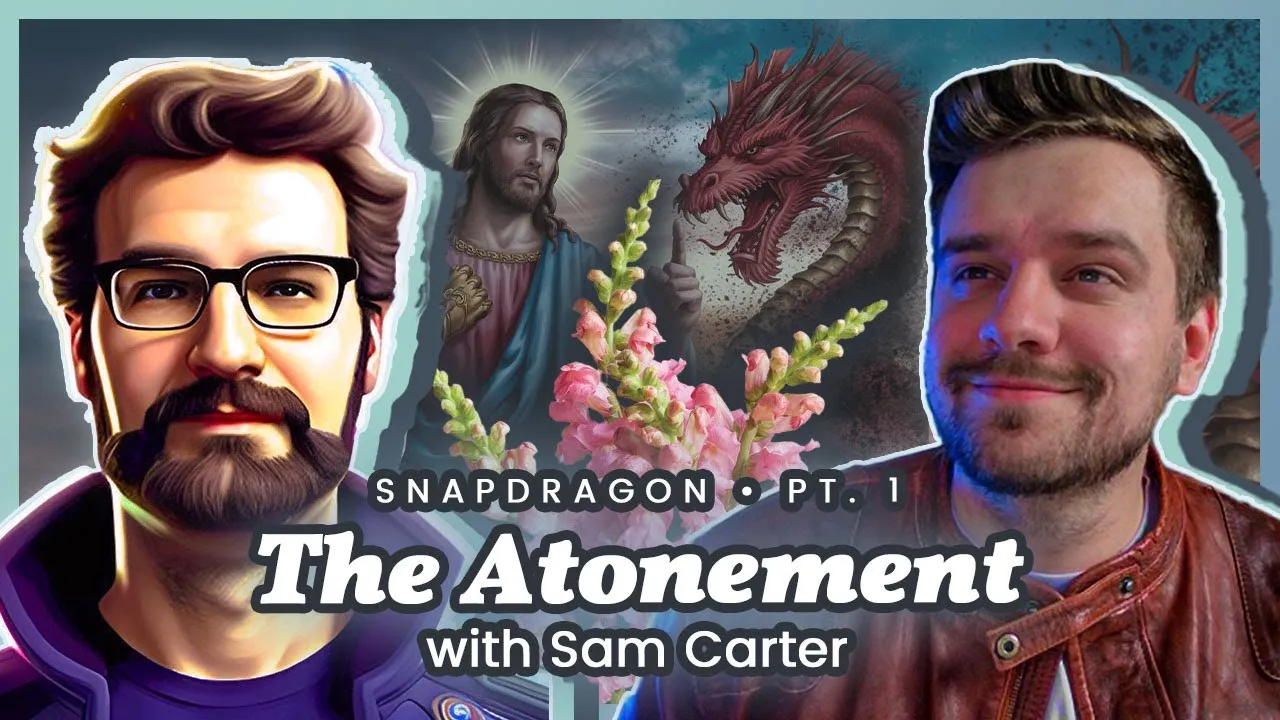
What do SNAPDRAGONS have to do with Jesus?
Sam Carter and Tim Barber unpack the Atonement through the Snapdragon acrostic, one letter at a time.
By Tim Barber··Video·Updated
Chapters
- 0:00Introduction: Sharing the Gospel and Its Challenges
- 0:33Meeting Sam Carter: A Theological Connection
- 1:25Unlocking the Puzzle of Atonement
- 2:35Exploring the Concept of Atonement
- 6:11Ancient Near East and Biblical Perspectives
- 7:43Snapdragon Acrostic: A Deep Dive
- 29:08Exploring Ancient Atonement Models
- 29:46Classical Names and Models
- 31:54The Scapegoat and Covenantal Models
- 32:48Modern Interpretations and Girard's Theory
- 35:19Theological Reflections and Housekeeping
- 38:53Summary and Final Thoughts
Introduction: Reflecting on the Gospel and Its Complexity
In my journey talking to people about Jesus, I’ve often found myself at a loss for words, especially when explaining the profound, foundational concept that He died for our sins. How do we articulate something so central to our faith, yet so complex? This question spurred me to explore it more deeply, and lucky me, I found a like-minded thinker in Sam Carter. Our recent two-part conversation delves into the various dimensions of the Atonement through an insightful acrostic, Snapdragon.
Meeting Sam Carter: A Theological Connection
- I recently connected with a brilliant theologian, Sam Carter, following my debate with James White.
- Sam and I share many theological pursuits, and our discussions revealed a significant overlap in our interests, especially regarding the Atonement.
- We’ve recorded our conversation, which breaks down the Atonement from multiple perspectives.
- This video is a deeper dive into concepts we’ve only scratched the surface of on my channel.
- Here, I introduce the Snapdragon acrostic—a comprehensive guide to understanding the profound truths of Atonement.
Unlocking the Puzzle of Atonement: Snapdragon Acrostic
S-N-A-P-D-R-A-G-O-N: The Components of Christ’s Work
- Scapegoat and New Covenant: Exploring how Jesus embodies the Day of Atonement ritual and establishes a fresh covenant.
- Adamant Restoration: Christ retraces and perfects Adam’s path, repairing what was broken in the Garden.
- Passover Lamb: Jesus as the ultimate sacrificial lamb, whose blood offers divine protection.
- Descent to the Dead: Christ’s journey to the underworld, liberating righteous souls.
- Ransom: The idea that Jesus’ sacrifice paid humanity’s redemption price.
- Archetypal Example: Jesus’s life as the supreme moral example, inspiring believers.
- Glorious Conqueror: Highlighting Christ’s victory over evil, sin, and death.
- Offering to the Father: Jesus’s life and death as a perfect offering to God.
- New Creation: The transformation of believers into His holy image and likeness.
A Broad View: The Importance of Different Facets
- Integration of Multiple Models: Understanding the Atonement requires acknowledging different theories aren’t mutually exclusive.
- Overcoming Simplistic Views: Avoid the fallacy of thinking Atonement is solely about one aspect (e.g., substitutionary atonement).
- Broadening Horizons: Recognize the breadth and depth of what Christ accomplished.
Ancient Near East and Biblical Perspectives
- Traditional Views vs. Modern Interpretations: How classic views from Church Fathers align with, and differ from, modern understandings.
- High Priest and Scapegoat Roles: Drawing parallels between Levitical rituals and Christ’s ultimate sacrifice.
- Cross-Cultural Dynamics: Eastern and Western perspectives on shame, honor, guilt, and individualism.
Modern Interpretations and Girard’s Theory
- Rene Girard: Exploring his modern interpretation of the scapegoat mechanism and mimetic theory.
- Understanding Mimetic Theory: How societal rivalry and conflict lead to scapegoating, exposed and subverted by Christ.
- Modern Relevance: Applying ancient insights to modern societal behaviors and understanding violence and reconciliation.
Housekeeping and Considerations
- Clarifying Terms and Concepts: Ensuring clear differentiation between scapegoat rituals and high priest roles.
- Interconnectedness of Atonement Models: Emphasizing relationships between models like recapitulation, restored icon, and others.
- Cultural Sensibilities: Recognizing how cultural contexts affect theological interpretations and understandings.
Final Thoughts and Reflections
- Continuous Learning: A mention that there’s always more to explore, such as Ignatius of Antioch’s concept of medicinal substitution.
- Encouragement for Personal Journey: Urging readers to delve deeper into the faith’s roots and challenge their preconceptions.
Summary and Invitation
In conclusion, our understanding of Atonement is enriched when we appreciate the multi-faceted nature of Christ’s work. The Snapdragon acrostic provides a comprehensive lens to view these complex yet foundational truths. I invite you to explore this topic further by watching our in-depth discussion on YouTube. There’s so much more to uncover about the depths of God’s love and Jesus’s mission. Let’s continue this journey together.
Thank you for joining me on this theological exploration. May we all grow more profound in our faith and understanding of the incredible sacrifice made for us.
Transcript
[0:00] have you ever shared the good news about Jesus to someone and then when you say the part that he died for their sins or he died to rescue them have they ever looked at you like you have like three heads I have and what happens is they'll often say like what does that mean what does it mean that he died for me and if you don't have an answer prepared you might be standing around looking like a deer in the headlights thinking how do I describe what Jesus did what comes out of your mouth when you are answering that question is what you think the gospel means and there's just about nothing that's more important for us to have very clear and precise language about I was blessed recently to be connected with a guy named Sam Carter now Sam is a brilliant brother who got in touch with me as a result of my debate with James White and he's been very encouraging and very kind and we just started to swap some stories and talk about what our main theological
[0:47] groups are and what our what our approach to the scriptures are and what our purposes are in studying them and it turned out that there was a lot of there's no way around it I'm just going to go with the term overlap there was a lot of overlap between what I'm working on and what he's working so what thought I would do is bring him on for sort of a two-part conversation about the atonement from a lot of different angles I've already done a video on the channel That if you want to go and watch it you can go and find it right up here but at the same time there's still so much more to say and I thought I'd bring on someone who has done their fair share of work in unpacking this and doing the research and doing the hard work to introduce this concept to you in a little bit more depth so what you're about to watch the rest of this video is my conversation with Sam the first one where we're sort of unlocking the puzzle of the atonement and what Jesus came to accomplish using an acrostic because of course as Christians we can't get away from flower acrostics uh and this time
[1:35] we're using Snapdragon so without further Ado my conversation with Sam Carter about Snapdragon started all right Sam so you and I got connected recently there were some cool stuff that happened obviously with the debate that was one of the things that principally got us on one another's uh on one another's page um but then we started talking about the atonement we found you know we found ourselves in each other's Facebook messages just kind of talking about this and that and it came it came kind of out that we really have a lot in common we talk about things a certain way we think about things a similar way and uh there are things that are kind of my hobby horse that you're interested in a little bit but there are some things that are on your side of the Ledger where I feel like I have a lot to learn and there's a lot that I could probably pick up from you and one of those things is the atonement now I did a video on the atonement uh a few weeks ago and
[2:23] after the debate almost inexplicably it's gotten a lot more views so it seems like it's something that people are interested in hearing and understanding and learning more about but you know what on Earth even is the atonement yeah it's a great question Tim and thanks for letting me on here um it has been a pleasure connecting with you and um all the things that happened after after the debate and you had your your new found Fame as it were and allowed me to have some very fun conversations with you but yeah what is atonement um maybe in a nutshell I would just say it's an explanation for how jesus takes away sin um in our own modern Christian context at least it's how I would say it uh and how would you say that Tim what is atonement for you yeah atonement I the way that I have always thought of atonement is that it's it's such an it's such an unhelpful word because it has so
[3:12] many other associations and so many connotations that get stacked onto it before we even enter into the conversation right so when I've heard atonement in the past people people use that word like I need to atone for my sins which they think of as like payment they think of like me I need to rake myself over the coals for having ever done this thing wrong and that's what they think of or um they'll think of atonement and they'll think of a few particular models of atonement that have have kind of had their share of the microphone when it comes to like the Christian conversation so I think the word itself people don't understand that the word itself is kind of mashing several words together where it's at onement right you have you have two parties where there was a break in the relationship and it's like a restoration of that relationship and is that is that accurate to your understanding too yeah I was gonna say something similar um you
[4:00] know to restore Unity or Harmony between us and God and um that that is fundamentally made impossible in the presence of sin because God Is So holy so we need to be cleansed and Sanctified from sin so therefore the entire goal of atonement is just to answer the question how does Jesus take away sin and bring us back to God so yeah you were you're right on makes perfect sense Okay so we've got a pretty you know fundamental like we'll just call it like a surface level understanding of what it is when we're talking about like why I guess why it matters what would you say when you're thinking about atonement why did Jesus have to do what he did um if the goal of atonement was to answer the question how does Jesus take away sin and bring us back to God why do you know why does it matter why did Jesus do that why should we be studying it it speaks to who God is it speaks to his character and the things that he really cares
[4:48] about um and if we see all the angles that he had in mind um it helps us to appreciate him more with just how many are his thoughts toward us in taking care of all these different things um so I think if you have a very large scope view of uh what atonement means and and what Jesus did um with atonement then it helps you to appreciate him much better than you did before and that's certainly true of me you know I I I started making this a hobby horse of mine close to two years ago and and that's exactly where I ended up is in a greater appreciation for the Lord and and uh I just want to invite people on that Journey with me and it's certainly not like a destination I've arrived at um an Ever growing appreciation that I have as I continue see the depth of this topic is is just a very deep well of information that um helps us all to appreciate Jesus
[5:36] more I like to think of the the entire Enterprise of Bible study as something a bit like spelunking where you're going down and you're looking for gems and you're looking for precious metals and and ore and uh you're going in with a pickaxe to find stuff to pull out and you know you're not going to find the really good stuff kind of in the surface level uh but even still you'll go really deep down and you'll think you found everything and you'll find one more vein in the wall and you'll swing your pickaxe at it and the whole W caves in and there's an entirely new Cave System further down that you have not even begun to explore yet and I kind of feel like that's what the Bible study in general feels like and I think it's certainly true here because there's a lot to cover absolutely um just one more thought I uh used an AI generated answer to um get kind of the uh summary of the ancient near East concept of atonement it said uh in the ancient near East atonement involves rituals of
[6:24] purification and sacrifice to appease deities seek forgiveness for transgressions and rest a cosmic Harmony often through offerings that symbolize experation and Reconciliation so I think that's also consistent with the biblical spiritual worldview um and so as we go further on into our discussion I'm going to try and focus a lot on on what I figured out from looking at ancient ways of describing atonement I think that's worth it to connect to Christian Roots and uh what early Christian writers had to say that's important because you know if you've been around my channel for more than about five minutes you know that I'm pretty passionate about kind of getting at what did the biblical authors think that they were saying why did they see this this way how how did they frame up a discussion and so theology is great church history is very helpful and very
[7:12] intive but it's also important to sort of ground all of that on the foundation of the word itself and what it meant from the original authors to the original audience and so uh we have all kinds of Cool Tools today like AI uh that can kind of help us frame around things and do some of the research for us uh some of the heavy lifting that was that was harder in years past um fundamentally this comes back to good solid Biblical EX aesus in the end doesn't it absolutely yeah um so that kind of brings me to what I want to present if it's all right to move on to that um so there is an acrostic that I came up with with the help of a that's where it was leading in um called Snapdragon now we have uh Calvinists have their tulip uh it's either Armenians or molinist that have their roses acrostic and and I thought well we
[8:00] could probably use something for ancient atonement models as well and so I went on to perplexity and went through a few different tries and and that's how this came to be um so I'm also in the middle of launching a startup business with AI chatbots for business websites and then I've been on a kick with AI tools like that and then separately I've been on this two-year kick with studying the ancient Christian views of atonement of the first four centuries so I decided to roll those two together and and just ask it to come up with this um and uh yeah took a few tries with some prompts for flower Beast acrostics just to keep with that theme and um this emerged after several attempts and I did tweak it somewhat based on my own research and that's uh how we got this um it's also connected with efforts that I put into to identify atonement models while going through a book called the dictionary of
[8:48] early Christian beliefs by David berso where he on the anti period Christians what was that you're saying just saying bro yes that's a fantastic that's a fantastic read it looks like burant but he pronounces berso um and you could see maybe uh I have some markups in here where I went through different quotes that we have and kind of wrote what atonement model do I see matches up the best with that um and uh from then it helped me to come up with this crostic um but then going back to where I just introduced the whole thought about AI tools there's there's an important word about AI tools and it's just a tool that helps uh it can help or hurt depending on if you're asking the right questions and with right motives um and if you have the wrong of either one you may end up down an unhelpful path but convince you've landed at truth then another word
[9:36] of caution is most AI gives answers based off of search engine results uh so if wrong answers are given very high search engine optimization value you're likely to receive a wrong answer so just ort of caution about that and then um yeah you got the the uh AC crosstick up there and a picture of a snap dragon so that's a type of flower and uh if you don't want to relate to the flower I the crostic you can also think of Jesus snapping the dragon talking about the serpent or Satan snapping him out of existence Thanos style but I I appreciate the beauty of the flowers so certainly good with that there's something really wonderful about having that double on Tandra working there where you have you have uh the obviously Christians through the centuries have loved their uh their sort of flower acrostics uh we certainly have them Warren and I um to kind of give a sneak
[10:25] peek are planning a a video about a counter acrostic t called flowers uh in obvious to our dear friend Leighton but um there's definitely also it's it's beautiful the atonement is beautiful like a Snapdragon but it's also uh it's really wonderful sort of triumphant victory of Jesus over the over the evil powers and their plans being brought to nothing through what Jesus did is enormously beautiful as well kind of a different range so if we want to think about Jesus snapping like thos I like that too yes amen so uh going through the 10 points here um these are based off of thoughts that I was able to find um in some capacity from looking through these these ancient quotes that we have regarding atonement and first one is skapegoat and New Covenant adamant restoration Passover Lamb descent to the dead Ransom archetypal example glorious
[11:15] conqueror offering to the father and new creation and uh in a while we can get to what are the more formal or classically named atonement models that those relate to but this is just to get it in your minds as um an acronym or acrostic so it sticks better um yeah we're going to talk about things like moral influence and Christus Victor and restored icon and go into a little bit more depth on all those as well and real quick does it have to be it doesn't have to be just one of those right I think that that's something that people have a confusion about when it comes to the atonement is that they think well I have to have one because they just assume that they're all mutually exclusive but that's not really the case is it not at all I if I'm looking at all across time I can only think of maybe one or two instances where you you can't hold this one atonement model with this other one um cohesively but I I endorse the uh kaleidoscopic view of looking at all the
[12:05] many different facets of what Jesus did um all at once and it's it's very multi-dimensional and if you look at it that way you're going to appreciate him a lot more so that's a very good point yeah they kind of they fit together and inform one another but yeah let's go right into uh what each of these mean so um scapegoat I'll just first and foremost say right off the bat this one is not something that you will find spoken of by name in the ancient you know early Christian writers but you'll see some ideas that relate to it quite well and especially get to D Descent of the Dead there's some interplay but uh you do see the idea that uh both in scripture and in some of the ways that these ancient fathers or ancient Church writers taught Christ Bears the sins of humanity opposes of them to Satan's territory like the biblical scapegoat and if you go back to levius Leviticus
[12:54] 16 the day of atonement you have some verses there 10 2126 that that speak to that and how that happened and uh quite an interesting ritual um and it's not technically a sacrifice um the sins were you know placed on this animal and it was set free Into the Wilderness um and it was dedicated to asaz zel which uh traditionally is spoken of as um it's probably the name of a demon the way that it's spoken of uh through the church fathers um and so I can see that that symbology working very well that Christ is also um you know in given over to the hands of Judas when Satan had uh entered him um you see some similar thoughts there and uh Isaiah 536 when you get into the suffering servant uh songs there um speaks exactly right right so moving on from that is new
[13:43] covenants so Jesus blood establishes a fresh promisory agreement between God and all Humanity that partakes in Christ we have a couple verses there luk Luke 22:20 and Hebrews 9:15 um just there are many animals that were sacrificial for this purpose right um blood would be the signifying thing that establishes a new covenant um and for those who partake in Christ this uh this is our covenant through his blood that's a pretty straightforward one I think nobody has any problems with that one um I would think it weirdly does not always get brought into discussions of the atonement but again if we Define atonement as not like the the weird all the weird connotations and it has to be this one View and it's mutually exclusive to all the other views if we just summarize atonement as what Jesus did and what Jesus accomplished through
[14:31] what he did then that obviously is going to feature centrally through what he did right Absolut shedding of his blood that's right on so moving on from that uh we have adamant restoration and there is some intentional word play in there because of the word or the name Adam in there and we know uh the word Adam itself can mean you know persistent or something like that but the idea is that Jesus retraces and perfects Adam's path undoing the shameful effects of the fall for those who identify with his headship and sanctification the concept of headship is really huge in this one as we're going to get into later it relates to the concept of recapitulation which I found is an absolute first place winner among all the different atonement models that are spoken of in the uh ancient Christian writers um that one was just absolutely everywhere yeah in terms of how frequently it features in their thought recapitulation and
[15:19] recapitulation doesn't mean like repeating it means rehead right happing um it's a very important feature in especially the earliest material we have for why for what Jesus's work accomplished it's so important yeah yes and um it literally means to sum up under a new head um you were getting at it close with the way you just explained it to um but uh it's also something that is more spoken of in eastern cultures it's a little little less uh familiar to us in the west because this had a lot to do with honor and shame culture um it does have um you know some connections in the West in that idea but mainly Eastern uh to think in those terms so yeah there's the intentional pun with Adam there um in Romans 5:18 and 1 Corinthians 15 verse 22 and verse 45 I
[16:09] would say you're the good ones to look up for that idea um that is a very deep well if you want to go down uh the recapitulation path there's there's very much to be said about it then more than just those verses to allude to it as well but those are just a couple of good ones yep exactly exactly same with most of these I just wanted to hit a couple the next one we have is Passover Lamb Jesus becomes the ultimate Passover Lamb whose blood protects from Divine judgment through a sign of fellowship and for that we have a couple passages to look at for that First Corinthians 5 7-8 and John 129 um but uh that if you're going to look for any uh verse that talks about what specific sacrifice Jesus was that one shines the clearest uh that he is our Passover Lamb that one's a very hopefully obvious go-to when describing atonement um with
[16:56] language that we have and uh I think Hebrews will will uh show that there's definitely Nuance into how people understand how it works for him to be the Passover Lamb um there are I find some like assumptions made where let's say for example the uh the s from earlier right our scapegoat passage and then the idea of a Passover Lamb just kind of get mushed together sometimes in people's thinking where it's like it's it's a sacrifice right and it's an animal and it's doing this and this and this stuff and we sometimes have a really unhelpful blending of categories I like that they're separate in this acrostic we can kind of look at them from both of those different facets and angles to understand what's happening in kind of both of those separate Concepts because they are separate Concepts I would say so um the next one we have here is sometimes tricky because it it gets into some things that AR are deeply rooted in in Tradition but you can also
[17:45] see obviously where there's verses provided where connects to it so descent to the dead Christ descends to the underworld liberating righteous Souls kept there because death could not hold him could not hold him there as a Guiltless Divine man and uh Peter 3 speaks of that that specifically verse 19 Ephesians 4:9 and acts 231 and so this somewhat relates as I said earlier with the scapegoat concept because Jesus had to show up in Satan's territory like the scapegoat but here is where he actually goes into Hades and he is liberating there the souls that were kept there that is something that is in conflict with I would say some reformed ways of telling what Jesus did when he was in the grave some reformed perspectives we talk about him actually in as if you were in hell I don't think that's across the board a reformed
[18:32] explanation of it but you will find some but in Orthodoxy and all throughout the the church fathers you'll see something like this instead of that idea so that one there's going to be some controversy but I would I would recommend some deep dives into that what are your thoughts I mean and it's it's scriptural right this is not just like an idea that's yed out of thin air or something it does exist in the scripture the concept of what is being alluded to here it's what it means me that is where a lot of the discens and where we kind of take the second and third order Downstream implications of the passages where it's mentioned and alluded to that's where we start to get ourselves into maybe some extra biblical Phil but it's not as though it's an unscriptural concept we just need to unpack it in a way that is it's harmonized with the rest of the scriptural witness but yeah it's it's
[19:20] it's an interesting one it's going to take us some time one of these day really dive into it that's true so moving on with the next one we have Ransom in Christ sacri sacrifice pays the Redemption price to free or rescue Humanity from Satan's dominion and the powers of death for that we have Matthew 20 verse 28 and Timothy 2:6 as some starting points for that one and obviously you know it's a very popular verse that Jesus gave his life a ransom for many this is familiar to a lot of us and I think it's pretty straightforward as a general concept but when you get to some father some early church writers like origin um he had some ways of explaining it that could be controversial it seems sometimes as if he's saying that the devil is being paid off that's where there there can be some uh Schism with how people talk about this one but the idea that it was uh the powers of death um that's an interesting
[20:09] one that I I think I can get behind a little easier um and uh people have pushed back and said well it's not as if death is a person well I don't think it has to be but um in some ways you can you can take some um abstracts like death and give it almost a corporate entity that that represents something that can demand you know a death or something like that so and that again frequently done in the poetic imagination of the authors of especially the Old Testament right they will yeah they will corpora ify and and I we should say corporate incorporate and then entire beings or entire you know ranges of being into a single entity that they then refer to as though it were a singular um and so yeah that's certainly that's certainly happening there I think and we we know the uh commonly used phrase from the Bible of
[20:57] oh death where's is your Victory O Death where is your stain or oh sin one of those was sin yeah so personifying things is is a very normal thing so beyond that we move on to archetypal example which you noted correctly the classically named atonement model this is his um moral example or moral influence Jesus selfless sacrifice serves as the Supreme moral example inspiring transformation in Believers and we see that Philippians 2: 5-8 and Peter 2: 21 as a starting place for that one this one is a subjective theory of atonement I should say a lot of these are speaking to things that actually happen kind of in an outside world perspective um you know saying something to the effect of um satisfying the demands of death or uh you know making a
[21:46] covenant promise this is something that happens within a person um we need the help from a perfect leader to lead us out of sin uh and to lead us into the type of lives that we're supposed to live and um certainly when when Jesus uh died on the cross that was an absolute profound message that leads us by a perfect example of what love is um and that's not to be underlooked just because it's a subjective view of atonement there's so much value there it's like it's a little bit less objectively about what he accomplished so much as it is about what is I guess what is now possible and what it maybe even expected to be reciprocated from those of us who are benefiting from his atonement right is how we how are we to respond as a result of all the rest of
[22:34] the things that he accomplished and this this speaking more to that than something concrete we can point to in saying hey this had an effect on the spiritual realm in this way not really what this about yeah I think you said it more beautifully than I did very good um and it yeah you could say this this could be a Capstone at the end as well just now that we've looked at everything that has objectively been done for us what does that mean on a personal subjective level that we can amend our ways and become more like Jesus because we need the help to not just be cleansed from sin but not to go back into that and to stay on the path of love and these things that keep us away from those things and on the path to becoming more like Christ that's always um something you want to end on but U moving on from that this one might be my personal favorite glorious conqueror and
[23:21] this relates to I think you've pointed out earlier Christus Victor so Christ's death and Resurrection triumph over the powers of evil sin and death and there's many places you can go for this but chiefly I pointed out Revelation 1:8 Romans 8:37 and 1 Corinthians 15:57 yeah this is all over the mouth of of the Apostle Paul every letter he writes this is shot through with his understanding of what Jesus did what he accomplished how he accomplished it uh I think always of uh of the early parts of Colossians where he's describing Jesus as disarming the rebel powers and then putting them to open shame um Jesus as Victor over evil is not just a again this isn't just an early church Motif
[24:08] this isn't something that arose hundreds or maybe even thousands of years later this is the authors of scripture themselves who understanding what Jesus did as inspired by the spirit are writing it in these terms where Jesus is Victor over the evil powers and it's it's extremely potent and wonderful to look into there's a lot of depth there and Tim we get to participate in that that's why I can't you know talk about this one without smiling a little bit um because it focuses on the resurrection chiefly uh we don't typically think about the resurrection as much we typically think about just the cross when we're talking about atonement but this one incorporates the resurrection and you know as as Paul says if if Christ has not been raised you're still in your sins um this is an absolute essential piece of it we need to participate in his resurrection um to have the full benefits of atonement and Christ invites us to that into the
[24:56] victory that he had over sin death and Satan we're we're not just um standing on you know on the side here we're we're participants in that and that is fantastic it makes me very happy when I when I talk about this on oh goodness yeah we we impoverish ourselves when we um when we limit discussions like this only to the Cross as beautiful and as wonderful and as Indescribable as what Jesus did on the cross is Paul himself points out that it's incomplete without the resurrection and then I would also add the Ascension those are all important things as well we can't just kind of chop it up and split them apart they they all inform one another right on and hey that's a perfect segue on the next one because I would see the Ascension has a lot to do with this one offering to the father so Jesus obedient life in human flesh is given up as an offering to the
[25:45] father to please him on behalf of redeemed humanity and for that we can look at such places as Ephesians 5:2 and Hebrews 9:14 um I want to just point out that this isn't just saying that his death is an offering to the Father the focus is it's his whole life all the way to the point of death and that's the absolute Capstone and ultimate fulfillment of what obedience to God looks like is taking that all the way to death and it's his entire like holistically that's given uh gift to the father on behalf of humanity this does relate somewhat to recapitulation and what I would call the other side of that same coin of recapitulation is restored icon model Christ's offering what the pure and undefiled image of God looks like in a human life which is what
[26:34] we were created to be um and we failed at that so we need going back to the adamant restoration uh we need need that headship of Christ who did it right and he can represent us um but then more than that he offers himself to the father um as this this gift of what Humanity was supposed to be and Paving the way for us to be made that way in the in the new heavens and new earth in the new creation yeah and and going back to both of those ideas uh the Incarnation itself is is a very huge factor in recapitulation the adamant restoration as well as Jesus offering himself to the father on our behalf on Humanity's behalf um we don't really talk about that much either like I said we kind of focus just on the cross which is wonderful and beautiful um we don't talk as much about the resurrection and
[27:22] we really don't talk very much about the Incarnation but those are all together part of what makes atonement so wonderful and beautiful in the holistic way and that brings to the last uh last part of Snap Dragon is New Creation so Jesus recreates his redeemed people through sanctification into his holy holy image and likeness and for that we have verses like 2 Corinthians 5:17 and Ephesians 4: 22-2 24 starting points for that beautiful absolutely stunningly wonderfully beautiful I I love this it's covering a lot of things it's attacking from a lot of different angles and discussing what Jesus did it is pulling on again so that so that people understand that this is not really just our our ideas or you know an AI cooking up some kind of weird this is all
[28:10] pulling from ancient atonement models right that's right might be some of these like we're pointing out things like recapitulation moral influence we mentioned some of these earlier and there's also like the interesting one the fish uh bait and switch but these are old old old like how old would you say these views of what Jesus did are relative to when it happened how far how long did it take for people to start using terminology like this yeah um I would say that irenius uh was very big into recapitulation so you get about about 100 years or so after the death of John the Apostle and you start seeing the terminology getting flushed out there and that one stayed pretty prominent through the entire anony scene period um but it it was um pretty popular right about the time he he came
[28:58] to start terming things like this that's what you're asking yeah it's it's it's about the ideas first and foremost but then as the terminology started to crystallize around what these things meant for example Christus Victor obviously that is uh that's Latin right just the way that it's written is Latin and um restored icon is strange to some of us simply because we're not used to that language even if you're like if you're a modern Western Protestant that's not really the kind of thing that you're used to hearing about so there are other things that are that are parts of the but the point being that this is all coming from either either biblical that's how ancient it is it's biblical it's literally coming to us from the scriptures in the way that the authors of the scriptures are presenting the work of Jesus or its uh extrapolations from that biblical date within the first couple of centuries after the resurrection I'd say that's all said so
[29:46] as you're looking at this slide here which thankfully worked this time the classical names we'll just say audibly as we're reading them here escapegoat one as I've said before was never formally called out by name in in the ancient near East but we do see the ideas that are contained within that Ritual from day of atonement in Le Leviticus 16 um and uh there's the covenantal model uh Advent Restorations recapitulation Passover Lamb is part of the covenantal model um yeah we mentioned uh fish hook ba and switch heroing of Hades is is what that's usually called within Orthodoxy um ba and switch metal I've heard what's that Tim it'd be a good metal band name if there isn't one already yes I agree in bait and switch I've heard that one thrown around here it doesn't sound as flattering because there's some negative
[30:34] connotations to that one in a business context and otherwise but you get the idea of uh fish hook makes it pretty clear that you know when you put bait on a hook you're you're trying to uh use a little bit of deception although that's again not a not necessarily very good flattering way to turn that but Satan thought he was getting a good deal with what he did and God knew better than that is the idea I would goal with one of my one of my favorite verses is is uh is Corinthians 2:8 and I've mentioned it on even recent broadcast I went on Trinity radio a couple Fridays ago and was talking to those guys and it's the verse in which Paul says that if the rulers of this age had known God's wisdom right he doesn't say those words he says it in the verse previous if they had known God's wisdom from before time they would not have crucified the Lord Of Glory meaning that God pulled a fast one on his enemies and got the better of
[31:23] them by presenting a situation where they understood it to be we are gaining this Victory but what God got out of it what it accomplished for God's purposes was so incalculably more more potent and more valuable and it actually was the means by which Jesus was for example enthroned as King right inaugurated as king um and we can even get into some of those ideas when we kind of do our part two to dive into this all a little bit more in depth absolutely sweet then uh let's just look at the rest of these that we have here um Ransom very self-explanatory that's its own named classical model of atonement archetypical example is the moral influence of the moral Exemplar we talked about glor's coner being Christus Victor um then the last two are the restored icon model but in kind of
[32:11] different parts and that restored icon model is very interconnected with the idea of recapitulation so um when we talk about restored icon as it relates to the father that's that's giving something to him on behalf of humanity and then in return New Creation is now that Christ has been given to the father on behalf of humanity it reflects something back to us and we are a new creation in that same process so that kind of wraps up how it connects to all these ancient named classically named model of atonement yeah let's talk about this just for some housekeeping because there are some other considerations here there is a later model of atonement that just came out in the last century or two by this man named Rene Gerard and he's a much more recent philosopher who came up with his own version of the scapegoat
[32:58] Theory based off of what he called mic Theory and think of the word MIME that's in it uh and this is what it came up with for response for what is mimic Theory uh mimic Theory posits that human desire is fundamentally imitative leading to rivalry and conflict which societies resolve through the scapegoat mechanism the collective violence against a chosen victim we especially see that in politics just a personal note of mine uh in Gerard's model of scapegoat atonement Christ fiction exposes and subverts this violent scapegoating process C offering a path to reconciliation without sacrificial violence so you can sort of arrive at the more modern girardian skapegoat model of atonement in the Bible when you pay attention to themes about how we're responsible for putting Jesus on the cross through our societal pattern to mob together blame and violently punish others and yet he was Vindicated through
[33:47] the spirit via the fish hook and Christus Victor models uh and he was shown to be the Guiltless Son of God through that so Jesus conquered the grave proving his complete innocence and exposing her harmful Behavior to band together as a society and F violently condemn when we are the guilty ones ourselves and this should cut us to the heart so we repent much like what is talked about in Acts chapter 2 and verse 36- 38 uh goes to that Motif so that's that that is uh just something to remember because um when we're talking about levitical scapegoat that's one thing and he emphasize it in this different way which I don't think I don't think he's wrong it's just this strange maybe unfamiliar way to talk about it tell but um just giving that it's it's interesting because again when we when we broaden the scope of what Jesus accomplished right and and why it
[34:36] matters and all those things then nuances of meaning start to emerge that if we were being really strident in defense of one particular view might make it harder for us to see those nuances or even to understand what those passages might possibly be referring to in terms of one facet of what's being said right where if we're looking for if you all you have is a hammer every problem looks like a nail but if you've got a full toolbox open to you you can really start to see what are the best applications of each of those tools and you'll start to notice emerging opportunities you hadn't really seen before even when it comes to you know understanding what Jesus accomplished and in which senses it can be understood what Jesus accomplished yeah those are very good thoughts um and just with a little more housekeeping considerations here uh some of the skapegoat language
[35:24] from Leviticus can also be said of the high priest uh since prior to the scapegoat in that day of atonement process he also bore sins of the people and the high priest does not get banished out into the Wilderness like the scapegoat though Jesus had to be handed over to the forces of Satan who entered Judas as we said before that's where it leads into that Descent of the Dead theme through Satan's involvement to have Jesus put to death but just note that the high priest and scapegoat were never killed as part of the ritual and that's something interesting because I think some of the other things we talked about do cover like why Jesus had to die like Ransom and things like that um then the the next point we have there uh so recapitulation and restored icon models of atonement are again basically two sides of the same coin but it all relates to Christ's headship over us and how that not only restores us to God but changes us into his likeness through
[36:11] sanctification we mentioned some of that before um the Orthodox use even stronger stronger language like theosis sometimes um it does go too far if it says something like we become God but it's accurate to say that we become like God through Obedience of faith and there's something inter thing about that because if you go back to the Garden of Eden obviously when Satan tempts Eve with the fruit he says you will become like God and recently I've had to rethink about this I don't actually think that in itself was wrong because that actually is part of the goal of what Jesus wants for us is to become more like him through sanctification but he gave a completely wrong way to do that and isn't that just so much like Satan too he he dingles something in front of you and says here's something that's good but I'm going to give you the totally wrong way to get there the wrong process shortcutting and things like that that's
[36:59] just exactly how he works in all kinds of ways Jesus Jesus Desiring ownership and rule over all the kingdoms of the earth is good in fact that's a central facet of his ultimate goal but the Me by which Satan was offering it to him in the Temptation episode again is a twisting of or maybe even just an outright denial of the path that was laid before him to go and accomplish that goal so yeah very good points and last housekeeping item on the considerations here is just um we talked a little bit about this before that recapitulation has the Eastern sentiments in it because it has a large focus on the shame brought into the world through Adam and Christ's righteous honor was to replace the shame on behalf of humanity so in the west we're very individualistic innocence guilt focused rather than honor and shame focused if you take this to the east they're going to have an easier
[37:47] time with it I think the East is more communal in that regard but there there's some interesting Pages oh man I just have to remember where but um basically like the creation itself is r raling or is eagerly awaiting the revealing of the sons of God I think in R what is that that is Romans 8 Romans I did talk about it recently just escaped me for the moment but um I think that that is an idea that's seen in there um is that even like the cosmos the creation um feels this shame that was brought upon it uh When sin entered the world and so when there's the revealing of the sons of God that means that um it's kind of Reinventing Humanity so we're not just pouring sin into the world that the cosmos may even possibly feel on some level um I'm not 100% sure about that but I I do see some themes
[38:35] that point in that direction which I think is very interesting unbelievable that's so good that's that whole passage is so I really want to do just essentially an entire video about Romans of these days because it's just such an unbelievably phenomenal passage but as it relates to this discussion that is yeah that's certainly playing on some of those same themes and some of those same motifs um and I definitely believe we are lacking in in our ingrained understanding of the honor shame Dynamic and even the collectivist individualist dynamic where really just the better we get at internalizing that kind of thinking both in our own lives but also just for the purposes of understanding the scriptures better I think that we're all going to bepr yeah so just to avoid going off the cuff because you can see how much I I enjoy doing that I I wrote this summary just to put everything all together as a kaleidoscopic overview of this Snapdragon acostic and as it looks
[39:23] at the atonement models that existed in the you know ancient Millennium so let's just read it right off Jesus came to Earth to live his entire life perfectly righteously so that it could be given to God as a fragrant offering in blameless representation of humanity this works because sin is a distortion or deprivation of righteousness because it is a shortfall or falling short of God's glory and Holiness man's debt to God since creation has always been to reflect his glorious image in the flesh we shamefully failed like Adam to pay that debt but Christ succeeded and represented us as our head so that together with Christ in his body we can pay back our lives to God in true righteousness as his new creation the second part of that is Christ acted as high priest to Bear our sins and also mediate for us in the holy of holies but also acting like a skategoat he was
[40:11] handed over to the forces of Satan and purged our sin from our midst to cleanse us and more or less dumped it out on Satan's doorstep like a garbage disposal to remove contamination kind of a humorous way of looking at it then the third part is I went even more Pur with that with the with the ding dong ditch but that's neither here nor there I've heard it said before it's it's almost like leaving a a flaming bag of poop on Satan's door steps yeah it's yes there we are and it's also like marking a package Return to Sender by the way I'll make a I'll make a plug for him now but um some of the some of these interesting ways that I've heard it described uh come from a gentleman by the name of Spencer Owen who recently uh just created his own podcast I think it's over on podbean is where he's doing it but he also has it on YouTube and it's it's called called trauma informed
[40:58] church kids the acronym is Tick we just love these acronyms um we can't help it I know but it it is quite good from uh the few that I've seen so far and I I would definitely uh I'm happy doing a Shameless plug for him so go go check him out um get my stamp of approval I've known I've known Spencer's work since our time in the Tim Mackie discussion group on Facebook oh we've both nuanced one another's posts a lot over there and he's a brilliant brilliant guy yeah absolutely we're I think we're all Bible project fans here they're doing a really fantastic job in all all kinds of ways so I I appreciate their work more plugs what's that I said more Shameless plugs B project is incredible too right on so moving along we got uh part three of this is that Christ satisfied the demands of death on our behalf by giving his body up as a ransom unto death this
[41:47] loosed the bonds of death but also tricked Satan into getting a bad deal because death could not hold Jesus captive he was innocent and divine so the spirit Vindicated Jesus and rais him from the dead leaving sin in the grave having sin be punished death through the body of Jesus then from there Jesus Took captive a host of captives and gave gifts to men he shares his glorious Resurrection victory over sin and death with his Sanctified ones um triumphing over the rulers powers and principalities in the spiritual world we are more than conquerors through him who loved us amen and amen wow then we move on to the fourth part here the life flood of Christ was given to the father to purchase and seal a new covenant for his people by the authority of the Living God his blood stands as a covenant sign of protection from Death through fellowship with the Living God
[42:34] who communes with his Covenant people and finally the last part we have we receive this message of Christ's love and righteousness and we are broken to our core would we recognize we have been dealing with their sins all wrong by denying the problem or even pushing it onto others even as we did unto Christ himself in a violent Act of the Cross so this moves us to repentance and to look to the moral example of Jesus the founder and perfector of our faith who joyfully endured sufferings and shame and is now seated at the right hand of the Throne of the father so we are Sanctified by and led by a perfect leader so we are able to become who we were always created to be and that is just if I can mic drop myself yeah that is that is awesome that's unbelievable man and so we're going to discuss this even right now in a little bit more
[43:21] depth but while it's up on screen can you tell us a little bit about um Faith rewind Outreach and kind of what you're up to what you're launching and if people want to find out more about you um I have a link prepared that is the overlap. life/ snap dragon that'll take you right to uh we're about to discuss but I want to give Sam an opportunity um since he put all this together to talk about what he's working on and where people can go if they want to find out more before we sort of break this down in a little bit more depth together so can find you I appreciate that you made the the notion landing page there for Snapdragon I also have my own that I've created as well both are good but you will you will find a form there in either case that will um allow you to sign up for updates and just participate in this journey with me so this isn't really much of a Ministry I just created it but um just wanted a way to stay in
[44:09] contact with people who want to go along this journey with me and as the tagline says the purpose is to and I guess you could say a mission statement is rewind to the roots press play on the past and fast forward faith for the future the ideas we need to go back and look at the beginnings of Christianity as well as what scripture says trying to root out the biases and things that we unknowingly bring to the text really challenge our assumptions and try to come at scripture with fresh eyes at the roots and give scripture a fair Shake on its own without those lenses that we have and um perhaps even just borrowing briefly lenses that we gain from some of these early Christians that spoke about it so um and I mentioned this book a dictionary of early Christian beliefs so David bro kind of was on a similar journey to that and um we're not in
[44:57] agreement on everything but a very many things um and he is likewise a person who did that and ended up moving from the feet where he was I believe he uh he was an Evangelical at first then he moved to Anglican and I believe now he is anabaptist of some sort um but uh I think all of us need to do a similar journey and uh that's what I want to encourage people as part of this ministry is to uh challenge those assumptions go back to the beginning and just rewind restart and uh see where you end up love that I love that I'm obvious I'm hugely passionate about that project the way that I've described it um in the past on my channel is uh it's a little bit like you bought you just bought a house and the you know that under all of the the layers of flooring no one would ever build a house this way well I can't say no one because there's some pretty
[45:44] crazy Builders out there but um the the house is built really really poorly but you know that it has this unbelievably beautiful like purple heart hardwood floor uh way down at the bottom that it was originally built and it's just stunning and it's beautiful but what's happened since then is that people have been moving in and out of this house and they've been laying down their own flooring on top of everything that was before that so you you've got o over a hundred years of all of the trends between when this flooring was first laid and then when you bought the house just now and you'll have to get through you know the big wide gray planks that are so popular today and the uh the lightw wash Maple and then you'll have to get through you know the lolium the really ugly lolium from like the '90s and then you'll have to get through you know brown carpet and the shag rugs and
[46:32] the black and white tiles carpeting I know and they built on top of it can you believe it um but as you're going down you're going through all these layers and you're clearing away all those layers so that you can get to the the hardwood at the bottom and then what you want to do when you get down there is just put a Polish on we don't want to uh stack stuff on top of it anymore we want to let that shine so your ministry is engaged in something like that where this is what your project is this has also been something that I've been working on for past yeah five or six years or so where I just became obsessed almost with pursuit of understanding the Bible as it's presenting itself to be understood and as the earliest readers the recipients maybe even of Paul's letters uh the the people who wrote the the gospel narratives what they would
[47:21] have understood and it's so amazing because all of that is also rooted in the Old Testament which means we need to go back and do some hard work in the ancient near East and the Old Testament as well um but that's the same project I'm working on so uh suffice to say I'm enormously passionate about what you're working on and it's wonderful to be on a similar Journey with you and then and uh yeah let's just encourage more people to uh do similarly cuz it's it's worth it so well with all that said um what are some of the thoughts that you have on just general recurring impressions of atonement in scripture and in what things that you've read that maybe we didn't touch on very much yeah I I want to I want to surface a couple of ideas that came to me as we were having this discussion and see if we can find a way to relate them so I I'm a big like uh CS Lewis and JRR tolken fan I'm a big fantasy nerd in general but obviously
[48:10] those are kind of the Pinnacle um and they they underwent very different means of expressing a Christian worldview to Their audience right so I think that what we often want when we talk about the atonement is something like Narnia where it's it's so easy to understand the metaphor it's so easy to understand the symbolism and the imagery it's just right there on the surface we don't really have to do all that much digging it's it's explained very clearly to us but then I feel like we lose some of the nuances a little bit it's it's just so on the nose that we we lose some of the nuances so I once saw a meme of uh CS Lewis uh saying if anyone does not understand that the lion is Jesus I will set myself on fire and that seems to be kind of the approach that he took but when I think of when I think of tolken and the approach that he took and I'll
[48:57] I'll make this make sense in a minute so bear with me when when I think of tolken and his approach especially to the Lord of the Rings I think of the character of Jesus Christ split out across an ensemble cast right so I I Envision Frodo as the one bearing the weight of sin right and the the the struggle of bearing that sin and even dealing with temptation we know from Hebrews that he is our great high priest but he's tempted in every single way as we are yet without sin right but he's bearing the enormous weight of sin he's burying the enormous weight of Temptation to sin yet never sinning never giving in I think of Sam the friend who sticks closer than a brother right I I think gandal yeah it's uh yeah if your name was Sam wise Carter then we'd really be we'd really be on to something there but um gandal the the wise guide who who
[49:46] knows more about the world and who knows and can see farther ahead than any of us and has abilities and Powers we can't fathom um or Aragorn the the the king who in the books is not at all reluctant to return and rule over his his kingdom right he's he's ascendant to the throne he knows that he uh is called to this he desires it and he desires to rule nobly and justly over his Dominion I just think of all of those different characters who all reflect something of the character of Jesus right and so I think what of the atonement where we can just say well this is what he did one or two sentences make it explicable make it understandable and there's like there's room for that there's room for that but there's also I find it so much more valuable to also be able to have a discussion about well let's look at all of the different facets all of the different um ranges of meaning of what Jesus accomplished and let's Express
[50:35] this and flesh this out in a great deal more depth and and um try to connect to them all and so I feel like what we've got here after this discussion is I feel like we've got the tolken version of the discussion on the atonement what I was wanting all along oh man I'm way too fighter to be compared to Tolen I don't think that's fair at all to him fair at all to him I love um but what's what's wonderful again is just like there's all these different there's all these different Nu nuances and facets to it so one of the things that we could probably do and I'll I'll link some resources in the description is talking about kind of the basic you know bottom level definitions of all of these terms we should probably have some resources for what does restored icon mean what does Christus Victor mean what do all these terms mean in their um when they were first originally framed up and used so if you can give us some recommendations
[51:24] for resources that people can go check out I would also be very grateful yeah I think I will attempt to do that and uh let you know when I find some of that out so cool we'll we'll pop that into the description below so that it's handy for everybody when we're uh actually coming around to publishing this so um one thing um real quick that I I want to try to follow up on is just where I'm at in my journey is next thing I want to look into some more is uh ignacius of Antioch who is one of the apostolic Fathers as they call him because he may have studied under I think it was actually Paul um and he had this idea that's called medicinal substitution and that's really peaked by interest so there may be some material at some point coming out about that can you summarize basically if you've if you've done a little bit of digging into that can you summarize basically what that medicinal substitution concept might like yeah well uh in modern times we talk about
[52:13] the idea of penal substitution um he would be a little different from that and where he would not describe so much as Christ taking on a a punishment from the father but to take on the role of cleansing and and medicinal purposes to heal people from sin it's looking at the the context of sin as you know an injury a moral injury or a disease and there's a lot of early discussions of sin in those terms and um Christ brings healing and and restoration just like medicine does and his his blood um from his death was necessary to produce that that medicine for the healing of people who come to him um that's at least the gist that I have of it so far but I know it goes more depth so that is where I think some of my journey will be uh in some point soon and uh I I may put out some
[53:03] material about that not committ at this point but it's it's a thought yeah well what's important about that I think is that what we're we're discussing broad themes right broad motifs that seem to recur in the Old Testament story that find a fulfillment or a completion in the story of Jesus right where we have healing we have restoration we have right relationships and the the Hebrew terms would use for right relationships and then um actions that you take to restore those relationships are mishpat and Sedaka right both of those would be the the Hebrew phrases there which I want again I want to do another really deep dive on those too but what we're what we're talking about is is fundamentally these are the big ideas that the the work of God has always been looking to accomplish what God has always been looking to do even before the fall but then certainly after the
[53:51] fall to bring his purposes about and the central thing that I've also noticed that I want to just call out in this discussion of the atonement is that Jesus's Incarnation your right to include that first his death his burial his resurrection and then his Ascension touches on and impacts every single one of those goals that God was looking to accomplish it's it's as if Jesus is summing up all of God's purposes and plans in the world summing up just like recapitulation says right well said very well said so I don't have too many more thoughts but I just want to know are there any things that struck you when we were going through the Snapdragon acrostic where you know I might say it just a little bit differently or um what are your thoughts there there's very little disagree with again because mostly what we're trafficking in our Biblical ideas I probably will want to
[54:39] just sit down with a nice cup of uh Earl Gray or like a a latte or something and go through all of those scriptural references in the Interlinear and just do the Deep dive alongside you you've already kind of gone ahead of me and and laid out the route that I can take to go and do that work but I look forward to doing that and really giving this a Ponder and maybe a couple of long walks to really think about it but there's nothing that on the surface of it I really disagreed with in any way it's clear there are things that we surface in our discussions of what Jesus did that are I think false inferences uh like I mentioned earlier kind of like you take this passage where there is the scapegoat involved and then you take this passage over here where the Passover Lamb is in View and you just kind of smush them together and then like the Passover Lamb is somehow equ with temple imagery when that's really
[55:28] not the same context at all um and there's a lot of different ways that we can be really imprecise about our language but I think that you've done a really good job of being careful not to do that in this case and that's something I deeply appreciate yeah I I appreciate hearing that I I do attempt to be very careful to be fair with um you know also people who might disagree but just be fair with um all the ideas and all the scriptures that we have to work with um so if I if I had to say if I were allowed to revise this I would um just switch the ordering of it but then you wouldn't have an acrostic that's as easy flowing as as this one I wouldn't probably put SK goat first because I don't think that's primary I think something more like adamant restoration could be a more primary uh Motif that we see that um first Christ came in the flesh and uh through that in his entire life
[56:16] holistically gave himself to God on behalf of us so that we can participate in his righteousness because that's ultimately what sin is is that deficiency of righteousness it's missing the mark we need somebody to hit that Mark for us and and participate in his life that was able to accomplish that um and I think that's one of the more beautiful things so I agree of of of all of these that we've discussed the two I think that are and you can let me know if you think I'm wrong about this the two that I think are a the most biblical by which I mean that they feature most frequently in the central argumentation of the Bible about what Jesus did and also the most pertinent in the thinking of the very early church the first couple of centuries after the death and resurrection of Jesus the two that I
[57:02] think feature most centrally in both the early church and in the scriptural record itself are recapitulation and Christ's victim between those two it's like all of the thinking themes to revolve around those two the most yeah as far as a time in the Bible you might be right about that we'll see some some things about Ransom in there as well which which had plenty of your time in the church fathers but um those are two very ones I I tend to agree with you yeah and Ransom in a very specific sense right because there are substances in which Ransom can be discussed that get into some weirdness or have some again false inferences but that might be that might be better left for a part two where we dive into this in a little bit more depth and really start some chewing cool and I would look forward to that um so let's definitely try to get some time set aside where we can do part two I appreciate you taking the time to speak
[57:50] with me and and thank you for sharing your thoughts you're absolutely beautiful in the ways that you word things and ways that I don't come up with so thank you for for adding more on top of what I was able to present and I hope that people take this as an encouragement to not just look at what we've presented here but to go and and be on this journey themselves to really find out what is the the face that the original Christians had and to try and not just understand but to live the same kinds of lives you know even going as far as martyrdom being encouraged by just all the many ways that we have to appreciate what Jesus has done for us it's not this monolithic expression of of atonement like churches might sometimes Express that it's all about um this or that happened on the cross there's so much more to it um we need to give appropriate attention that's what I have to say I agree and and my final
[58:38] thought there is that this can sometimes feel like a scary Journey it can feel like a destabilizing journey um you may even if you speak publicly about this or even if you speak privately to it about uh about this to other Christian friends they might start to think that you're deconstructing but that's not what's happening if what you're doing is you're opening up the scriptures and you're diving in deep to understand them in the original context in the original languages if you come away with differing views from what you used to hold before that's growth that's reconstruction that's not deconstruction yeah so uh if it's if it's if it's uncomfortable to you to talk about things in this way or if you do what I'm about to do and go get yourself a nice cup of coffee and dig through those those verse references and uh and look through some of those resources we put in the description below this video um if you go through that endeavor and
[59:25] you're starting to feel de stabilized keep going because there's there's greater riches on the other side of that Journey uh for all its perils it's very worth it well said Tim if I can make a recommendation you you talked about an Earl Gray and a lante if you get a an Earl Gray t lante with a full shot of vanilla that's called a London Fog that might be a good beverage of choice to roll roll with here lond is excellent yes I'll go get the uh I'll go get the the the vanilla I like from Trader Joe's and make that happen yeah sounds like a plan well thank you so much for this and it it's it's been a good time getting to chat with you and thank you for for giving me the attention from the first message where I reached out to you and leading to this conversation it's been a blessing thank you for the encouragement that you've been before during and after the debate and thank you for uh again bringing a Snapdragon to chew on there's
[1:00:12] a lot to think through and a lot to pray over and I really appreciate your time too of course to God be the glory all righty have an amazing rest of your day you as well
Tagsatonementsam cartersnapdragon acrosticcross of christtheology