

What is The Overlap Life, and where is it headed next?
The Overlap Life is a Bible-teaching ministry, and a single conviction sits under all of it: God is better than you were led to believe. Today that means a new video every week on YouTube, thirty free Deep-Dive Study Guides, the free Heaven on Earth Prayer Journal, a free quiz, and a community that is free to join. Next come two books: a second edition of The Overlap Life, and a new book called A Story Worth Telling: Heroic Christianity for a World at War. Neither has a release date. I want to do live videos too, and I have no plan or date for those yet. The rest of this page takes those one at a time, with the verses underneath them.
What is the first thing God tells anyone to write down in the Bible?
Open to Exodus 17:14 and read, "Write this as a memorial in a book." Any free concordance will show you that this is the first time the word "write" appears anywhere in Scripture. What goes on the page is the story of a battle that went badly until two men stepped in to help. I love that the Bible's first writing is a story, because I have spent about a year writing one. That battle also explains how this work gets done, and I'll come back to it.
What does "far more than all we ask or think" mean in Ephesians 3:20?
Paul ends a prayer by saying God "is able to do far more abundantly than all that we ask or think." I read "ask" and "think" as two ceilings. "Ask" is the boldest thing you have ever prayed. "Think" sits above it, because the mind can hold pictures no one would ever dare to say in a prayer. The Greek behind "think" is nooumen (noh-OO-men). It covers whatever a person is able to imagine or conceive. God goes past both ceilings. So take the kindest, most Jesus-like Father I am able to imagine: my imagination is the floor, and he starts above it. I don't think anyone has ever overestimated him.
Can you believe in God and still picture him wrongly?
Yes, and C.S. Lewis saw it in himself. After his wife died he wrote, in the first chapter of A Grief Observed, "Not that I am (I think) in much danger of ceasing to believe in God. The real danger is of coming to believe such dreadful things about Him." He expected his belief to survive. He was afraid for his picture of God. A mind too small to imagine God as good as he is has no trouble imagining him worse. It happened in the garden, where God said "every tree" and the serpent's first question turned it into "not any tree." Everything I make is meant to hold your picture of God up against the Bible until it gets bigger and truer.
What free Bible study resources does The Overlap Life offer?
There are three, alongside the weekly videos.
The study guides live at theoverlap.life/study. Each one gives you the teaching written out, the key Hebrew and Greek words with how to say them, every passage quoted in full, and questions to sit with. They started when my friend Justin asked if I had anything in print to go with my video on the Olivet Discourse. I talk fast, and a guide sits still.
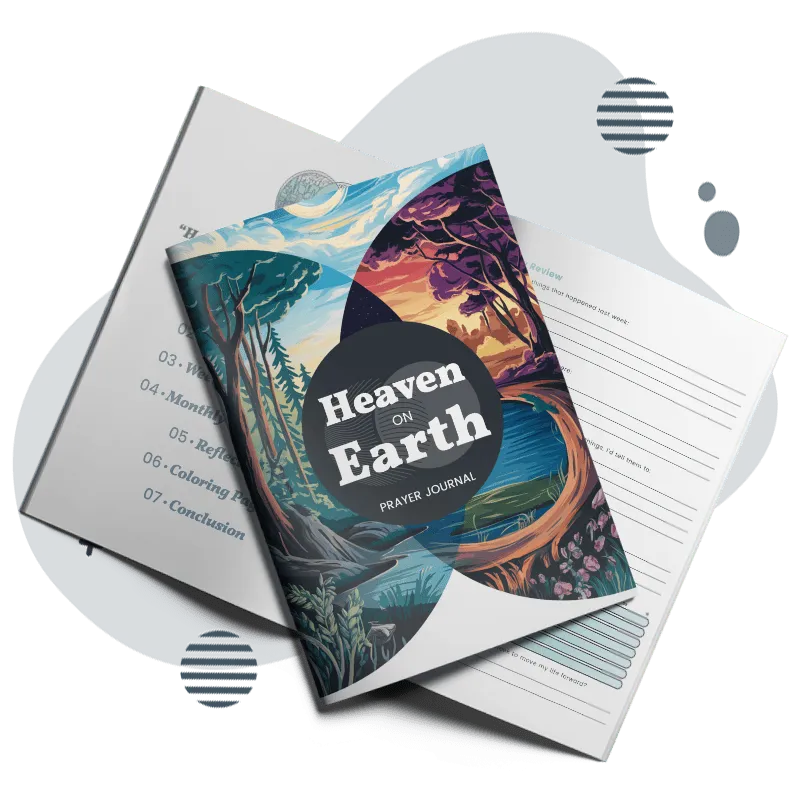
The Heaven on Earth Prayer Journal is 46 pages built on the Lord's Prayer, because that prayer is Jesus teaching us what to ask for.
The quiz is called "Which Lie About God Is Secretly Ruining Your Life?" It has nine questions, takes about three minutes, and gives you one of five results with a way forward from Scripture.
Is there a second Overlap Life book?
There are two books in the works. The Overlap Life came out in 2021, and a second edition is under way; my own review of it is what I'm doing these days. The other book is new, and it is called A Story Worth Telling: Heroic Christianity for a World at War. I have it planned from front to back: an introduction, ten chapters in two halves, and a conclusion. An author friend once told me that getting the table of contents right is about half the job. I have not drafted the chapters yet, so I won't give a date for either book. The first book grew out of Sunday school, and this one grew out of YouTube.
Does everything happen for a reason?
People say that sentence kindly, and it comforts right up to the moment you wonder whose hand drew the plan. If God planned every event, then he planned the diagnosis and the funeral as well. Greg Boyd calls this the "blueprint worldview." A blueprint has everything that happens already drawn on it, which leaves no room for an enemy.
The new book sets a war beside that blueprint. A war has two sides, a King and his enemy. Part of what goes on in this world is that enemy's doing, which God never ordered and is fighting. Among Christians today that view is a minority one, and I know it. Verses like 1 John 3:8 are why I hold it: "The reason the Son of God appeared was to destroy the works of the devil." A king does not take up arms against a plan he drew himself.
As for what kind of King this is, Jesus said, "Whoever has seen me has seen the Father." I take him at his word. If I cannot picture Jesus doing something to a person, the Father is not doing it either. He is a King who gets to the front before you do and bleeds first.
If Jesus already won, why is there still a fight?
In 1946, with the Second World War barely over, a scholar named Oscar Cullmann wrote, "The decisive battle in a war may already have occurred in a relatively early stage of the war, and yet the war still continues." The decisive battle is the cross and the empty tomb. Victory Day is the day Jesus returns and sets everything right. We live between those two days, which is why a life can feel contested even though the outcome is settled. Frodo wished it had not happened in his time, and Gandalf answered, "All we have to decide is what to do with the time that is given us."
Will The Overlap Life do live videos?
I want to. I have no plan and no date, and I would rather say so plainly. Live videos need big, uninterrupted blocks of hours, and those are the hardest kind for me to find.
Who is behind The Overlap Life, and who pays for it?
Two people: my assistant and me. Every bit of it is paid for out of my own pocket. I have always had other work on the side, and I want to keep it that way. There are no sponsors.
I'm glad to pay, and Jeremiah 20:9 is the best explanation I have. A temple official has had Jeremiah beaten and put in the stocks, and he swears he is done speaking for God. Then, in the King James: "But his word was in mine heart as a burning fire shut up in my bones, and I was weary with forbearing, and I could not stay." Keeping it inside exhausted him, and quitting turned out to be harder than preaching. In a King James that keeps its italics, the last word, "stay," is in italics, because the translators added it. The Hebrew stops at "and I could not." I am no Jeremiah, but I recognize that fire.
Why did Aaron and Hur hold up Moses' hands?
Back to that first battle. Israel prevailed whenever Moses held up his hand, and his hands grew heavy. Nobody told him to dig deeper. He sat on a rock while Aaron and Hur "held up his hands, one on one side, and the other on the other side. So his hands were steady until the going down of the sun."
The word for what they did is tamakh (tah-MAKH), which means to grip a thing and keep it raised. In Isaiah 41:10, God uses it for what his own right hand does for you. Behind "steady" stands emunah (eh-moo-NAH). Scripture later uses that word for faithfulness, and it shows up here before anywhere else. The faithfulness of that day had three men in it.
Hur never held the staff. By old Jewish tradition, his grandson Bezalel built God's tabernacle. The historian Josephus, writing around AD 93, treats them as one family. The Bible never says so outright, so hold it as tradition. But when Solomon became king, generations later, there still stood at Gibeon "the bronze altar that Bezalel the son of Uri, son of Hur, had made." If the tradition is right, the people who hold up hands and the people who build are the same family.
So I ask gladly for that kind of help. Support buys back my time: hours for the chapters I haven't drafted, and for everything else described here.
What is one thing I can do this week?
Choose one free piece (a study guide, the prayer journal, or the quiz) and work through it with one other person. Think of your wife or your husband, a friend, or the brother you keep meaning to call. Send a text. There is no deadline and nobody is grading it. If God is better than the best thing either of us can picture, I don't think anyone should have to discover that alone.
The video at the top of this page goes further into each of these, chapter by chapter through the new book.
Giving doesn't unlock anything, and there is no pressure. If this work has been worth something to you, giving is one way to help keep every video free for the people who need it most. One time or monthly, any amount: theoverlap.life/support