
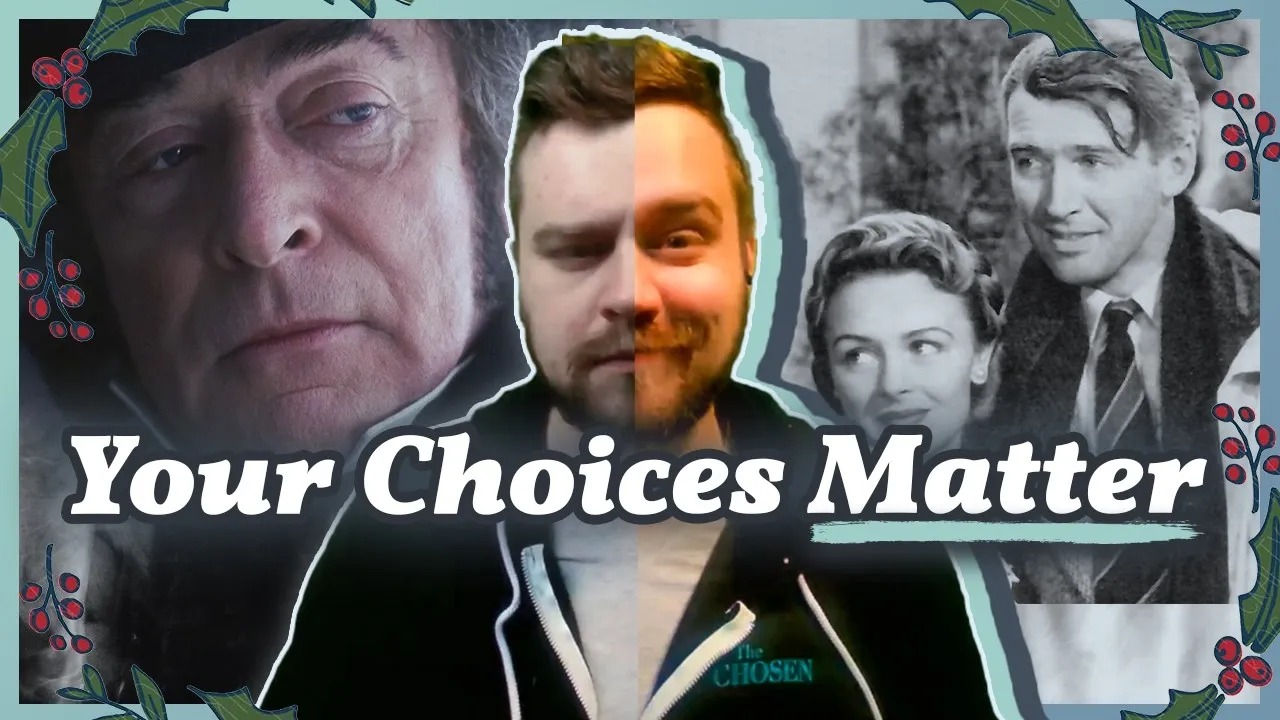
What George Bailey & Ebenezer Scrooge show us about Our Choices… and the Future
George Bailey and Scrooge reveal the futures our daily choices are already growing.
By Tim Barber··Video·Updated
If Jesus pulled back the curtain on your life and showed you two different futures, what would you see?
One where your love never touched anyone.
Another where your current choices kept growing, year after year, into the world around you.
That’s the question that has been sitting with me as I’ve revisited two of the most famous Christmas stories we have: It’s a Wonderful Life and A Christmas Carol. On the surface, they’re cozy, nostalgic, maybe even overplayed. But if you sit with them a bit longer, they become something more like mirrors.
They start to show you the kind of future your life is already growing.
George Bailey and the World That Falls Apart Without Love
When we first meet George Bailey, he doesn’t look like a hero. He looks stuck.
He’s the guy who never left his small town, who keeps saying yes to responsibilities he never asked for, who watches his own dreams die so that other people can live theirs. He saves his brother. He protects a sick child from a terrible mistake. He keeps the little Building and Loan alive when it would be easier to walk away.
By the time he’s standing on that bridge in the snow, he’s convinced his life has amounted to nothing.
That’s why the “no-George” sequence hits so hard.
When the angel Clarence shows George a world where he never existed, the changes are not cosmetic. George sees what happens when his quiet, costly love is removed from the ecosystem of his town.
The cozy main street turns loud, predatory, and hollow.
Families who once had a shot at owning a modest home are crammed into unstable rentals.
People who had dignity and belonging now orbit around money, vice, and fear.
George always assumed “real impact” required leaving town, doing something obviously great, building something big and impressive. The alternate world shows him the truth: his small, inconvenient choices were already carving a path through the darkness. When you pull that presence out of the story, the whole environment changes.
That has discipled my imagination more than I realized.
Because if Jesus is telling the truth about the kingdom of God—that hidden faithfulness matters, that the last are first, that even a cup of cold water in His name is remembered—then George Bailey’s life looks far closer to greatness than most of what we usually call success.
Sometimes the only way to see the weight of a faithful life is to imagine the world where that faithfulness never existed.
For many of us, the “Bedford Falls” we’re called to cultivate is not glamorous. It looks like a kitchen table, a workplace, a small church, a handful of friends, a couple of neighbors whose names we actually know. When we choose to show up in love, to absorb cost so that others can breathe, we’re already partnering with Jesus to keep our little corners of the world from sliding toward Pottersfield.
Scrooge and the Future Grown From Our Current Choices
If George’s vision shows us what the world loses when love is removed, Scrooge’s vision shows us something even more uncomfortable: what the world becomes when love never gets the chance to grow in the first place.
When we meet Ebenezer Scrooge, he knows exactly who he is.
He’s hard, efficient, and proud of it. Christmas is foolishness. Generosity is weakness. People are numbers on a ledger. His life revolves around safety, accumulation, and control.
When the spirits visit him, they don’t show him a random horror story. They show him a harvest.
The Ghost of Christmas Yet to Come walks him through the fruit of his own choices. People talk about his death, but no one weeps. They pawn his belongings. They speak of him with fear, disgust, or indifference. There is no legacy of love, only the echo of a closed hand.
That part feels much closer to home than I’d like to admit.
I don’t wake up in the morning eager to hurt people. But I do wake up tempted to be safe. To pull back. To protect my time, my money, my energy, my reputation. To live as if the only story that really matters is whether I feel secure and in control.
If those instincts keep making the decisions long enough, they grow into a Scrooge-shaped future—even if I never set out to become that kind of person.
Scripture uses the language of sowing and reaping for a reason. Our choices are seeds. Our habits are seeds. The way we relate to God and others, day after day, quietly shapes the kind of future that can grow around us.
Scrooge’s story becomes a mercy at this point. The vision interrupts the process. It lets him see where his trajectory is taking him before he runs out of road. Not to crush him in shame, but to wake him up while there is still time to plant something different.
Jesus, Matthew 19, and the New Creation
So what does Jesus have to do with all of this?
In Matthew 19, Peter asks a question that lives under the surface of both George and Scrooge’s worlds: “We’ve left everything to follow you. What then will we have?” In other words, Is any of this actually worth it? Does any of this count?
Jesus does not answer with a vague, “Trust Me, it will all work out.”
He promises that those who have left houses, family, or fields for His sake will receive a hundredfold and will inherit eternal life. He talks about harvest and reward—real outcomes in a real future. Jesus is not indifferent to what our choices grow.
That matters for both men.
George Bailey’s life looks, on the surface, like a long string of losses. He loses travel. He loses certain career paths. He loses the version of his story he assumed was “meant to be.” But if Jesus is telling the truth, those losses are not wasted. They are seed.
Every late night at the Building and Loan, every costly decision to protect people instead of profit, every quiet act of love becomes something Jesus intends to remember and bring into full bloom in the New Heavens and New Earth.
Scrooge, on the other hand, shows us what happens when we plant something else. His future is not God being petty. It is the honest result of a life that never trusted Jesus enough to plant anything beyond self-protection and control.
And yet, even there, grace breaks in.
Scrooge wakes up. He can repent. He can re-plant. He can open his hands and let love finally grow. That’s not just sentimental storytelling. It points toward how Jesus meets us: He exposes where our choices are taking us and then invites us into a different tomorrow.
So What Do We Do With This?
If you feel more like George lately—faithful but unseen—hear this: your hidden choices in love are not invisible. They carry real weight in God’s kingdom, even when you feel stuck in a small town life.
If you feel more like Scrooge—tired, closed off, or scared to love—hear this: you are not stuck with the future your habits have been growing. The invitation to repent, to re-plant, to walk with Jesus into a different story is still open.
Here’s the question I keep bringing back to Him:
In light of the New Creation You’re bringing, what kind of future are we actually growing together with my choices today?
If you want help turning that question into an actual conversation with God (and not just an idea in your head), I’d love to give you my Heaven On Earth Prayer Journal as a free resource. It’s a guided journal built around the Lord’s Prayer, designed to help you name your “George” moments, face your “Scrooge” places, and walk with Jesus into the future He’s inviting you into.
You can download it here: https://theoverlap.life/prayer-journal
Transcript
[0:00] If Jesus showed you two different versions of your life, a world where your love never touched anyone, and a world where your current choices kept growing into the future, what would you [music] see? In the Christmas movie, It's a Wonderful Life, one of my all-time favorites, George Bailey [music] is given that kind of a gift. He sees what his town becomes without his own ordinary, costly [music] love. The cozy small town Bedford Falls, he thinks, doesn't really need him. Well, without him, it twists into something darker, colder, and far more selfish. And in A Christmas Carol, Ebenezer Scrooge gets the same kind of gift from the other side. He doesn't just see life without him. He sees the future that grows out of the choices he's been making all along. A future where his wealth has bought him comfort, but not love, control, but not joy, and a
[0:49] presence, but not a happy presence, and no healthy relationships. On my best days, I want to be George Bailey, faithful, self-giving, making my little corner of the world more [music] gardenlike. And on my worst days, I see a lot more of Scrooge in my fears, my self-p protection, my cloistering into my own desires and the lies I believe about my worth and my future. So, in this video, I am hoping to be able to invite you into that [music] tension with me. We're going to take a look at George's absence, Scrooge's Christmas future, and Jesus's promise of real rewards in the new heavens and new earth. We're going to ask ourselves what kind of future that you and God are actually growing together and how to take your next small, ideally more George Bailey like step. When we meet George Bailey, he doesn't
[1:39] feel like a hero. He feels trapped. He's the guy who never left his small town, who keeps watching his own dreams die so that other people can live theirs. He saves his brother's life. He protects a sick child from Mr. Gower's mistake with the poison. He keeps the building and loan alive when it would be easier to walk away. And yet, by the time he's standing on that bridge in the snow, he's convinced that his life has added up to nothing and the whole world would be better off if he weren't in it. Spoiler warnings, I guess, if you haven't seen the movie, although it is like almost 80 years old, so hopefully you've seen it by now. But that's what makes the no George sequence in the story so devastating. When Clarence the Angel shows him a world where he never existed, George sees that his absence doesn't just create a few cosmetic changes to things. He gets to see what
[2:28] happens when his ordinary, costly love is removed from the ecosystem of his town. The happy, cozy little main street that once felt like a small, imperfect, but warm Bedford Falls is now loud, predatory, and hollow. Families who had a shot at owning a modest home are squeezed into cramped, unstable huts. People who once had dignity and belonging now orbit around money, vices, and fear. George had always imagined in his own mind that real impact looked like leaving his town, building something big somewhere else, traveling, seeing the world, or doing something obviously impressive and huge in scale. But the alternate world shows him the truth. His quiet, daily, inconvenient choices were already carving a path
[3:17] through darkness and creating a world that was better than the alternative. Without him, the town slides toward Potter'sfield, towards something harsh, exploitative, and evil. What moves me most still years later is how small his heroism looks from the outside. He doesn't preach great sermons. He doesn't lead a big movement. He just keeps showing up for his family and his friends and his neighbors. And this little company that helps ordinary people get a foothold in life just keeps plotting on. even though it's not profitable at all, he absorbs cost so that they can breathe. And when you pull that presence out of the story, the whole environment collapses. I think that that's one of the ways that this film has most discipled my imagination. Because if Jesus is telling the truth
[4:04] about the kingdom of God, that the last are first and the first last, that a cold cup of water given in hospitality and love to someone who needed it really matters, that hidden faithfulness is seen and remembered, then George Bailey's life looks a lot closer to greatness than what most of us would call success in this life. Before the bridge, George looks at his life and sees failure, smallalness, and regret. After the vision, he sees the same life with the same choices, but now he understands the reality he'd been missing. He's seen the alternate future where his love never touched anyone, and it's terrifying. So, that's that's the key move. Let's sit with that for a minute. Sometimes it's it's almost like the only way to see the weight of a faithful life is to imagine a world
[4:53] where that faithfulness never existed. You don't have to be a pastor or a public figure or some great well-known person for that to be true. In fact, it's probably for the best. For many of us, the Bedford Falls that we're called to cultivate looks more like our kitchen table, a workplace, a small church community, a handful of friends, a few neighbors whose names we actually know. When we choose to show up in love to absorb costs so that others can flourish, we're already partnering with Jesus to kind of push back the Potter's Field version of our circle of influence, even if no one ever makes a movie about us. And in a minute, we're going to talk about Scrooge and the opposite vision. What happens when a life turns inward and lets fear and self-p protection do the planting? But before we go there, I want you to notice where perhaps your own life already looks a little bit like George's. Where
[5:42] have you stayed when you wanted to run? Where have you chosen costly love over easy comfort? Where have you quietly kept something alive? A family, a friendship, a church community, a friend group, a team that would have withered without you. You might not feel very heroic at all. Most days, neither did George. But from a new creation perspective, from the vantage point of Jesus's own kingdom, those are the exact kinds of choices that keep little pockets of the world from sliding into potter's field. It's the kind of life that Jesus loves to point at and say that will be remembered. That will be rewarded a hundfold and I don't ever want you to forget it. Now, on the other hand, if George's vision shows us what the world loses when love is removed, Scrooge's vision shows us something even
[6:32] more uncomfortable. What the world becomes when love is never allowed to grow in the first place. Choked out by the things that we believed were more important. When we first meet Ebenezer Scrooge, he's not confused about who he is. He's hard, efficient, as solitary as an oyster, and proud of it. Christmas is humbug. Generosity is naive. People are numbers on a ledger or a spreadsheet in 2025 terms. Costs to be controlled. His life is built around safety, accumulation, and control. And he's made peace of a kind with the idea that this is just how the world works. So when the spirits come and visit him, they're not just showing him some kind of a random horror story or something. They're showing him a harvest. They're showing him what he's going to reap from what he's already sown if he does not change
[7:19] his choices. They show him what seeds he has been planting day after day, year after year, and what they're growing into. And when it comes to the ghost of Christmas yet to come, Scrooge watches people talk about his death. No one weeps. No one remembers any wisdom or his care or his presence. They pawn his belongings. They speak of him with fear, disgust, indifference even, or joy at his passing. It reminds me of Proverbs 11:10. When the righteous prosper, the city rejoices. When the wicked perish, there are shouts of joy. I don't know about you, but I don't want to live the kind of life where people are making shouts of joy when I pass away. And rather than punishment dropped from the sky, this is mostly just the natural end of the road Scrooge has been walking all
[8:07] along. It's the principle of sewing and reaping in action. What he is reaping at the end of that story is what he's been sewing all along after it bears fruit. And that's the part, if I'm being honest, that feels uncomfortably close to home for me sometimes because I don't wake up in the morning wanting to be cruel. But I do wake up tempted to be safe, to pull back, to cloister away, to protect my time, my money, my energy, my reputation to live as if the only story that really matters is whether I feel secure and in control. And if we let those instincts keep making our decisions for long enough, we could end up in a Scrooge shaped future, too, even if we never meant to. Scrooge's Christmas future is really just the logical conclusion of life that has slowly closed its hands. He has money but no meaningful community. He has
[8:58] control of a certain kind but no joy. He has presence in people's memories but not the kind that anyone actually wants. In that sense, Dickens is doing something deeply biblical in the story of the Christmas Carol. Scripture constantly talks about our lives in terms of sewing and reaping, planting and harvest. Our choices are seeds. Our habits are seeds. the way we relate to God and others day after day in the mundane moments between now and all of the other major tentpole events. That's our real life and it's quietly shaping the kind of future that is growing around us. Scroo's story is immersy for us because it interrupts that process. God in his kindness sometimes lets us see ahead of time what our current trajectory is doing to our own soul and
[9:46] to the people around us. not to crush us with shame, but to wake us up while there is still time to choose a different path. And when I look over my own life, there are certainly seasons where I can see both George and Scrooge at work inside me. You know, that old meme of like that there's two wolves inside you. Well, I don't know about you, but there's two uh old like old movie Christmas characters at work inside me and you know, George and Ebenezer Scrooge fighting. This sounds like a dream. Maybe like a fever dream. Anyway, there have been moments when I have stayed by God's grace and served and sacrificed even when it didn't seem to pay off. But there have also been seasons where fear, uh, exhaustion, frustration, worry, anxiety made me pull back. Times when I believed lies like, I need to protect myself. No one else
[10:34] will. If I don't hold on to this tightly, it's all going to fall apart. Or, people right now feel mostly like interruptions, not not gifts. And left alone, lies like that don't stay small. They grow. They shape how I respond to my kids, how I treat my spouse, what I'm willing to risk in friendship, how generous I am with money and time. And they slowly build a future where I may have more control and less vulnerability, but also less love, less joy, and maybe most damning of all, less resemblance to Jesus. The story ends in a very different place from where it began. The whole point of the vision is that it's not too late. He wakes up. He can still repent. He can still open his hands. He can still let love and generosity and joy start planting
[11:23] different seeds from a new creation open future perspective, which is kind of the vibe here in case you're new. That's incredibly hopeful. It means your future is not locked in. God is not standing over your shoulder coldly watching you act out a script he already wrote in secret. He's right here in real time inviting you to participate with him in growing a different kind of world tomorrow and the next day and the next day. So we can first ask what would the world lose without your love? Then we can ask what kind of future are my current choices already growing and do I actually want to live in that world? And if the honest answer right now is I don't like the direction this is going, this isn't the end of the story. Scrooge is proof that God knows how to interrupt us, confront us, get our attention, and
[12:12] still offer us a way into a very different Christmas future, let's call it. Now, quick pause here. We've been talking about George and Scrooge and these alternate futures. But for most of us, the real question is, okay, well, what do I do with all of this in my actual life with God? One of the ways that I've been trying to process these kinds of themes, calling, regret, eternity, the future that God is growing for me in my partnership with Jesus, is through something that I created called the Heaven on Earth Prayer Journal. It's my free Christmas gift to you all. It's a guided journal built around the Lord's Prayer, designed to help you sit with God about your own story, where love has already shaped your Bedford Falls, where fear has choked things out like Scrooge and what kind of future you and Jesus are actually growing together. So, if you want a simple, structured way to pray through this stuff, journal through
[13:01] this stuff, and some practical tools, and even some coloring pages, if that's interesting to you in any way, the link to download it is in the description. Totally free, no payw wall, no gimmicks, just a resource to help you talk with God about your life, your loves, and your future. It's also a great planning tool going into a new year if you're the weirdo like me who likes to think about a year ahead of time. So, merry Christmas. I hope it's of some benefit to you. But in the meantime, let's get back to George, to Scrooge, and what Jesus actually promises us about reward for our unseen choices. So, what do we do with all this? We've sat in George's world, a town that flourishes because one man keeps choosing costly love, even though he can't see any way that he'll get rewarded for it. We've also sat in Scroo's world, where a future that withers because love is never allowed to
[13:48] grow. Now, where does Jesus himself land with this? He gives us a promise about the kind of future he is actually building with us actively. In Matthew 19, Jesus is talking with his disciples about following him in costly ways. I wonder if that sounds familiar. Peter basically says what many of us feel? We've left everything to follow you. What then will we have? In other words, is any of this actually worth it? Does any of this count? Jesus doesn't rebuke the question. He doesn't dismiss it as theologically unworthy. He answers it. He promises that those who have left houses and family or fields for his name's sake will receive a hundfold and will inherit eternal life. That's a heck of a lot better than a well at least you tried or service is its own reward. Peter, what are you talking about? And notice he's talking in the language of
[14:36] harvest and reward. Real outcomes in a real future. I think that that matters quite a bit for our two Christmas stories because George Bailey's life looks on the surface like a string of small painful losses. He loses travel. He loses his career options and his dreams for what he thought his vocation would look like. He loses the version of his story he thought he was meant to live. But in light of Jesus's promise, every hidden act of love, every late night at the building in loan, every time he chooses people over profit, looks less and less like wasted potential and more like seeds. Seeds that Jesus is personally committed to remembering and lavishly rewarding in the age to come. seed that he intends to bring into full bloom into the new
[15:23] heavens and the new earth and to reward the one who planted it with very very good fruit indeed. Now, on the other side, Scrooge's life shows us the opposite kind of harvest. He spends his years protecting himself, building his own security, choking out love for the sake of what feels urgent and important in the moment. The future he sees is not God being petty and throwing it back in his face. It's the honest result of a life that never trusted Jesus enough to plant anything other than self exaltation and glorification. And yet even there, mercy of mercies, the grace of Jesus breaks into Scroo's life as well. Because Scrooge is given the chance to repent, to replant, to let love finally start to grow. Far better than some unbiblical sentimentalism. That is a picture of what Jesus is
[16:11] always doing in real lives on a daily basis by his great love. He exposes where our choices are taking us, then lays a hand on our shoulder and says, "We don't have to keep walking this way." If you put all of this together, I think that Jesus's response to George and Scrooge, the one he would give if they were sitting across the table from him, would sound something like this. To the George Bailey's of the world, he might say something like, "You are not foolish for choosing love. Your hidden faithfulness is not invisible to me. None of these small deaths and losses and sacrifices are wasted in my kingdom. Nothing done in love is ever lost and you will receive far more for far longer than you've laid down. I think it's the kind of thing to which he says, "Well done, good and faithful servant." And to the Scrooges of the world, including the Scrooge in you and me, he might say,
[17:00] "You're not stuck. The future is not a closed door that I've already locked. Turn around, open your hands, start planting different seeds with me, and you'll not regret it. And you have no idea what hangs in the balance of your decision to be obedient and loving. So seen through that lens, the new heavens and new earth are more than just a simple spiritual escape hatch from this life. It's a place where the real weight of our choices in this life is finally revealed. The George Baileyike acts of love that felt small and thankless will be seen as pillars in the stories of countless people. The Scrooge-like seasons we repent of will not define us forever. We'll be rescued out of them. They'll become part of the testimony of God's mercy and of our transformation in that age to come. And that's why this is
[17:49] better than just some kind of like a sentimental cozy Christmas reflection for me. It's it's a literal reflection. It's a mirror into my life. So, a question I have to keep bringing back up to Jesus is,"Lord, in light of the new creation you're bringing, what kind of future are we actually growing together with my choices today?" My hope is that this video nudges you to ask a similar question, not in fear, but in partnership with him. To thank God for the Georgeike faithfulness he's already grown in you, because he is already at work in you if you've trusted in him. and then to repent of the Scrooglike places where love has been choked out and to trust that every step forward in love with him really does echo into eternity. So, if you've stuck with me this far, first off, merry Christmas. Uh, here's what I hope lands in your heart. George Bailey shows us that
[18:37] ordinary costly love day to day, year after year, even if no one notices, is never wasted, even when it feels small, insignificant, or unseen. Ebenezer Scrooge shows us that love choked out by fear and self-p protection really does shape a future we may not want to live in. We can see where God has created a more garden-like world in service to him through our presence, starting from our present now and looking into our past on the George Bailey version of the story. And he can show us where our past choices don't have to define the trajectory of our future. And both are such unbelievable, beautiful gifts to his children. None of this is theoretical. There is a real new creation coming, a real harvest, and he is paying attention to every seed of
[19:26] love that we plant with him in partnership as his children. So, what can we do with this from here? Let's start maybe by naming our George moments. Let's take a minute. You can pause the video if you like and thank God for one or two places where he worked in you to quietly choose love, to stay when you wanted to run, to give when you could have kept and held for yourself, to listen and love when you could have just kept walking. Ask him to show you how much those choices matter. And I think that you'll find that you've had a a very rich life indeed if you've had any length of following Jesus at all in your time on earth. Now, we can also do the other thing and look at our Scrooge places, right? gently without self-hatred or morbid introspection. We can ask where has love been choked out in me? Where have other important things, safety and image, money,
[20:16] control, where have they been strangling what Jesus wanted to grow? We can bring those to him as places for repentance and replanting, not as reasons for despair. Because as long as you still draw breath, your story's ending has not been written yet. Your choices matter. Of course, another suggestion I might make is that you process it with a god. using the prayer journal. If you want help turning this from just like interesting ideas and into an actual conversation with God, you can grab the free Heaven on Earth prayer journal using the link in the description and think of it as my Christmas gift to you as a way to walk through your own story with Jesus page by page, prayer by prayer. But then ultimately, I want you to take one small concrete step this week in preparation for Advent and the birth of Jesus that we celebrate at Christmas time and ask Jesus, "What is one very specific George Bailey choice
[21:05] of love you're inviting me into this week?" It might be a conversation or an act of generosity, an apology, or simply staying present where you usually check out. Write it out. Write it down. Follow through. Let God work with you in that grace. And then keep these things in mind because ultimately if we're all trying to get away from the materialism of Christmas and piling a bunch of cool stuff under the tree and thinking that all of this is about hot cocoa and Christmas movies and songs and trees and ornaments and presents and if we want to get away from that it doesn't do to just say let's get away from that. That's not the point of all of this. The point is Jesus, but even it's what Jesus came to accomplish and what Jesus gave to us when he was born 2,000 years ago. What was he after? I would argue that it's the new heavens and new earth brought to
[21:53] fullness and fruition filled with people who once were Scroo, but he worked in them by his spirit to make just a whole community of George Bailey's. So, if this video helped you to see Jesus yourself or your future or the possibilities it holds with a little bit more clarity, feel free to share it with someone who might need that same hope at this time of year. And whether you're feeling a little bit more like uh, you know, George Bailey right now or more like Scrooge, you are not invisible to God. You matter to him. You are not stuck. He delights to grow something beautiful with you one small faithful step at a time. And the gift of all gifts is eternity with him where he'll reward you a hundfold. For every obedient and faithful step and choice that you make, your sacrifices will come
[22:42] back to you 100fold [music] by his grace and his love toward you. That's very good news indeed. Merry Christmas further up and further in.
Tagsit's a wonderful lifea christmas carolchoiceskingdom of godnew creation