Tim’s CRAZY Hidden Agenda – EXPOSED
Tim answers the heresy hunters by naming the real reason behind this channel and his book.
By Tim Barber··Video·Updated
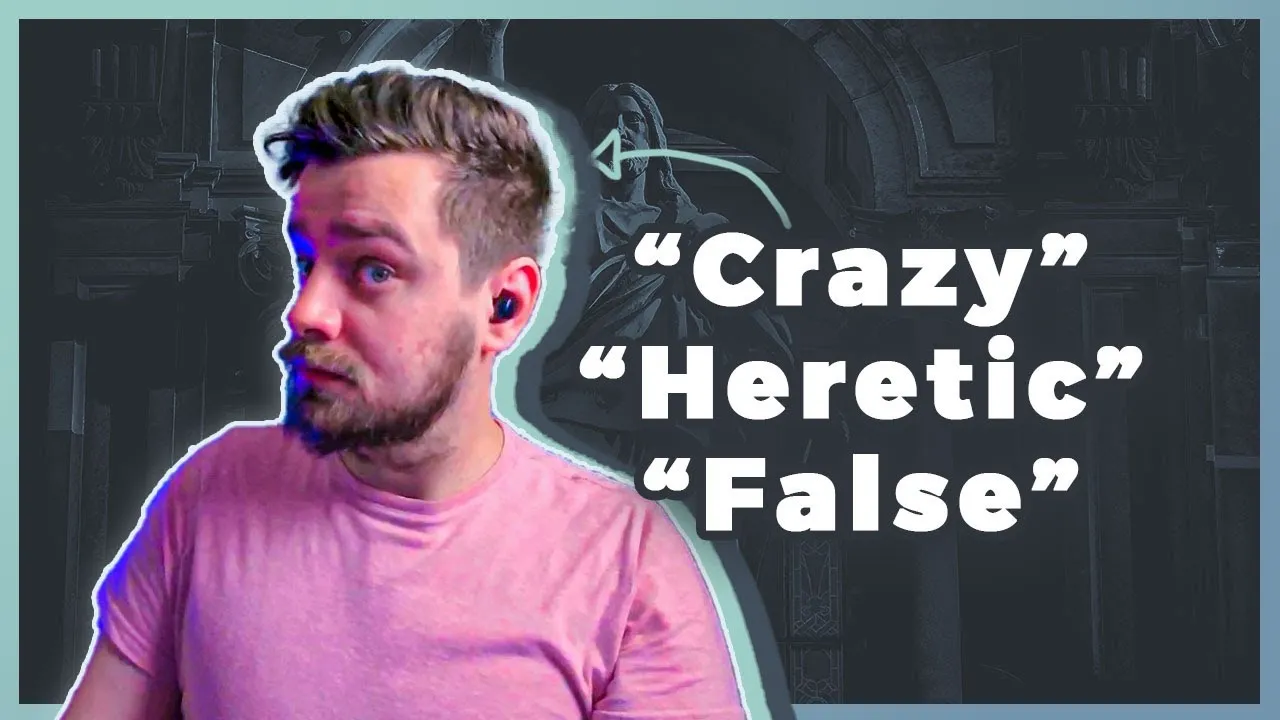
Crazy. Heretic. False Teacher.
I’m only 30 videos into this thing and I’ve ALREADY been getting it with both barrels from the heresy hunters.
I’m about to make it worse. I’m going to EXPOSE my own “crazy” hidden agenda for both my channel, and my book.
The fire was already burning. I’m here to pour gasoline on it. EVERYBODY’S going to be mad about this one.
I cannot hold it in. The Spirit is burning within me and I MUST speak it out.
Further up and Further In!
Transcript
[0:00] Do I have a hidden agenda for running this YouTube channel that I'm trying to get out there and convince people of something? Yes, and it's actually not that hidden. I've had a lot of conversations with people lately that I'm kind of figuring out how to navigate the way that I discuss these things. I have a lot of theological positions that I hold that I feel are very biblical and they're they're sound and they're easy to defend from the Hebrew and the Greek if you understand the Bible on its own terms. But then it becomes really difficult when you actually discuss these things in the context of a church conversation or a conversation with another believer because then they'll be saying, "Oh, so that sounds like X theological bucket that you fit into now that I've got a place to categorize you." As far as I'm concerned, I don't actually think that that's a helpful impulse that we have. When we dump people into all these buckets of Calvinism or Lutheranism or Marcionism or Pelagianism uh or we call a a method
[0:50] of thought Zwinglian, you're requiring somebody to have a philosophical understanding of what another person thought rather than dealing with the Bible on its own terms. It is no secret to anybody that's been to my channel before that Tim Mackie is a hero of mine, especially in this regard. You might know him as the main voice from The Bible Project. The Bible Project has come under fire from a lot of different doctrinal watchdog channels and things like this because they're not Calvinist, for example. They are not um coming out with a specific doctrinal statement that says, "We hold to this way of categorizing what the the Bible says and so we're not in league with any of these other people." Instead, their mission is an incredible one and I think I'm going to let Tim Mackie explain for you the way that he approaches this because he says exactly what I've thought in better
[1:40] terms than I could say it. So, let's just hear what he has to say for himself. The most rewarding feedback we get is um from uh people who don't identify as religious anything. Mhm. But they feel like they're able to understand what their parents or co-workers or friends believe now and I can see I mean I yeah, we straight up have had letters and emails from self-identified atheists saying, Mhm. you know, "Thank you for what you're doing. You're helping demystify what I used to believe." Um That's really cool. Yeah, but there's something for me just when if you avoid if you don't let the the debates of our age determine what you're looking for. Mhm. And I to me this has become the biggest challenge and project now as I can see is just to hear the Bible on its
[2:29] own terms, not filtered through what I want it to speak to, but really trying to listen to it and learn to read this literature along the the weave, you know, going with the grain. Yeah. And you'll hear all kinds of things you never expected to hear. Mhm. And um but but it also you find that many of the things that seemed so important maybe aren't quite as important as I thought they were. Mhm. Anyway, it's been a great great journey. So, speaking of journey So, I'm sorry to cut you off, Preston. I love Preston Sprinkle, too, but let's talk about what's going on here. So, I am blown away by what he just said. He says the challenge and project is avoiding the debates of our age and not letting them determine what you're
[3:18] looking for and just hearing the Bible on its own terms. What does that mean? You will not find the name Calvin in the Bible. John Calvin was a man who came later and interpreted the Bible in a certain way. You won't find Augustine in the Bible. You won't find Aquinas. You won't find any of these people. What you'll find is 66 books divided into two halves, Old and New Testaments, which were themselves written in very particular contexts and have very specific things to say, which we counterintuitively know more about the original historical contexts than people did 1,500 years ago. Archaeology has advanced to a degree um biblical scholarship has advanced to a degree that we know more about what was in the mind of an ancient Jewish person writing a book of the Old Testament than they did 1,500 years ago. And so what
[4:07] has unfortunately happened is that over the course of 2,000 years since the completion of the New Testament, roughly 2,000 years, we have added on layer and layer upon layer upon layer of human tradition philosophy, methods of understanding the Bible that are disconnected from that original context, that in fact do violence to that original context. We've taken there's a medieval uh method of interpretation that we have then taken their attempt to contextualize the Bible to their context and we've built our own beliefs on top of those contextualized beliefs and we're now five degrees separated from the original text. So, there are going to be some things that I say on this channel that are probably going to really ruffle your feathers, but I'm going to do my best to always prove it
[4:55] from the scriptures, not just the translations that we have in English, but the Hebrew and the Greek. We're going to talk about what is the soul. We're going to talk about eschatology. We're going to talk about soteriology. We're going to talk about what is the end state, not just for those who are believers, but for those who are unbelievers. And the fact of the matter is it's going to be a pretty uncomfortable discussion because I think that the Bible says very clearly different things from what most of us have been taught growing up. If you've been around my channel at all, you know that that is really starkly present in the discussion surrounding what happens after a believer dies, what is the end state. We've talked about how the fact that it is not heaven. Heaven is not your eternal home and that is good news. I put out my book trailer and people reacted to that really negatively. They were throwing all kinds of comments on the Facebook ads like heresy alert and uh I found the heretic and all these
[5:43] things. Except that's just you just read the Bible. Revelation 21 and 22, that is not heaven. The the New Jerusalem comes down to Earth out of heaven and that's where believers dwell with God forever. I don't mean to get so heated and so incensed and so um so emotional about this, but it really is something that I think Christianity needs. I consider myself proudly to be part of a movement that is trying to sweep away all of the unhelpful cruft and and accumulation of thousands of years of attempting to contextualize the Bible, which is not a bad impulse. You need to contextualize the Bible to your day and age. The problem is that the Greeks did that, then after the Greeks did that, the Romans did that, after the Romans did that, it went into Asia and all of these other countries, all these
[6:33] other pieces and places of the world and then it just gets layer after layer after layer and before we know it, we're four layers deep and we don't even understand what it is from Greek philosophy that we're thinking that's not from the Bible or we don't understand what came from European philosophy and European worldview that we've just imported wholesale and we haven't thought about. And now we've got several hundred years of Americans doing it, too. What does the Bible say on its own terms in its own context? Michael Heiser says this, he wants all of his readers and all of his podcast listeners and all of his YouTube viewers to have an ancient Israelite in their head. That is to say, if you're reading the Old Testament, he wants Isaiah and what he thought and how he viewed the world to be in your head while you're reading
[7:20] Isaiah. If you're reading the New Testament, he wants a first-century Jewish fisherman to be in your brain helping you understand exactly what's being said in that context. A lot of people think that what we should be doing in terms of biblical interpretation is using the literal historical grammatical method, right? And I'm a fan of this method. You interpret the text in the way that it presents itself to you. If it is story narrative, you you you interpret it as a narrative. If it's poetic, you interpret the symbols and the imagery, especially if there's background helping you understand what that means. But then there's the the historical part where this is the part I think most of us skip. There's a very strange culture around the historical part of interpreting the Bible where people say, "You look, it was written by an original author who had authorial intent and was writing it to an audience." But then you
[8:08] actually put that into practice and action and people say, "Oh, you're just over contextualizing it." No, that's the way that you make sense of the text. Now, you you contextualize it and then you apply it to the present circumstances if it's applicable. Sometimes it's not. So, I hope you guys are ready for some uncomfortable conversations. Um I'm looking forward to it. We're going to have a lot to talk about over the coming months. I have several things planned where we're going to be discussing some sacred cows uh in the modern Western Christian community and um I think a lot of people are going to be unhappy with me, but I feel put upon by the spirit. I feel I don't have an option. I think that the more that I talk, I'm going to be saying things that are going to make people in the modern West, the political left, really really really uncomfortable and really angry with me. I'm going to say a lot of things that are going to make people on
[8:55] the political right pretty unhappy with me. Um but my goal is to make the people who read the Bible and really want to understand what it says just open up their minds and to see exactly what it says in its context in the original languages and we're going to get a lot of good news. We're going to get a lot of things in our in our minds, in our spirits that are exciting and good from the scriptures that aren't being talked about broadly enough because somehow somehow the church has lost the way through thousands of years of philosophy and I'm looking forward to seeing what God does through it, not just through what we are doing, but even even more things like Bible Project, things like Michael Heiser, the work of N.T. Wright, the work of other uh biblical scholars who are getting to the original languages. It's going to be a lot of fun. So, real quick, sound off in the comments below. I'm actually really interested to know, is there something
[9:42] that I could cover that you've really got questions about? You've always read in the Bible and you've always interpreted it a certain way and you're like, "What does that even mean?" And you would like me to maybe take a take a a time to use a video, make a recording of a video for it to give an answer. Not always a Not always a response that's 100% accurate. I'm not saying I have all the answers, but I can always give a response. Is there anything in the Bible that you're just like, "What on earth is this about?" I'm actually going to be recording a response video. There's already been a person in some of my other videos, namely the Stranger Things one, who have um put in some really good uh questions that I'm going to make a response video to these questions cuz I think that they come from a really good place and I'd like to give them answers. But, I want to know what you have to think, too. What you have in your mind that you'd like answers to, as well. So, go ahead and write that down in the comments, and I am looking forward to talking about it. If you are interested,
[10:29] you've never heard about this way of discussing the new creation before, you've never understood, um you've never really understood why people talk about going to heaven when they die, um you want to know what the Bible really says, then go ahead and click this video up here in the corner and give that a watch. I think it's going to be really enlightening for you. But, until next time, further up and further in.
Tagshidden agendaheresy hunterskingdom of godchannel purposefurther up and further in