

Did God promise me a good life?
God never promised a safe life, but he did promise something in John 16:33 that changes how you carry the hard days.
By Tim Barber··Video·Updated
No. Nowhere in Scripture does God promise you a safe, smooth, comfortable life. He never promised your kids would stay safe, your health would hold, or your faithfulness would keep the hard things away. I know how that lands, especially if you typed that question with a diagnosis or a funeral behind you. But stay with me, because the second half matters more than the first: God did make a promise about your suffering, out loud, on the record, the night before He died. And once you read the promise He actually signed next to the one you were handed, everything about your disappointment with God changes.
I want to walk you through both documents.
Where did the "good life" promise come from?
Try an experiment. Take one clause of the deal you're carrying, say, follow God and your family stays protected, and trace it back to its source. Where did you get it? For most of us it arrived through a song, a sermon illustration, or something a well-meaning person said at a funeral. So ask the song where it got it. A sermon. Ask the sermon. Another sermon. Keep pulling the thread and you keep waiting to hit a verse, chapter and book, God's own mouth. You don't. You hit culture. You hit comfort. You never hit a signature.
That matters, because most of us are prosecuting God for breach of contract. Every hard day gets filed as one more exhibit against Him. And a verdict like that will cost you your entire relationship with God, which is exactly why the paperwork deserves an audit.
Does the Bible say anything about promises God never made?
It does, and it's the very first conversation recorded between a human being and the enemy. In Genesis 2:16, God tells the man he may eat from every tree of the garden. The Hebrew word is kol (KOHL): all, every, the whole orchard. One chapter later, the serpent opens his mouth for the first time in your Bible, and he quotes God. The phrase "from any tree of the garden" in Genesis 3:1 is lifted word for word out of God's mouth in 2:16. Same words, same order. Then he makes one edit: he slides lōʾ (LOH), the Hebrew "not," in front of the verb. "All of it is yours" becomes "none of it is yours."
He makes a second edit too. Throughout these chapters God is YHWH Elohim (YAH-weh eh-loh-HEEM), the personal covenant name. In the serpent's mouth He shrinks to Elohim (eh-loh-HEEM), a generic deity, stingy and distant. The method is on the record: quote God, edit the terms, hand the forgery to someone standing in the middle of provision. The promises you're holding about safe kids and smooth roads came off that same drafting table. God's actual words, with the terms rewritten.
What did God actually promise about suffering?
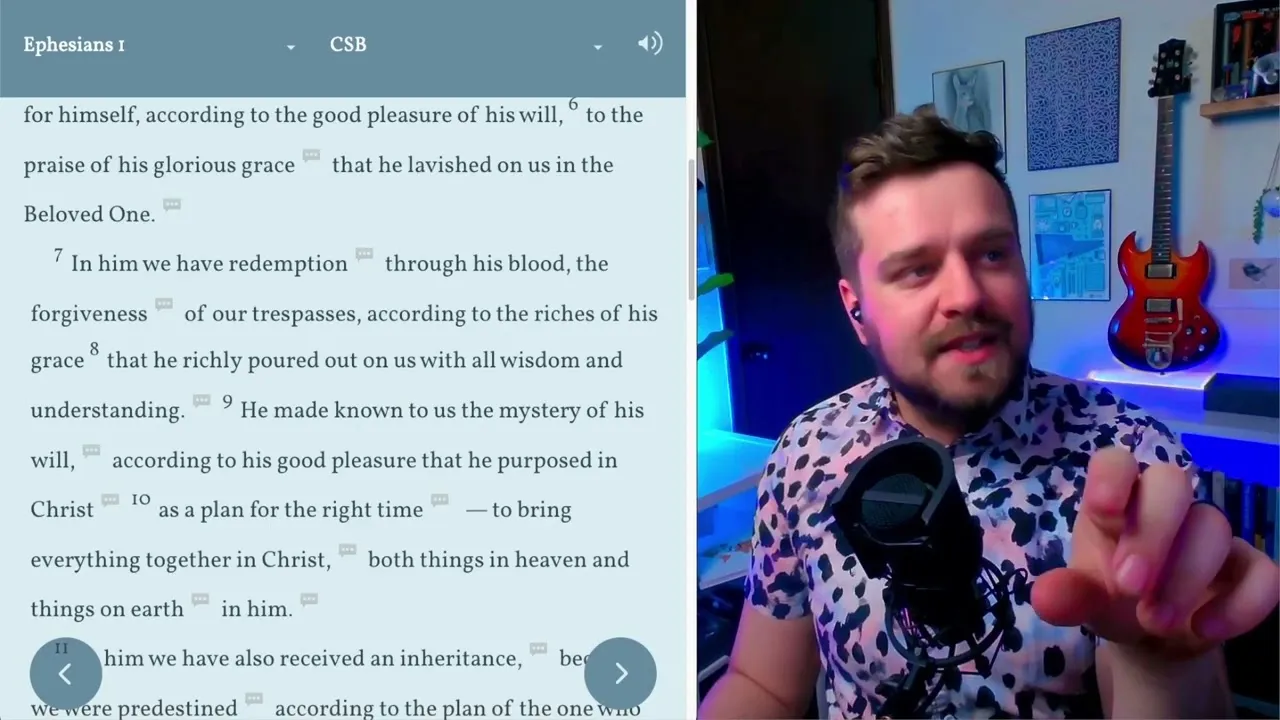
John 16:33. Do the math on the timeline: this is the last sentence of the last teaching Jesus gives His disciples before the arrest party arrives two chapters later. People do not waste their final sentence. Here it is: "In the world you have trouble; but take courage, I have overcome the world."
Three things sit in the grammar of that verse, and your English Bible may be hiding two of them.
First, "trouble" is thlipsis (THLIP-sis): pressure, crushing weight. And the verb is present tense. You HAVE trouble, now, as a standing fact of living in this world. Pull two Bibles off the shelf and check: the NASB reads "you have tribulation," matching the Greek, while the NIV and ESV read "you will have," a future tense the translators supplied. Jesus did not forecast trouble on the horizon. He diagnosed it in the room. He is the only one who put the trouble inside the promise. Forgers promise exemption. He promised pressure, to your face.
Second, John uses thlipsis (THLIP-sis) exactly twice in his whole Gospel. The other time is twelve verses earlier, where a woman in labor has sorrow, and then no longer remembers the anguish for joy that a child has been born. The only other place John reaches for this word, the crushing is childbirth. Pressure with a person on the other side of it.
Third, "I have overcome" is nenikēka (neh-NEE-kay-kah), Greek perfect tense: an action completed, with the result still standing. Read the verse with the grammar showing. Your trouble is present tense. His victory is perfect tense, already banked, and He conjugated it in the first person. The pressure is yours; the winning was His.
So did God break His promise to me?
He can't have. The contract you're holding, the one with the safe kids and the smooth road, carries no divine signature anywhere on it. Somebody else drafted it, and we watched his method in Genesis 3. The promise God did sign, trouble, courage, victory, He has kept in every clause, including the one He sealed in His own blood within twenty-four hours of making it.
That doesn't mean you have to perform being okay. There is one psalm in the whole songbook that never turns toward hope. Psalm 88 ends on the Hebrew word maḥšāk (mahkh-SHAHKH): darkness. God looked at a complaint with no resolution and filed it in His own hymnal, forever. Your unresolved ache is allowed in the building. But the verdict against God is a different thing than the ache, and the verdict was built on a forged document. You're allowed to put it down.
Where do I go from here?
I made a full video walking through all of this: the forgery in the Hebrew, the audit of every clause, why people keep handing sufferers "God is in control," and the strange weapon Scripture puts in your hands for fighting back. If this post found the question you've been carrying, the video is where it gets answered all the way down.
Watch it here: https://youtu.be/gSB97YX7-yw
Further up and further in.
Questions this post answers
Did God ever promise believers a safe, comfortable life?
No. Scripture never promises your kids will stay safe or your health will hold. That idea usually traces back to a song or sermon, not to a verse where God actually says it.
What does Genesis 3 have to do with false promises about God?
The serpent quotes God's words from Genesis 2:16 but edits them, adding 'not' and shrinking God's name. That same method of quoting God and rewriting the terms is behind promises like guaranteed safety.
What did Jesus actually promise about suffering in John 16:33?
He said 'in the world you have trouble,' present tense, but 'I have overcome the world,' a completed victory. He didn't promise no trouble, he promised trouble plus his own finished victory over it.
Transcript
[0:00] Somewhere along the way, you were issued a set of promises. Follow him and your kids will stay safe. Keep your side of the deal and the road stays smooth. But nobody could ever show you a signature. It arrived through sermons and songs and well-meaning people at funerals, but you hold it like a contract. So when the diagnosis came, or the funeral, or the year that was so difficult it broke your framework for who God even is. You did the math that every honest person would do. Seems like God broke his end of the deal, and that verdict is gently no. I want to tell it to you straight. That verdict is costing you all of the trust and depth in your relationship with God. Every hard day gets filed as yet one more exhibit in the list of what you think is evidence against him being good or being loving or even
[0:52] existing at all. You're prosecuting him for breach of contract. And today I'm going to try to walk you through what I think the actual document is, the actual promises, the actual agreement we have in place. Because when we get to the signature line, his name is missing on the one you're looking at. He never signed it. Somebody else drafted those promises. There's a war on, and that contract is enemy propaganda. I'm gonna tell you right now how you fight back, even though it won't make sense yet. Promise we'll get there. You fight this war by saying thank you. Greg Boyd opens his book, Is God to Blame, with a woman he calls Melanie. She'd spent years trying to conceive. She believed God had assured her a child was coming, and a child did come. She carried that baby all the way to labor, and then during labor, the cord wrapped around the baby's neck, and the baby died.
[1:42] And then the sentences started arriving. God has a reason for everything. I'm sure you've heard that one before. There are no accidents with God. And a religious leader sat with this grieving mother and suggested that maybe God was teaching her a lesson, and that if she learned it well, maybe could give her another child. Boyd's answer in print, one question. Can you picture Jesus doing that to someone? Now your wound has a different shape than Melanie's. Maybe it's a diagnosis. A person who is gone way before their time. Like I said, a year that took your framework for God apart bolt by bolt. I want to name this exactly once, plainly, and I'm going to keep moving because I don't believe that pointing at your wounds over and over again is going to heal anything to any for anybody. What happened to you was real. It was terrible, and nothing in this video is going to pretend otherwise.
[2:32] Okay, now come with me because I promised you a document. Here's the thing about spotting a forgery. You can't do it without the original in your other hand. The forgery, as you're about to see, actually gets drafted all the way in Genesis chapter 3. And we'll get to this in a second, but I want to start one chapter earlier with the original. Genesis 2, all the way down in verse 9. God plants a garden and the narrator gives you the walkthrough. Every tree that is pleasing or pleasant to the sight and good with tov for food. If you're holding an NIV, it says all kinds of trees, which is soft. The Hebrew word is kol, every tree. The camera pans the entire orchard and the narrator says all of it. Then verse 16, let's scroll down a little bit further. I'm gonna have to probably slow way down here because uh the grammar is the entire point of this. When Hebrew wants to stamp absolute certainty on a verb, it doubles the verb. In God's words to the man, right here, eating you shall eat, a kol
[3:25] to kale. Doubled. Emphatic, certain. One verse later comes the warning about the one tree. If we look at this next one, for the day that you eat of that tree, this is the tree of the knowledge of good and bad, dying you shall die. Same exact drum beat. Motamut, same exact point on the gift and on the warning. Honestly, if you go check your own Bible, chances are pretty good. A lot of English translations mess this up It's gonna keep the doubling on the death sentence, you shall surely die, but it's gonna drop it from the gift. The Hebrew hands you both at the same volume. We only got taught one of them. But if we watch the scene between the chapters, right? Let's scroll down just a little bit further. The right narrator does something kind of sneaky here. The last sh the last picture we get from from chapter two is that the man and his wife were both arumim, naked, and then they felt no shame.
[4:12] But then the first image of chapter three is that the serpent was more arum, crafty, that is, than any beast of the field. Uh same consonants in the Hebrew. It's a pun sitting right there on the chapter break. Michael Heiser used to say, you know, if it's weird, it's probably important, uh, and this is important. The narrator is kind of elbowing you in the ribs. He wants you to. These two, the humans, uh Adam and Eve, are utterly exposed, and something crafty just walked in. And then the serpent speaks. First appearance in your entire Bible, first words this character ever says, Is it true that God has said, you shall not eat from any tree of the garden? If you're like the average believer, first hundred times you read that, you file it as a lie, a clumsy one, easy to just kind of swat down, right? Then you put chapter three, verse one next to chapter two, verse sixteen in the Hebrew, and you can see what's actually happening. It's a little craftier than lying. He's quoting God.
[4:59] The phrase, from any tree of the garden is lifted straight out of God's own mouth. Same three words, same order, letter for letter. It's God's sentence, but with two edits. The first one is the word lo, one syllable slid in front of the verb. It's basic, not from any tree. One added word converts total permission you may eat from any tree into total prohibition. All of it is yours because none of it is yours. Oh, and while he's at it, he shaves off the double verb. The emphatic generosity, eating you shall eat., is the first other thing on his cutting room floor So he goes from, you may freely eat all that you want from every tree in the entire garden, save this one, all the way to Did God really say that you can't eat from any of the trees in the garden? I'm laughing, but it's really no laughing matter. This is literally the devil's lying playbook in action right here.
[5:50] And now there's another edit. All the way throughout Genesis 2 and 3,20 times God is called Yahweh Elohim. Here's an example right here at the beginning of Serpent or at the beginning of chapter 3. The personal covenant name, the name he gives to people he intends to actually know and be in relationship with, welded on to the word for God or spirit being. That's Elohim. When you hit the dialogue here, he cuts out the covenant name. The serpent just calls God Elohim, no Yahweh, generic deity. Gordon Wenham, one of the really great heavyweight Genesis commentators, says that the god of that conversation comes across as malevolent, secretive, and concerned to restrict man. A character so unlike Yahweh Elohim that the narrative refuses to use the name while the serpent is talking. That's the strategy. Get Eve debating about a god who doesn't exist, who isn't the one that you find acting on the pages of scripture.
[6:41] We'll talk about that again in a minute. Stingy, distant, maybe even threatened by her presence, feeling like he has to constantly manipulate and control her behavior. And then it, you know, it really no longer matters who wins the debate. And it's contagious. If we look at the woman's answer just a couple verses later, let's check her vocabulary. Here we got starting verse two. And the woman said to the serpent, you know, from the fruit of the trees of the garden, we may eat. We've lost the emphatic, you may eat freely, eat your fill, double eat. That's not there. Um, what else is missing? Ah, Elohim., She also just calls him spirit being not Yahweh. No personal name. She caught it. It's viral And then she adds a rule God never made. Neither shall you touch it, right? Where did this come from? You shouldn't eat from it and you shouldn't touch it.
[7:28] She added a rule. Robert Alter points out that the serpent's question seems like it was bait, engineered to get her talking, and it worked. Within two verses, she's describing God in the same way the enemy does, and enforcing regulations God never issued. And if we get to verse six, honestly, this part just kind of breaks my heart. She looks at the forbidden tree, that it was good for food and pleasant to the eyes. If you flip all the way back to the earlier chapter, Genesis 2, verse 9, Yahweh made sprout from the ground every tree that is pleasing to sight and good for food. Describing every tree she already had access to. Two of the three things she sees in that one tree she is standing in an orchard full of. The only genuinely new item is this l haskil to make wise. Everything else on her wish list was
[8:17] already satisfied, and the narrator told you so in his own vocabulary a chapter early. This is what the enemy's propaganda does. This is what it looks like. A woman standing in total abundance, total provision, looked around and saw scarcity because she believed a couple of lies. So when things went wrong, and you heard words from others that didn't seem to fit the picture of God that you have when you read the Bible of someone overwhelmingly generous and kind and loving.ing. It's not like people come to you with these platitudes and then they hand you a casserole, sorry that your brother died, and they also hand you a talk snake The way that the sentence gets to you is different. It comes through people who love you, most of whom would take a bullet for you. you. I can hear some of already Tim, are you seriously calling my grandmother an enemy courier?
[9:06] Look, the couriers are almost all innocent, but there's a reason that human beings keep delivering this exact package to sufferers. And in 1966, two psychologists, Lerner and Simmons, caught the mechanism in a lab. It was an incredible study. They brought people in to watch a woman receiving what they believed were painful electric shocks, and they ran a little test. The group that could do nothing, no helping, no end in sight, did something that should give you chills or raise the hair on your neck. They started rating her character more negatively than any other group did. Same woman, same shocks, but when you can't fix somebody's suffering, and you desperately need the world to stay fair, the mind has one move left. Decide that the sufferer somehow had it coming. Psychologists call the engine the just world belief, the bone deep need for the
[9:57] ledger to balance. And it means God is in control, sweetie, is usually doing its real job for the person saying it. It keeps their world fair and their ledger balanced. The bill gets mailed to you at a funeral with a casserole in your hands. And there's one other courier, and this one lives inside your own head too. Psychologists call it hedonic adaptation. Your internal meter for enough re-zeros on whatever you're currently standing in. In a separate study in 1978, lottery winners within a year of the win, the ordinary pleasures of a normal day lower than people who had never wanted die. Exactly the same condition that Eve was in. You'll recognize. She looked around at an orchard full of blessings, and it all was just invisible to her. She couldn't register how blessed she really was.
[10:45] Now, I'm you don't fix that by feeling guilty about it. It's a problem that we all deal with You're gonna see what actually breaks the loop here in a minute, but let's count what we've got so far. The sentence that you're holding, the idea of God that you're carrying around with you is probably largely shaped by God's own deepest and most ancient enemy. His method is on the record, and the delivery network is still fully operational. So before your verdict against God can stand, we do what any honest investigator does with a suspicious document. Let's audit this thing. Every promise you are carrying goes on the table, and we find out who actually issued it. Because God did put a promise on the record. He made out loud night before he died, and almost nobody quotes this at the funerals, but it's the truth. So let's do the audit. Grab the contract, so to speak. We're reading every clause of this thing out loud, And next to each we're
[11:34] writing down who actually issued it. Clause one, we talked about this earlier. Follow him and your kids stay safe. Let's chase that one back. Where did you get it? Stop and really think about this. Let's see if we can trace this one to the source. Where did where did you hear this idea? For most of us, it arrives through a song or a sermon illustration or something again, some well-meaning person says. So where did you get this from a song? Where did the song get it? You keep pulling the thread, waiting to hit a verse somewhere in the Bible, chapter, book, God's own mouth, and you don't. You hit culture, you hit comfort, you hit the same network we just watched. I think that you at root come to a lie. What about keep your side of the deal and the road stays smooth? Let's run the audit again. Same result. We I don't think there's a verse that says that. But I'll tell you something. God did sign a promise about your suffering out loud on the record, and
[12:25] I walk you, I want to walk you into the room where he said it. For the record, this is why. it is so important to be able to point back to God's own words If you don't know God's words, you're very easy to deceive and easy to lead astray. So let's make ourselves go over to John's Gospel, chapter 16. I want you to do the math and the timeline because it matters. This is the night of the Last Supper. In a few hours, chapter 18, the arrest party comes through the garden with torches. Between here and there, chapter 17, Jesus prays, which means John 16:33, the verse that I'm about to read to you, is the final sentence of the last teaching Jesus ever gives his disciples before he dies. This is the closing line of the farewell speech. He's taken after prayer in the oncoming chapters. So if you've ever sat with someone who knew their time was short, you
[13:16] know exactly how much weight the last sentence carries. People do not waste it. Here is that last sentence. These things I have spoken to you that in me you may have peace. In the world, you will have tribulation, but be of good cheer. I have overcome the world. Or take courage. I want to slow way down on three words because each one is doing something your English Bible might be hiding from you. Let's go dig these up in the interlinear two. But now we're in the Greek, not the Hebrew. Uh, that first word was tribulation, thlipsis in this case, or thlipsis in its normal, more neutral cast. It means pressure, crushing, the weight that squeezes, and the verb attached to it, this one right here, equete, is present tense. You have pressure right now, not you will, it says you will have uh pressure, but you have it.
[14:04] You have tri it's also the tribulation, you know. People talk about the great tribulation. There's a whole other video. I don't subscribe to that same way of thinking, but the point is that you need to recognize that that's the same word. John calls himself the partner in the tribulation with a group of people to whom he wrote a letter. You have it You're right now, you're going through it right now. It's it's there at hand with Jesus, standing there in the room with him. So here's the craziest thing. If you pull your Bible down off of the shelf, chances are good, like NIV, in this world you will have trouble. Future tense. That future is supplied by the translators. The Greek doesn't have it. It literally says, in this is present active indicative, you have trouble. I get why they did it. You know, you will have trouble. Sounds like a weather forecast, something out on the horizon you might still route around. But what Jesus said is a diagnosis of the present moment. The pressure is a present tense fact of being in the world.
[14:53] Now, of course, he says it to his disciples. These I have these things I have spoken to y'all, plural you, that in me, peace you might have. Now, this one's subjunctive. There's we can we can geek out about it some other time. But I don't think it's a stretch to say that this is a present tense fact of the world still. He's the only one in your life who put the trouble in the promise. Every forger promises you exemption, right? The scam always sounds too good to be true. Jesus promised you pressure, he promised you trouble, he promised you tribulation to your face the night before he died, which is exactly what an honest party to a contract does. He's arguing in good faith. That word thlipsis for trouble or tribulation, it occurs exactly two times in John's entire gospel, twice. The other time uh is actually earlier in this exact chapter, all the way back, I think in verse 20.
[15:41] Same speech, same night, where Jesus says, A woman in labor, she no longer remembers the thlipsis for joy that a human being has been born into the world. The only other place that John reaches for the word, the crushing pressure is childbirth, pressure that is producing something, pressure with a person, a beloved person on the other side of it. Jesus picks the word for your trouble, twelve verses after loading it with that image on purpose in the same breath of the same speech. That's the promise on the record. The pressure is real, the pressure is now, and the pressure is labor, the kind of pain that ends in somebody new being born. And Jesus says he's going to be with you in the midst of that pressure, and we'll have peace in the middle of it with him, in him. And then finally, this word here, nenikeka, I have overcome. Greek has a tense we mostly don't use.
[16:30] We don't really have. It's called just the perfect. It just means a completed action whose result is still standing. Done and it stays done. Done and now it has ongoing implications, right? The trouble verb is present tense. The victory verb is perfect tense. Let's read the sentence with the grammar showing. You are currently under pressure, but the war is already won. So Jesus did not hand his grieving friends a battle plan for how to go on and win the war. The only command for them is this is the say to pick courage. That's the only thing for them to do because the world is already overcome. This word only shows up, I think, seven times total in the entire New Testament. And in six of them, the speaker is Jesus. The seventh is a crowd relaying Jesus' words to a blind man. Nobody else in your New Testament says this word. It is functionally Jesus' word. The thing he says to paralytics and bleeding women and terrified men in boats.
[17:21] So the entire promise of my reading of this, sorted by the grammar, the pressure is yours. You're dealing with pressure right now. Present tense. The victory is his. Perfect tense. Already banked. You can count on it. Your one assignment is to hear him say the word only he says. Take courage. He has already overcome. Oh, and you know, small detail. He actually kept the same promise the same night he made it. We're getting a lot of Greek and Hebrew today I'm sorry if that's a lot, but I want to do more of this with you guys because I think this sort of thing is extremely and extraordinarily important. The only time John's gospel uses the word for weapons is two chapters later, carried by the arrest party coming for him. Peter draws a sword, Jesus tells him to put it away. He walked into the thlipsis. He had just promised, unarmed, and overcame it. The signature on this promise is written in Jesus' own blood within 24 hours of
[18:12] him making it. I get now, I can hear some of you in my mind just saying, okay, okay, Tim, but what about abundant life? Right? John 10:10. I came that they may have life and have it more abundantly. I was promised abundance, and my life looks like a demolition site or a war zone. Guys, I love this verse. I want to give you an honest reading of it because the honest reading is honest to God, so much better than just the coffee mug reading. So here's the whole verse. The thief comes, the thief does not come unless he can steal and kill and destroy. I came that they may have life and have it abundantly. Kill here, like the word is the old, right? Sacrificial slaughter word. It's what the father does to the fattened calf. It's what happens to the Passover lamb. Butchery. And abundantly, perisson means over and above, more than necessary, super abundantly, super added.
[19:02] So far, so good. Now the question everybody skips is who is the thief? Nearly everyone says Satan, but let's uh let's examine the text, right? Let's back up. Nine verses. John 10:1 introduces the kleptis, the thief, as the one who refuses the gate and climbs into the sheepfold another way, a fake shepherd. Verse 8, Jesus says it out loud. All who came before me clepte are robbers, thieves, right? He's describing leaders, people who claimed the flock. And remember, chapter 10 has no scene break from chapter 9 He's saying all of this directly to the religious leaders who just threw a healed blind man out of the synagogue. The whole speech runs on Ezekiel 34 underneath, where God indicts the shepherds of Israel for feeding themselves while the flock starves, and then says, I myself will search for my own sheep. The predator from outside gets a different word entirely. Lucos, which is in verse 12.
[19:52] Look at what this unlocks for you. The thief doing the stealing and slaughtering in John 10 is a false shepherd. Listen so closely here, please. It is a false religious voice that damages the vulnerable while claiming to speak for God. That's not me stretching the text. That's what the text says. Craig Keener writing on this verse says that those false shepherds abused their authority over the sheep, like many of the religious leaders of Jesus' day, and not a few religious leaders in our own day. That's a quote from Craig Keener. His sentence, seriously, not mine. Which means that when somebody in a position of spiritual authority literally got down and handed you God took your baby to teach you a lesson, you were meeting the thief of John 10:10. A courier in a clergy collar. I don't want to say a wolf in sheep's clothing, but it's not too
[20:41] far to say that they're a thief. Jesus saw him coming 2,000 years ago and named him first. The abundant life you were promised was issued in the middle of a warning about this thief. Abundance, super added life, promised under assault, with the assailants identified as someone who seems trustworthy and isn't. That's the honest verse. It is always assumed you'd be reading it with damage in your hands and a record of having been wronged in this specific way. Which brings up the question underneath all of this, which is the one the propaganda most needs you to get wrong. In this war, whose side are you on? I know how people who are suffering try to make that decision and do that math. If there's a war and my life looks like this, I must be losing it, or I must be on the wrong side of it. I got I got two more verses that will help you here. All the way back in Genesis 3.
[21:29] God's opening move after the whole catastrophe is a declaration of war, and I want you to see more grammar. Again, sorry we're getting a little nerdy today, but I feel like this is necessary in order for us to really be able to capture what is happening here. Because the devil's play has always been to add one or two words to change the meaning of the entire passage. So we need to get really down deep into the Hebrew and Greek this time in order to avoid falling into that trap. But I want to look at God's words here. Verse 15, God speaking to the serpent. And enmity I will put between you and the woman and your seed and between her seed. And he continues on. Okay, but the word for enmity, eyvah, hostility, war footing, being at odds and in conflict with one another. And the verb asheet, I will put, I will set. It's first person.
[22:17] God is the subject of that sentence. The hostility between you and the enemy was installed by God Himself by divine decree on day one of the disaster. You didn't enlist in the war, you didn't really have to. You did not qualify. You were conscripted onto God's side of this war by God's own act. And no diagnosis, no funeral, no broken year has the authority to reassign you. And the same verse tips the ending. One strike verb shall bruise. Literally shuf, Yeshu Feka, right? Used for both blows, and the only difference is the body part. Her seed strikes the head, the serpent strikes the heel. Both sides get hurt in the war. Only one side gets hurt fatally. Jumping around here, but we're gonna go move to Ephesians 6. We're gonna go find our way down to verse 12, somewhere around here. Yeah, here we are. Uh we've talked about this one before on the channel, but let's talk about
[23:04] it again. Let's look at what this verse actually does Our wrestling is not against flesh and blood, but against the rulers and against the authorities, against the cosmic powers of the darkness, against spiritual forces of evil in the heavenly realms. Paul's word for wrestling, let's get into it again. Hale appears exactly once in the whole New Testament, right here, and it's hand-to-hand language, pugilism, close, close quarters combat, personal. The verse's entire function is to take every human being off the target list, every one, which cuts both directions, and you need to hear both of these things really. Direction one, your you know friend or well-meaning older lady at church or even your grandmother with casserole and terrible theology is off the list. She's not your enemy. She's a courier, couriers are contested ground, you're allowed to love her while refusing the package. Direction two, and hear me on this, you are off the list too. God is not wrestling you.
[23:53] Your suffering is enemy action in a war where God put you on his own side by decree, and then in John 16 told you to your face that the pressure was coming and the outcome was already banked. He is heartbroken over what breaks your heart. He's fighting for you, never ever against you. He doesn't expect anybody else to fight you, and he doesn't expect you to fight any other human. So let's stand back and look at the whole board here. The contract in your hands, the ideas you carried about what God promised you. It carries a drafted in Genesis 3 watermark and no divine signature anywhere on it. The promise God actually signed, trouble, present tense, courage, his word, the one only he says, victory, perfect tense, finished and standing, he has kept in every clause, including the one he sealed with his own blood before sunrise. The verdict that you have been carrying that either God is lying, he's not
[24:44] trustworthy, he's against you, or he's holding out on you, or you're blowing it somehow, it dies right here. You were prosecuting God for breaching a contract he never signed. Which unasks, did God break his promise, and leaves a different question standing there armed and ready. If this is a war and you're on his side by decree, and the victory verb is already perfect tense, then what does fighting back actually look like for you on some random day in the middle of a mundane week with your life the way it actually is? Carrying the pain, carrying the weight, carrying the difficulty. Because there is a real arsenal of tools for you. It's stranger than you think, and one of its weapons is a sentence I told you at the top that wouldn't make sense yet. It's about to. Quick pause before we open up that arsenal because I want to hand you something first. If any of this is hitting close to home, there's a good chance one specific lie about God is secretly running the show for you.
[25:34] I built a two-minute quiz to help you name it. It's the first link in the description. There are five of these lies, and the contract we just tore up is gonna be reflected in a lot of them. So if that verdict felt familiar, first off, sorry if this is uncomfortable. But number two, the clip the quiz will tell you exactly which one has your voice, exactly what it is that you're suffering under, what lie it is that you're believing about God. Two minutes, first link. It's there, I made it for you. And there are some free resources on the other side that are intended to be of as much help as possible. But let's get into this arsenal. So if this is a war and we've spent this entire time proving that it is, then the first question any soldier asks is what I think would be an obvious one. What do I shoot with? Uh, and the Bible answers this question in the strangest, one of the strangest chapters. I mean, Ezekiel has a lot of strange chapters. Job has a lot of strange chapters, but this is one of the strangest
[26:24] chapters in the entire Bible. It's in Revelation 12. So let's see our way over there now. There's a dragon., there's a woman, there's war breaking out in heaven itself And then verse 11 stops us right in our tracks just to say, in plain terms, how the dragon actually goes down. Oh, the dragon goes down. That ancient serpent who is the devil and Satan. They conquered him. They, who's they? We'll get to it in a minute. A Nikeson. The same conquering verb family Jesus signed in blood back in John 16. By the blood of the Lamb, by reason of the blood of the Lamb, and by reason of the word of the testimony of them, and not they have loved the life of them unto death. Let's let's just reflect on how strange that weaponry is. The weapon one, blood of a lamb already shed, the heaviest ordinance in this war went off before you were born, and someone else absorbed the recoil.
[27:16] It was Jesus. Weapon two, the word of their testimony telling the truth out loud about what happened to them and what God did about it. Seems like and and that's it. That's the whole loadout. Remember, the one time Jesus saw a literal sword drawn on his behalf, he ordered it to go back in its sheath. Here at the climax of the Bible's own war book, the winning side is armed with pre-shed blood that they did shed on their behalf by a baby sheep, and and sentences describing what happened in their life and what God did about it. Isn't that wild? Now we could watch that same pattern show up. I think it's Galatians 5. We don't need to go there right now. Paul lists works of the flesh, right? Works, plural 15 of them a row or something like that. And the verse reads, The works of the flesh are. Then he crosses the line to God's side of the ledger, and the grammar
[28:06] changes under his feet. He says, The fruit of the spirit is. I don't know if you've ever noticed that the fruit of the spirit is one thing with like a bunch of different facets. Okay. Love, joy, peace, patience, kindness, goodness, faithfulness, gentleness, and self control. One fruit. You can see it in English The works of the flesh are these things, but the fruit of the spirit is this list of things. The flesh produces a warehouse of separate products. The spirit grows one living thing with nine flavors in it. Uh, and again, I'm gonna connect all of this here in a minute, I promise. But I love the picture Paul uses there where it's fruit, it's agriculture. So here's a sketch you can use, right? Go stand in an orchard and watch a peach try really hard. Watch it, watch it grit its teeth. You're gonna be there a long time. Because there's never that's never once happened in the history of peaches. The branch abides in the tree, the tree does what trees do, and the fruit shows up. Gonna matter a lot more in about 90 seconds.
[28:53] Weapon three, not for you. Jesus fired this one in public. Psalm 8, verse 2, David writing a war verse, it has enemies in it, and Avenger in it, silencing in it. Out of the mouth of infants and nursing babies, you have founded strength because of your adversaries to silence. God takes the least dangerous humans on the planet, babies, just like the least dangerous sheep on the planet, lambs, out of the mouths of babies, he builds the thing that shuts his enemies up. That's already wild. But centuries before Jesus, when Jewish scholars translated that psalm into Greek, they made a fascinating call. For strength, they often wrote ainon, praise. Elsewhere, I think it's Matthew 21. Again, I we could go super deep into all of these things, but I want to kind of move through this for you. In Matthew 21, Jesus is standing in the temple, children are shouting Hosanas at him.
[29:40] The chief priests are indignant. It's an open conflict scene, and Jesus answers them by quoting Psalm 8. And he quotes the Greek version, the one where the thing that comes out of the babies, the thing that silences the enemy is praise. So let's put some verses side by side next to yourself. Okay, we've already got Revelation 12 in mind. Psalm 82, next to Matthew 21:16, and watch the word strength turn into the word praise right in front of you. Jesus, in a confrontation, quoted a war psalm where the weapon is worship coming out of people who can't even hold their own heads up, let alone speak clearly. Which brings us to Paul's marching orders for suffering people. I think we really should go to this one. This one's in 1 Thessalonians 5, and there's a non-zero chance that you're gonna hate it. Always rejoice, pray without ceasing, give thanks in every circumstance, in everything, in panti. Or in panti.
[30:29] And I want to be dead honest with you about that because sloppy versions of this teaching of her people, the word is in in every circumstance. Full disclosure, I don't I don't hide verses that compliment my view. Ephesians 5:20 does say giving thanks always for all things. Huper panton. So anyone who tells you the Bible never says for hasn't read carefully, but the verse Paul aimed at a suffering church says in. Give thanks in all things. And that distinction will hold your own weight. You can thank God in the hospital room without thanking him for the diagnosis. Those are two different sentences. Your integrity survives the first one. Nobody's even asking you for the second one. So I promised, I said it wouldn't make sense until now. You fight this war by saying thank you to God. Here's why it works. You have watched the enemy's whole strategy across this video, and it's always the same move. One or two words, twisting, sounding well meaning, but destroying the entire point. An edited inventory.
[31:21] Fix your eyes on the one clause that you are owed and don't have. That's the propaganda. And gratitude, spoken out loud, is the counter-transmission. It's Revelation 12's second weapon. The word of your testimony aimed straight at the lie. Every thank you is you reading the actual ledger over the doctored one. It's how combined with Jesus' own shed blood, it's how the victory is won. Every thank you is you reading the actual truth. Its Melanie's moment from the top of this video. She saw what she already had. When you say thank you for this coffee, thank you for this kid's laugh. Thank you for this lung full of air right now, every second. Again, happened again. Every time I take it to breath, you are testifying under oath that the serpent's inventory was forged.
[32:09] And that's why praise silences the enemy. He runs on your resentment. Gratitude cuts off his supply lines. Hear me very carefully. I really don't want you to get this wrong. This is an invitation to resistance. If you are in the worst stretch of your life, and you read give thanks as one more performance you're failing, I want you to look at the truth again from Revelation 12. We just looked at this. The blood was already shed. The victory verb was already perfect, tense, he has already overcome the world, and the fruit gets grown by the spirit while you abide. The praise came out of, you know, nursing infants who have never achieved anything except being loved. There's no striving anywhere in this picture. You were conscripted onto the winning side by God's own decree, and the war's outcome doesn't ride on your performance. A whispered exhausted, even through tears. Thank you from a hospital chair is a live round fired in this war.
[33:00] It counts and it's powerful. Paul compresses this entire doctrine into one sentence in Romans 12, and he does it with the conquering verb twice, back to back in opposite voices. Do not be conquered, Nikol, passive, by evil, but conquer, Nika, active, evil with good, overcome evil with good. That sentence caps a whole paragraph of bless your persecutors, never avenge, feed your enemy. The instrument of conquest gets named right in this verse. The good, not force, the good. Where have we seen this at work before? Act 16. Paul and Silas get beaten with rods in the public square. Illegally, by the way, they were Roman citizens, legally protected from exactly that, which Paul points out later to some pretty pale faced magistrates who recognize that they've done something wrong, backs shredded, thrown into the inner cell of the prison, the deepest one, feet locked in the stocks, and then at about midnight, Paul and
[33:50] Silas were praying and singing hymns to God, and the prisoners were listening to them. They kept on singing, in fact, I think it's Hun. They kept on singing, continuous, sustained, and the prisoners kept on listening, also continuous. The grammar paints two soundtracks running side by side in the dark for a long time. Two men with shredded backs singing hymn after hymn after hymn, and an entire cell block that went silent to listen. The weapon was working on that whole prison before the earthquake ever showed up. The earthquake gets the sermon time, but the singing had already taken the entire point of this story. I have another story of Dietrich Bonhoeffer,1943. Eight and a half months into Nazi custody, he writes to his best friend Eberhard. There is nothing that can replace the absence of someone dear to us, and one should not even attempt to do so. One must simply hold out and endure it.
[34:39] It is wrong to say that God fills the emptiness. God in no way fills it, but much more leaves it precisely unfilled, and thus helps us preserve, even in pain, the authentic relationship. But gratitude transforms the torment of memory into silent joy. I'm holding back tears Bonhopper does exactly the right thing here. He does two things at once, and both of them are for you. First he gets rid of the pious consolation. The emptiness stays empty. God refuses to paper over your lost person or the thing that was broken that shouldn't have been with a platitude, because the whole is shaped like someone he also loves. And then second, in the same breath, penned from inside a Nazi prison on Christmas Eve, he fires the weapon. Gratitude transforms the torment of memory into silent joy. The loss is real, but the thank you is still the right call.
[35:31] Same situation, honestly, it's a separate separate story. Ravensbrook,1944, Barracks 28. Crawling with fleas, where Betsy ten Boom insisted that they thank God in their circumstances, fleas included, and Corrie ten Boom prayed one of my favorite honest sentences ever. There's no way even God can make me grateful for a flea. They later learned why the guards never entered their barracks, why scripture got read aloud every night unsupervised. The fleas. In one of the worst situations the 20 th century ever created. Thanksgiving got set out loud, and the enemy would not cross that threshold. Last thing, I really want to give this some room to breathe. We've covered your weapons, we've covered what the situation is. You're in a war, okay? You need to know that. I want to show you your commander's face in this war. Because if you've ever wondered what God's actual expression is at a graveside, John
[36:22] recorded it, and your English Bible has been softening it your whole life. We gotta dive deep into this one again, too. John 11. I think you probably know where I'm going. The story, Bethany, Lazarus has been in the tomb four days. Martha has already had her raw theological argument with Jesus. Mary's on the ground weeping, the mourners are wailing. In verse 33, in most of our Bibles says that Jesus was deeply moved in his spirit and troubled, deeply moved. In fact, here it says, deeply moved. Ennebri mesatom. Sounds like, but it sounds like a man getting misty at a funeral. In classical Greek, that word family means something so specific, you'll never unsee it. It's the snort of a war horse, the sound of battle horse makes before the charge. Exactly one translation that I am aware of gets this translation right. It's the NLT A deep anger welled up within him. So if you if you go compare the NIV and the NLT on John 11:33,
[37:14] uh you're gonna see it's the same verse. John uses the word twice, verse 33, and again in verse 38 at the mouth of the tomb itself. Jesus, therefore, again snorting like a war horse. You can picture it. The incarnate God stands at a grave he is about to empty minutes from reversing the entire funeral, and his recorded reaction is an angry war snort twice. And verse 35, he does cry real tears. Jesus wept, one of the shortest verses in the entire Bible. He weeps anyway, he's about to cancel the funeral, but he cries anyway because the grief in front of him is real and he honors it. But the anger is aimed, you're so important. Catch this because it's everything. Never once at Mary and Martha, not one syllable of where's your faith for the weeping sisters. Their tears are for them. The snort is for death itself, for the grave. That's not a private mood of his either.
[38:04] And uh Paul puts God's uh same exact attitude in 1 Corinthians 15:26. The last enemy to be destroyed is death. Ekthros, enemy. Scripture tells you in so many words where God files the thing that took what you lost under enemy, marked for demolition. Last on the list, but on the list. So stand where the smoke is clearing and look at your actual position for me. You were drafted onto the winning side of a war by God's own hand in Genesis 3:15. Your commander weeps at funerals, he has already scheduled for reversal, and the thing that took what you loved sits on his demolition list. It's days are numbered. Your arsenal is Jesus' shed blood and the truth told out loud, the testimony. of what happened and what God did about it Fruit that spirit grows while you rest, and thank yous that come out of the mouths of babies and
[38:53] silence even dragons. Every weapon is preloaded and handed to you. Every weapon striving free, you don't need to fight any farther. The victory is already won. Jesus has overcome the world in which we presently experience trouble. Things are not always what they seem, my friends. You were dragged into this war that God is already winning. Indeed, in some sense, has already won. The deepest cell in the prison at midnight had a song running through it. The empty chair on Christmas Eve had a silent joy that a Nazi prison could not confiscate. And your mundane life, this one, the real one with the diagnosis, and the person who took their own life and shouldn't have. The person who died too soon from cancer, and the bills, and the ache, and all of the things you suffer from on a normal day, has live ammunition lying all over it in the shape of every good thing the propaganda trained you to stop seeing.
[39:42] You fight this war by saying thank you, and you can sing while you work. One thing left, the end of the war. There's a sentence God speaks from the throne on the second to last page of the entire Bible. And the tense it's written in is going to change what you do with your Monday. That's where we're going to land right now. Revelation 2:15, one of my very favorite chapters, one of my very favorite passages, second to last page of the Bible. God speaks from the throne. Through almost the entire book of Revelation, by the way, God's words came through angels, elders, voices, and a vision. But here he speaks directly. In the whole book that happens exactly twice, once in chapter one, where he says, I am the Alpha and the Omega, and here. And the sentence he chooses for the second of his two direct lines in the whole book, idou kaina poio Pant. Behold, I am making all things new. poio, by the way, is present tense. I am making the verb is happening while he says it from the throne
[40:32] at the end of everything. God describes the renewal of the world as a project already in motion The ending has already started, and it's running right now in your life and in this world. The object matters just as much. kaina is the word new, and panta is the word all things, right? And in the grammar, all things is what he's working on. The all things that already exist, this creation, this life, this you, God's plan for the world that broke your heart is renovation, healing, fixing it. He keeps the original and he makes it new. He makes it new again, which means the things that you've lost, many of them, most of them, if they're in keeping with him, if they're in partnership with him, are still ahead of you on the road, in better condition than you saw them last time. So here's what I want you to do about it. And I know that this has been kind of a weird one, it's been kind of heady, been kind of different. I want to I want to give you some some practical tools you can
[41:21] do here. First, fire the weapon once a day out loud. One deliberate, spoken thank you for coffee, for the kid asleep down the hall, for the fact that your lungs work. If you have both of your arms and legs, for the fact that you have both of your arms and legs. Gratitude cuts the enemy's supply lines, and you now say thank you the way that a soldier fires a round when he wants to destroy the enemy and win the war. Number two, I want you to understand that lament is still completely on the table here. There's one psalm in this whole song book that never turns toward hope, that's Psalm 88. Its last word in Hebrew is makeshak. It's about as visceral as it sounds. Darkness. That's how it ends. And God looked at a complaint with no resolution and filed it in his own hymnal on purpose forever. C.
[42:08] S. Lewis wrote the very famous book on suffering, and when his own grief came, he published the book about it under a fake name. God's songbook is braver than that. Psalm 88 has a name on it and darkness at the end, and it's still in the building So your unresolved ache is allowed in the building too. Fighting with gratitude and praying through the ache and the pain and the lament are both perfectly legal, perfectly acceptable acts. They aren't enemies. Some days you're gonna do both before breakfast. If you've lost someone, you know how crazy grief can feel in those days immediately following. Number three, have your response ready because someone at some terrible moment is going to say, Oh, God is in control again. And now you know what that sentence is doing for the person carrying it. You've seen the machinery from the inside. You can be gentle with that person and say, I I don't accept that. It doesn't have to get in.
[42:55] So listen, friends, you walked in here believing that God signed a contract that he never signed, promising you a better life, everything going great in this life. Nothing, nothing's wrong. It's all hunky-dory as soon as you accept Christ. That's just not at all what the actual promise was. You're walking out with a promise that you're gonna have trouble, you have trouble. Presently, you have it. I don't have to tell you you're gonna have it, you have it now. But Jesus has won. There's a there's a demolition list that has death's number on it, and an arsenal of weapons that's been handed to you that fires from a hospital chair, and you have a king on the throne saying, I am making present tense. Your all things new. Thank God, not all is as it seems. So before you go, I do want to invite you one more time to go find out which lie about God is secretly shaping your faith. Two minutes, links right below. If you want more of these, subscribing is the easiest way to not miss the next one.
[43:43] Thank you from the bottom of my heart for sticking with me so long. Further up and further in.
Tagssufferingjohn 16:33promises of godgenesis 3hope